- HOME
- Thought Leadership
- Building Customer Relationships Beyond Ticket Resolution
Building Customer Relationships Beyond Ticket Resolution
- Published : July 29, 2026
- Last Updated : August 3, 2026
- 35 Views
- 5 Min Read


Today, in a market that is flooded with similar products and services, the true differentiator is no longer what you sell, but the experience you deliver with every interaction. This is why companies need a mindset shift, instead of handling tickets as one long line of things to be resolved, service reps should be focused on assisting individual customers and remember that their issues matter to them.
This makes every service interaction more than just a resolution point, it becomes an opportunity to build and strengthen a long-term relationship. These relationships are not just built as emotional outcomes, they drive the business. Strong customer relationships directly influence retention and support. In a competitive market, the way you serve often determines whether a customer stays, leaves, or brings others with them.
Companies that prioritize customer experience see benefits like better retention, faster revenue growth, and stronger profitability. This is why organizations should look at customer service as more of an operational function that is essential for promoting growth.
How customer service can make or break customer relationships
Customer service is often measured through tangible metrics that revolve around how quickly a resolution was provided and the ticket was closed. From the service provider’s perspective, each incoming query is a problem to solve with ticket closure as the goal.
However, from the customer’s perspective, it is a moment of need, where the entire journey to the resolution matters more than the resolution itself. How they felt while interacting with the support rep can also impact the decision to engage with a particular brand.
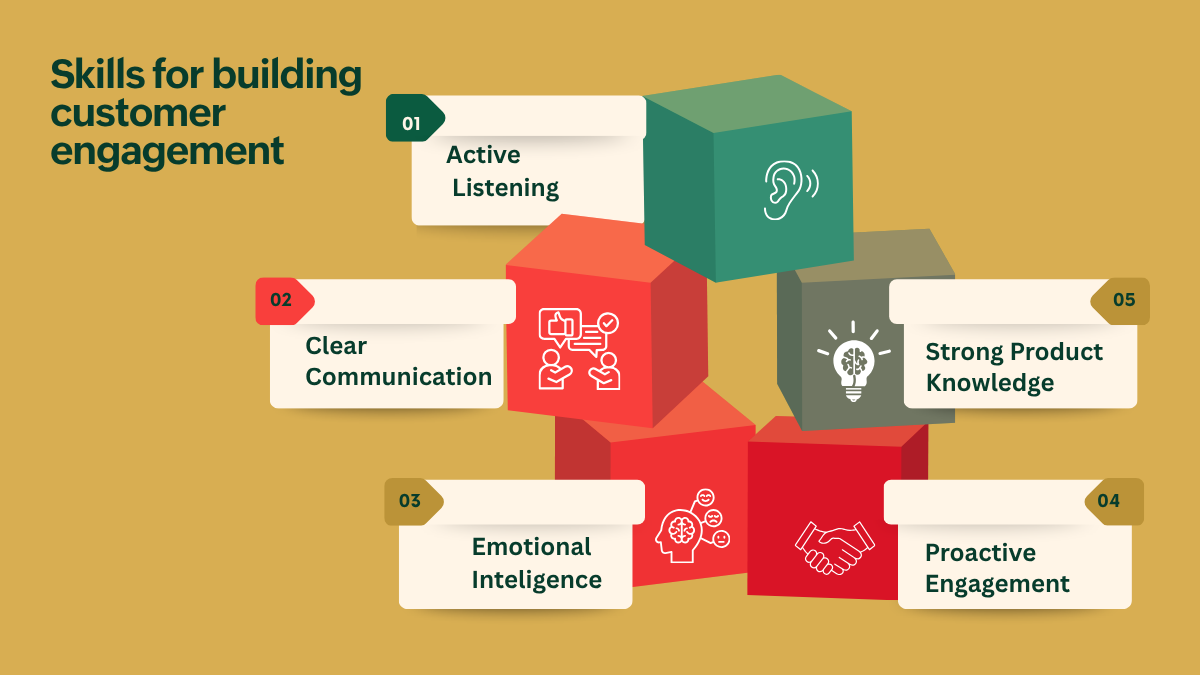
Here are some of the skills and elements that are important in building customer engagement:
- Active listening and empathy help in understanding and acknowledging customer concerns and building trust.
- Clear communication ensures solutions are simple, transparent, and reassuring.
- Patience and emotional intelligence help manage high-stress or emotionally charged interactions.
- Strong product knowledge and a problem-solving mindset enable accurate and meaningful resolutions.
- Personalization, responsiveness, and consistency enhance the overall customer experience.
Ownership and proactive engagement turn routine support interactions into trust-building opportunities.
What can break a customer relationship?
A customer’s journey is rarely limited to a single interaction or a single representative. Depending on their needs, they may engage with sales, logistics, engineers, or support teams. This makes it important to recognize that building a lasting customer relationship is a shared responsibility. Every touchpoint matters, and it is not solely the responsibility of support representatives to demonstrate strong customer engagement skills. All customer-facing personnel play an equal role in delivering a seamless experience.
However, relationships can be easily weakened when this responsibility is not upheld. Lack of communication, unexplained delays, absence of ownership, and responses that feel rude, overly scripted, or lacking empathy can quickly erode trust and damage the overall experience.
Over the years, the importance of avoiding these pitfalls has become increasingly evident. Back in 2010, only 36% of companies prioritized customer experience. Now, that number has grown to 89%, highlighting how customer experience has surpassed affordability, outreach, and several other factors to become a key competitive differentiator.
Source: Agenda Overview for Customer Experience, 2015
The emotional side of service
Every support query carries emotional weight. Frustration, doubt, anger, irritation, urgency, and even anxiety accompanies a support ticket. Understanding and empathically handling the customers emotion while decoding the issue can turn moments of friction into moments of connection.
Empathy, ownership, and pro-activeness to engage with the customer and understand their problem beyond the support ticket builds confidence. When delivered consistently, these interactions foster trust and reinforce the assurance that the business is committed to supporting and valuing its customers.
Building systems that enable strong customer relationships
Customer service reps need a system in place that supports these goals. When teams have access to a unified view of customer interactions, past conversations, preferences, and history, they can move beyond transactional responses. Each interaction becomes informed, relevant, and continuous, allowing teams to operate with context and continuity.
This also requires a focus shift in service in certain areas, such as:
- Shorter resolution time is not always the end goal, it should be accompanied by quality.
- Resolution must be reassuring.
- Each communication should by backed by context and continuity to leaves a positive impact.
- Customer ownership over ticket ownership.
Tools that support relationship building in customer service
When the mindset to value the customer's experience at each stage is paired with supportive tools, it creates an environment that supports and values relationship building in customer service.
Omnichannel communication
Customers today move between multiple channels such as email, chat, phone, and social platforms, while communicating and expects the conversation to follow without loosing context and continuity. Systems that bring these touchpoints together enable organizations to present a single, cohesive experience. Omnichannel support reduces frustration and creates a smoother, more connected experience.
Internal collaboration
Enabling internal collaboration allows teams to work together without losing context, especially in cases involving escalations or cross-functional dependencies. When information is recorded systematically and is accessible to all, conversations and collaborations happen effortlessly within the organization. Being able to add private comments, sharing tickets across departments, summery of long conversations, access to conversation history, are a few internal communication and collaboration enablers.
This adds the value of having a well organized and collaborative internal communication that elevates customer experience. For the customer, this translates into fewer handoffs, quicker clarity, and interactions that feel informed rather than repetitive.
Automation and AI
Automation further strengthens this foundation. Automating routine processes such as ticket routing and workflow management reduces operational friction. Over time, this leads to fewer repeated problems and a more reliable experience for customers.
The incorporation of AI in services is helping shift services from being reactive to proactive by analyzing data to identify trends and anticipate customer needs. For example, if multiple customers are reporting payment failure, AI can detect this trend and flag it. Agents can escalate the issue for expert to look into and meanwhile reach out to customers informing them about the server downtime in advance to avoid frustration. In this situation, being proactive helps the business to avoid another set of furious customers.
AI also guides agents with customer sentiments and intent to enable personalization in each interaction. This brings the shift for customers from being just heard to actually being understood.
Finally, the ticketing system provides visibility into service performance to close the loop. Insights into customer sentiment, and recurring issues help organizations deliver consistent service with empathy, context, and ownership. Over time, this creates a feedback system where every interaction contributes to improving the next.
Good service doesn't happen by chance
While not every customer support system is created to build relationships, finding one that helps turn every ticket into moment of connection is a great differentiator.
As a customer, we don't always remember how fast the issue was solved but we never forget how we felt through the process. Remember that every support interaction is an opportunity to build trust.