- HOME
- Thought Leadership
- Evolution of customer support
Evolution of customer support
- Published : June 19, 2026
- Last Updated : August 3, 2026
- 94 Views
- 6 Min Read


Customer support did not appear overnight. It did not start with tools, automation or AI. It grew slowly over time shaped by how people interacted, the needs of the customers, growth of the business and how expectations evolved.
In the beginning, customer support was simply a conversation between two people. There were no departments, no defined roles and no proper system in place. When a customer had an issue, the seller would try his best to fix it. But as business expanded and reached more people, this simple exchange expanded and became more streamlined and complex.
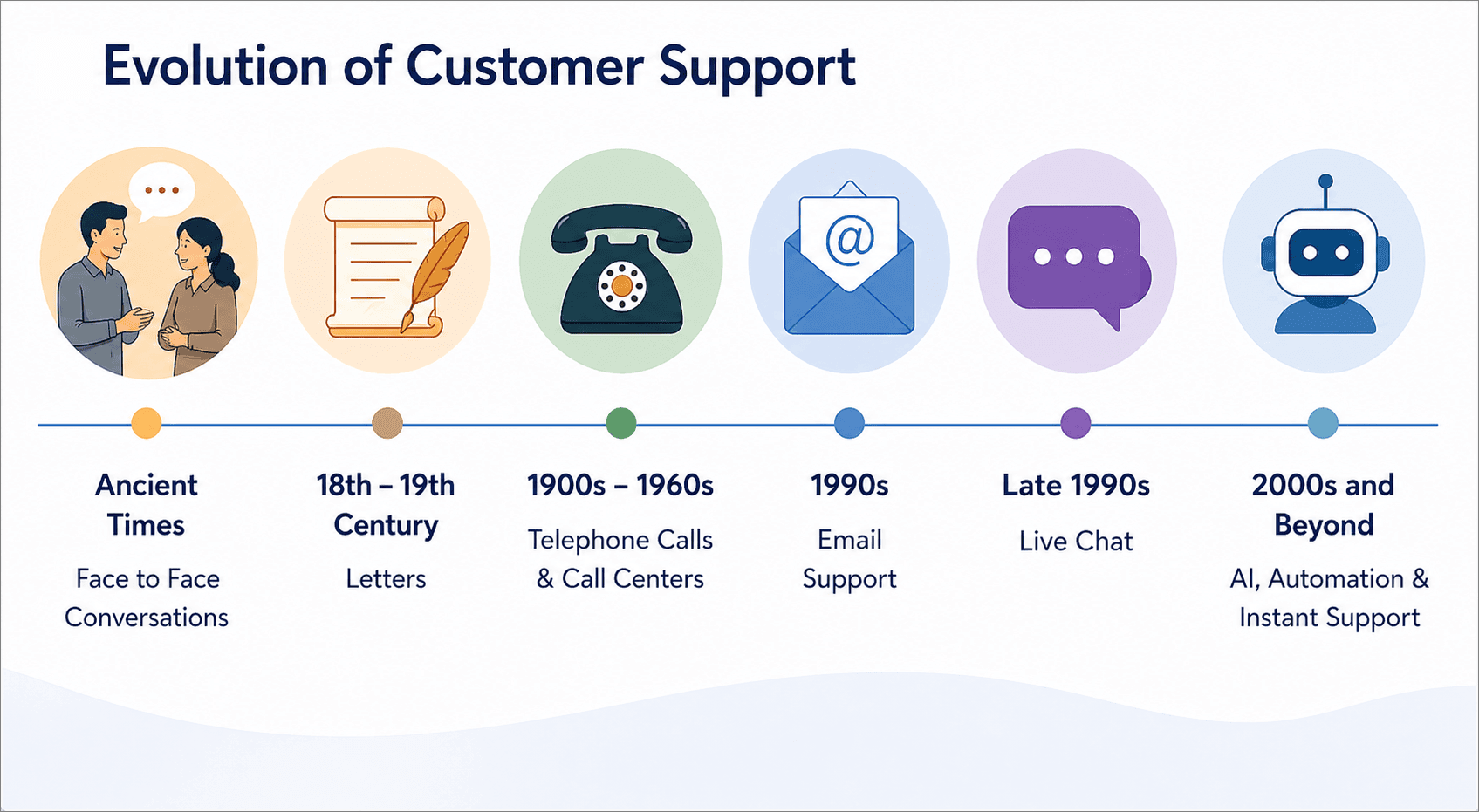
With every shift in the world, be it the rise of large scale production, invention of technology, new ways of communication or digital transformation, the support domain adapted and evolved. It quickly changed from face to face interaction to letters, from emails to phone calls, and now instant responses powered by technology.
What makes this journey interesting is that while the methods and systems have changed, the customer expectations remain the same. They want to be heard, understood and helped. The speed, channels or medium might have improved, but the basic need has not changed.
This is why customer support continues to hold a critical position in a business architecture. It is often the deciding factor for a customer whether to trust the company or leave.
A journey through time: History of Customer support
The beginning: Support as human interaction
Long before technology came into existence, support existed in the form of everyday conversations. Support began thousands of years ago in ancient marketplaces. If a customer had a problem, they simply walked up directly to the seller and spoke about it. Picture a busy street in ancient times. Merchants are selling spices, pots, bronze articles and fabrics. A customer walks up and says, ''Some of the paint on the rim of the pot faded while watering the plants. Can anything be done?"
The merchant who wants to safeguard his reputation says, "Of course, let me touch it up. The natural colors strengthen when reapplied." It was just human interaction and understanding that one unhappy customer could influence the entire village. That right there was the earliest form of customer support.
Distance made things harder
As businesses grew during the industrial revolution, things started to change. In the 18th and 19th century, factories started producing goods at large scale. Goods were no longer sold locally, they were shipped to different cities and even countries. Suddenly, the sellers and buyers were not in the same place. This became a challenge.
This era made support more formal. Customers began writing letters to businesses and waiting for their responses. A steady streamlined approach but that was the foundation for the very first structured customer support system.
The telephone era: Real-time support
The invention of phones came next, which was the turning point in the support domain. Customers did not have to wait for weeks for a reply. They could call them directly and get a reply instantly. It was the first moment in history when real-time support became possible.
By the 1950s, businesses were flooded with calls. They had to appoint dedicated employees to handle them. Telephone-based support brought the development of dedicated call centers, allowing businesses to serve many customers efficiently. Thousands of calls could be routed to multiple support agents. This allowed support to become a recognized profession with a complete process of training, scripts, dedicated teams and processes.
Making support easier to reach
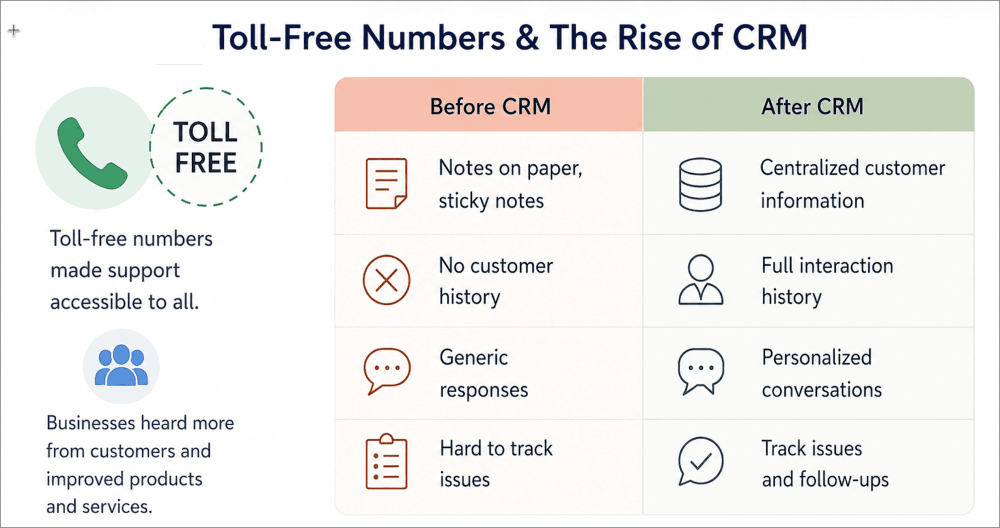
In the late 1960s, toll-free numbers became popular. Customers did not have to pay for support calls anymore. This made support more accessible and businesses suddenly started hearing a lot from customers: some good feedback, some that was not so happy. But this was a win as businesses listened to customers pain points, their expectations and the issues which helped marketing, sales, and product teams refine their strategies.
CRM emerged about the same time—around 1987. Before CRM, agents had to note down details on sticky notes or notebooks. With CRM, companies could store customer history, look at past interactions, track issues and personalize conversations. Imagine an agent calling a customer and saying, "Hi John, I see you raised a return request for your gadget. Let me check that update for you." Customers felt recognized and heard. Support was no longer just a department. It became the intelligence center of business.
Beginning of email and live chat
In the 1990s, email became popular and a convenient way to reach support. Customers could attach images, explain the issues in detail and send the email whenever it suited them. Support teams also had sufficient time to inspect each issue and send a thoughtful reply. That is where the idea of support changed from being reactive to thoughtful.
By the late 90s, websites started slowly adding live chats, which made it possible to get instant help without having to call. It felt quick and easy. It was not as slow as an email and not as formal as a phone call. For many people, it became the preferred way to get help.
Modern era: How has customer support changed?
In the 2000s, everything moved even faster. What was once a reactive function changed into a proactive and technology-driven experience. This shift introduced the era of rapid advancements leading up to artificial intelligence. Support became accessible like never before.
Businesses expanded beyond email and phone, and live chat flourished. Soon after, social media platforms like facebook and twitter became important support channels where customers could publicly raise their issues and expected quick resolutions. This made customer support more transparent and accountable.
As technology advanced, automation began to play a bigger role. Businesses introduced chatbots to handle repetitive and straightforward queries such as order status, password resets, and FAQs. These bots could operate 24/7, ensuring that customers received instant assistance regardless of time zones or business hours. This was a major leap from traditional support models that were limited to working hours. Studies from WiFiTalents indicate that nearly 50% of customers are willing to use chatbots to save time when interacting with customer service.
Source: https://wifitalents.com/customer-support-industry-statistics/
Around the same time, automation and ticketing systems streamlined internal operations. When a customer raised an issue, it could be automatically categorized, prioritized, and routed to the right team without manual intervention. Support teams could focus on solving the issues rather than struggling to manage them.
The AI era helped analyze large volume of customer data to identify patterns, predict potential issues, and understand customer behavior. For example, if multiple users reported similar problems, the system could identify the issue, allowing teams to address it proactively.
Most successful customer support strategies today are not purely automated or purely human. They are a blend of both. This balance ensures that businesses can deliver efficient support without losing the personal touch. Companies that invest both in technology and human connection are better positioned to meet the evolving customer expectations and stand out in this competitive market.
Customer support: The non-negotiable part of a business
Looking at all this, one thing becomes quite evident, Customer support has always been important across every era and technology. When we look at this journey from ancient marketplace to AI, the message gets more evident. Support has always been more than a service. It is the foundation of business trust, brand reputation, customer loyalty, and long term growth. Support, undoubtedly, is one of the pillars of the business.
FAQ
1. Why is customer support important?
Customer support helps businesses build trust, improve customer satisfaction, strengthen brand reputation, and retain customers. A good support experience often influences whether a customer stays loyal to a brand.
2. How has customer support evolved over time?
Customer support evolved from face-to-face interactions in ancient marketplaces to letters, phone support, call centers, email, live chat, and now AI-powered support systems.
3. What was the first form of customer support?
The earliest form of customer support was direct interaction between buyers and sellers in local marketplaces, where merchants personally resolved customer concerns.
4. How did technology change customer support?
Technology introduced faster communication channels—such as telephones, email, live chat, CRM systems, automation, and AI—making support more accessible, organized, and efficient.
5. What role does AI play in modern customer support?
AI helps automate repetitive tasks, provide instant responses through chatbots, analyze customer behavior, and improve response times while allowing human agents to focus on complex issues.
6. Will AI replace human customer support agents?
AI is designed to assist, not completely replace, human agents. Human support is still essential for empathy, personalized communication, and handling complex situations.
7. What is the future of customer support?
The future of customer support will likely focus on AI-driven personalization, faster automation, omnichannel support, and a balance between technology and human interaction.