- HOME
- Customer Support Operations
- Enhance customer experience through different support personas
Enhance customer experience through different support personas
- Published : August 20, 2026
- Last Updated : August 20, 2026
- 0 Views
- 5 Min Read

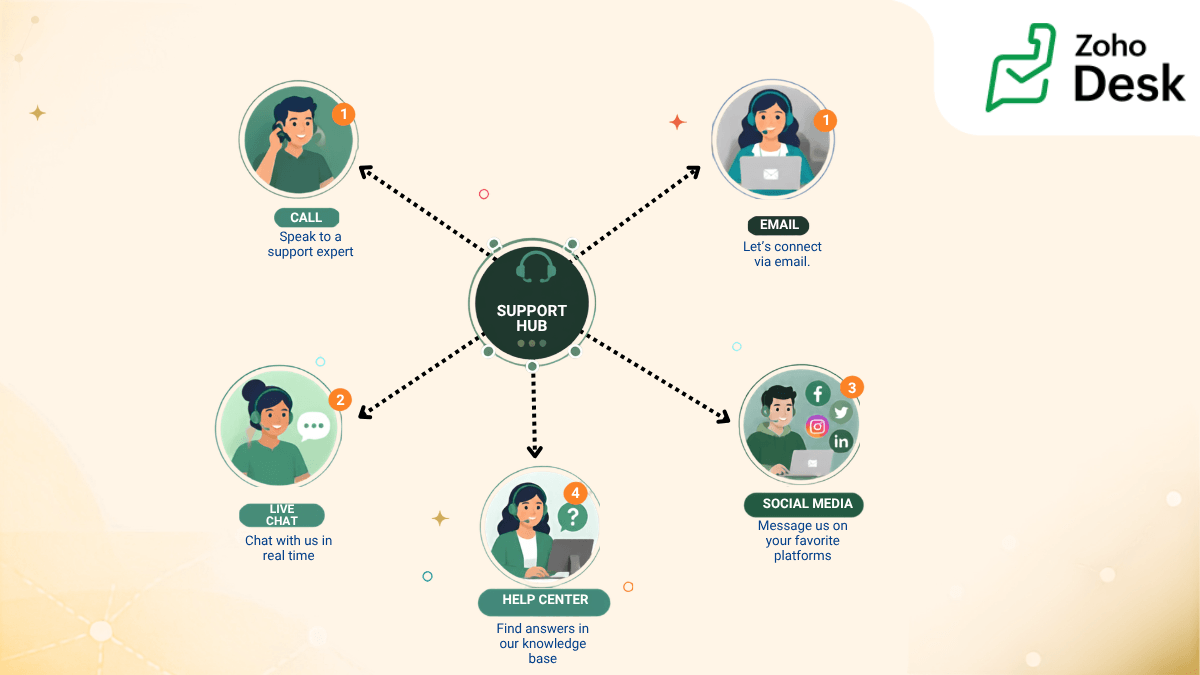
There are multiple ways by which customers interact with a business: it's website, social media, email, or voice calls. By offering customers a seamless experience across these touchpoints, a brand can build trust and loyalty that eventually converts into a long term relationship. Its pivotal that business be consistent in their messaging, policies, and service across touchpoints to truly make an impact throughout the customer journey.
As a customer how do you reach out to a brand for their support services?
Your mode of communication often depends on the type of problem, the urgency of the situation, and your availability. In other words, the needs and circumstances play a major role in determining the channel of communication.
For example, you might send an email to explain an issue in detail, go to the live chat for a quick clarification, or call when there is an urgent requirement for immediate solution.
On the surface it may seem like you are just opting for one of the feasible channels to reach out. However, there's more to it from a business perspective: the service approach needs to adapt accordingly to suit customers' needs.
Each channel demands a different way of thinking and responding that makes the customers feel heard and important. Behind the scenes, each of these channels may often be handled by the same people, but they need to use different personas and skill sets designed to match the customer's temperament and sentiment.
Email support persona
Email remains one of the most critical support channels as it allows structured communication. Common reasons customers prefer an email:
- The issue in hand is complex and it needs to be described in detail, along with additional information that can be shared in the form of attachments.
- There is back-and-forth conversation expected.
- The details need to be recorded.
For example, if a customer sees a discrepancy in their credit card bill, they are likely to reach out the support via email so they can include supporting documents.
The email support person has to:
- Review all materials and analyze the issue thoroughly.
- Collaborate with other teams and third party vendors.
- Schedule meeting or calls with the fraud detection department.
- Analyze the source of lapse and educate the customer about secured payment methods.
- Help the customer understand and prevent types of identity theft.
Email as a support channel gives both customers and agents the space to explain issues in detail, making it ideal for handling complex or sensitive requests. To be effective, email support agents must demonstrate:
- Strong problem-solving skills to analyze detailed queries, empathy to acknowledge customer concerns thoughtfully without real-time interaction.
- Focus on First Contact Resolution (FCR) by providing complete, well-structured responses that minimize back-and-forth.
- The ability to communicate clearly and contextually, ensuring every response is thorough, precise, and easy to understand.
Phone or call support rep persona
A customer usually decides to speak with a support rep when there in an urgent or confusing issue that needs immediate clarification. Call support is generally where the most emotionally charged support requirement is raised. For example, if a person suddenly losses access to internet banking or a business tool, these issues are going to affect their day and may even cause panic. They tend to reach out to support in a distressed state and want to resolve the issue immediately.
Hence, a call support agent needs the ability to resolve issues in real time while managing human emotion through conversation.
Here is what is expected from a support agent handling customer calls:
Sharp thinking and quick response
They should have information at their fingertips and be technically agile to understand the problem quickly. Reps handling calls should be aware of the policies, process guidelines, governance, and compliance related details to avoid delays in triaging issues.
Empathy and compassion
Over a call, the tone, pace, and choice of words matter as much as the solution. When a customer reaches out in frustration, a calm and reassuring interaction can ease an anxious customer as well as build trust at the beginning of the interaction.
Active listening skills
Reps must have good listening skills and be patient. Taking notes of the specific details helps avoid repetitive conversation and also makes the customer feel heard by ensuring follow up on every item. It allows them to ask the right questions and guide the customer to a more definite direction. Its important to paraphrase and get a confirmation from the customer before proceeding with the subsequent steps.
Good communication
Unlike email or chat, there is no written communication. This makes it important for the rep to practice clear communication explain solutions in a step-by-step manner that is easy to follow and remember.
Language proficiency
Routing calls to reps who have proficiency in the language the customer prefers to speak is an added advantage as it helps build rapport and puts the customer at ease.
When done right, telephone support makes customers feel heard and understood. Support calls are a great way to build trust in a business and call support reps become the voice of the business.
Digital media support reps
Most startups, solopreneurs, and SMBs prefer customers to reach them for support inquiries through social media, instant messaging apps, community, and other public forums. A digital support persona functions in a dynamic, high-visibility setting where each interaction can influence public opinion. Unlike traditional channels, the response isn't just for a single customer—it's frequently observed, understood, and evaluated by a broader audience.
A digital media or chat support person should be:
Capable of handling high visibility interactions carefully.
Knowledgeable enough to to provide prompt, accurate responses.
Able to reflect the reflect the brand voice in each message.
Adaptable to deal with different platforms and situations.
Businesses are now moving towards providing agentic support particularly for social media and chat-based queries. This helps seamlessly handle order related queries, product issues, and other common requests, which reduces the ticket load and improves first response time (FRT).
Enhance customer experience with channel-specific experts
Channel-specific experts improve customer experience (CX) by aligning the interactions to match the unique strengths and expectations from each platform. Popular channels such as voice, email, live chat, social media have specific nuances that customers expect from the reps handling their queries. Instead of generic responses, specialized support reps are equipped to deliver highly relevant, efficient, and satisfying resolutions.
Channel-specific support reps:
Deliver the right solution in the right format
Create a seamless and consistent communication experience.
Adapt to customer emotions and context effectively.
By aligning communication style with customer expectations, channel-specific support personas play a key role in enhancing the overall experience a customer has with a business.