
- HOME
- Ecommerce business
- 5 Small business ideas to start with low investment for 2026
5 Small business ideas to start with low investment for 2026

If you want to start an ecommerce business but are held back by limited startup funds, you’re not alone. The good news is that there are plenty of small business ideas today that require very little upfront investment. However, the real challenge lies in identifying the right idea from the many available options.
In 2026, consumer expectations have evolved rapidly, and newer generations are gaining significant buying power. With increased competition and changing market dynamics, choosing the wrong business idea can slow growth before it even begins.
In this article, we highlight the top small business ideas you can start with low-investment in 2026. We also share practical ways to secure funding and market your business effectively, even with a limited budget.
Why should you start an ecommerce business?
Last year, 2025, records a massive hit where nearly 1 in 3 people shopped online, amounting to 2.77 billion digital buyers globally. While this number is already significant, it is expected to continue rising steadily in the years ahead. With such a massive and growing consumer base, businesses that capitalize on this shift by starting an online store stand to gain huge profit opportunities.
Doing business online is not only more convenient, but it also reaches a wider, even global, audience. You have more control over your branding and marketing. The convenience and ease of online shopping is hard to beat, and, as a result, people are turning to it in much larger numbers.
5 Small business ideas to start with low investment
Below is a small business idea list that includes ideas requiring low investment, yet yield high profits.
1. Sell used goods online
One of the most successful small business ideas is selling second-hand goods. There are a variety of reasons why people buy used goods. For one, used goods are often cheaper than new goods. This is especially true for electronics, secondhand designer apparel, and accessories, which often sell for a fraction of their original price.
But perhaps the fastest-growing reason buying used goods has become so popular is because it’s more environmentally friendly. As people embrace the idea of sustainability, they’re reducing their purchases of new products.
Now, thanks to the proliferation of ecommerce websites, individuals and businesses alike are using online auctions to sell a wide variety of used products, including clothes, books, electronics, home goods, and more.
Before you jump into the ecommerce arena, however, there are a few things you should keep in mind when starting such a business.
Take good photos. Well-lit photos showing the item in detail will make it more likely to sell.
Write accurate descriptions. Be honest about any existing flaws or damage.
Price your items fairly. Don't try to rip people off, but don't undersell yourself either.

There’s no denying that the market for used goods is booming. In fact, ecommerce businesses that focus solely on selling used goods are some of the most successful online businesses around. So if you’re thinking about starting an online business, selling used goods is definitely worth considering.
Sahivalue, a Mumbai-based company selling refurbished gadgets, scaled greater heights by taking their business online. Discover how Zoho's business solutions helped them automate their tasks and create an enjoyable experience for their customers in this detailed tell-all video.
2. Provide freelancing services
Whether you're a web developer, graphic designer, consultant, or writer, there has never been a better time to start a freelancing business. Starting an ecommerce freelancing business is relatively easy and it doesn’t cost much to get off the ground. All you need is a strong internet connection and a computer. Plus, there are plenty of resources available on the internet to help you get started.
With freelancing, you can set your own hours and work as much or as little as you want. In addition to that, freelancing is relatively low risk. The barriers to entry are low, and with the right ecommerce platform, you can get up and running in no time.
Here are a few things you need to keep in mind when starting an online freelancing business.
Create a portfolio of your work so potential clients can see what you're capable of.
Market yourself through social media and other online channels.
Charge what you're worth and remember, this is your business.
This infographic shares some mind-boggling statistics about the freelancing industry.
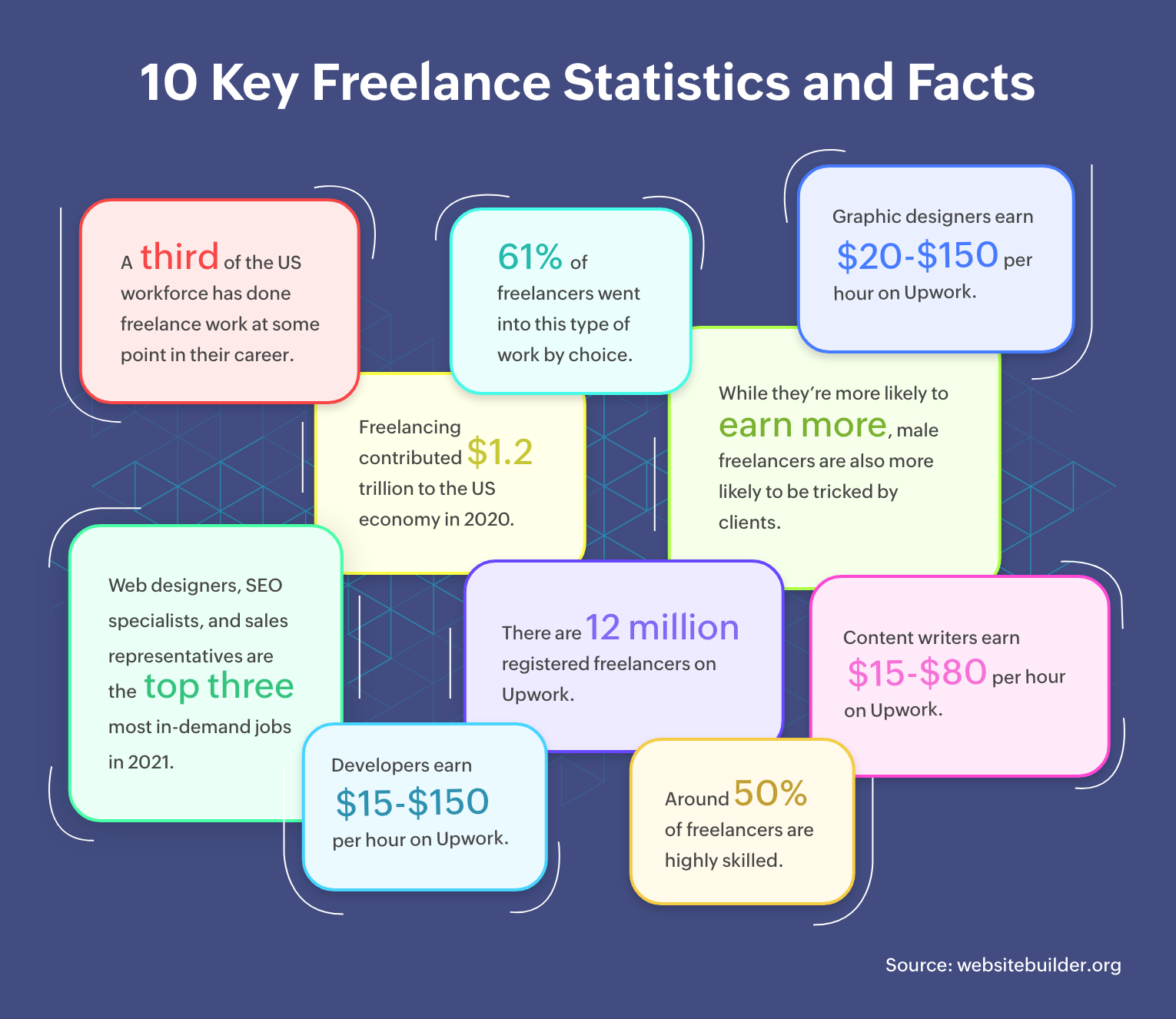
There are plenty of ecommerce businesses out there, so it can be tough to stand out from the crowd. Having your own website helps you brand yourself as a unique freelancer, which can attract more clients and lead to more success.
Having a website can help showcase your skills and what you can offer to potential clients. When you have a strong personal brand, you become more memorable and trustworthy, which can help you stand out from other freelancers in your field.

The most recent data by Flexiple finds that freelancers are set to become the majority of the U.S. workforce by 2027. A Forbes article explains that freelancing is rapidly increasing, especially among Generation Z, with almost 52% of them working as freelancers. With a little hard work and dedication, there's no reason your online freelancing business can't be a success.
3. Create online courses
Creating online courses is a great way to share your knowledge and expertise with a wider audience while being a lucrative revenue stream. Here's what you need to know about creating an online course that can garner good profits.
Decide the topic you'll be teaching. You need to choose a subject that you're passionate about and that people are interested in learning more about.
Outline the structure of your course. What will students learn in each lesson? How will they progress from beginner to expert?
Create engaging content. Your course should be packed with valuable information that's presented in an engaging way. Think about using videos, infographics, and other visuals to break up the text and keep people engaged.

Creating an online course business does not require a lot of money. You can start small and grow your business over time. With the right planning and execution, you can create a thriving online course business right away.
4. Launch an affiliate marketing website
Affiliate marketing is a highly-profitable small business idea where a business rewards one or more affiliates for each visitor or customer brought in by the affiliate's own marketing efforts. Affiliates are paid a commission for every sale they generate, making it a popular way to earn money online.
With relatively low start-up costs and the ability to scale up quickly, this is one of the most flexible and profitable ideas for small businesses.
Here are a few things you need to know before getting started.
Choose a niche. This is the market segment for the products or services that you’ll be promoting.
Find potential customers and partners. There are many ways to do this, including social media, search engine optimization (SEO), and paid advertising.
Start promoting your affiliate links. You can do this through email marketing, blogging, and social media. The key is to be creative and consistent with your promotions.

The advantages of starting an affiliate marketing business include:
Low startup costs. You can get started with just a few hundred dollars.
No need for inventory. You can promote other people's products, and don't have to worry about stocking or shipping inventory yourself.
High potential for growth. With the right strategies in place, your affiliate marketing business can quickly grow to generate a full-time income.
Be your own boss. You'll have the freedom to work from home and set your own hours.
If you're looking for a way to start your own ecommerce business, then affiliate marketing is definitely worth considering. Tapfiliate is a great affiliate marketing website that allows customers to integrate seamlessly with ecommerce platforms.
5. Start a print-on-demand (POD) business
POD businesses offer a great way to make money from your creativity. If you have a passion for design or art, you can turn your hobby into a profitable business by selling your designs on t-shirts, books, mugs, and more. POD businesses are becoming increasingly popular because they offer a convenient and affordable way to sell products online.
There are many success stories for this niche of ecommerce because it gives customers the freedom of creating and gifting custom products either for themselves or for their loved ones.
There are a few things to keep in mind when starting a POD business.
Find a reliable supplier who can provide high-quality products at competitive prices.
Create compelling product descriptions and photos that will attract customers to your store.
Advertise your store on social media accounts and through several online forums.

There are many advantages to starting a POD business:
It’s easy to set up and can be run from anywhere in the world with an internet connection.
There are low overhead costs, and your business can be started with very little capital.
There’s no need to stock inventory or deal with storage problems.
It’s flexible and can be easily scaled up or down as needed.
POD businesses offer a great way to enter the ecommerce market. They provide a low risk way to test niches, products, and market demand without investing a lot of money upfront. POD businesses are also a good option for those who want to start an online business but don’t have the time or resources to invest in developing their own product line.
Is starting a business on a budget really possible?
The short answer is a resounding "YES". In fact, many successful businesses have started this way.
Bill Hewlett and David Packard started Hewlett Packard, or HP, in 1939 with just $538. Today, it generates revenue of more than $126 billion.
Here is the sequence of key things you need to do to make sure your business is successful, even on a tight budget:
Brainstorm to create a list of businesses that fit within your budget.
Conduct some market research to find out if your business idea is sustainable.
Create a concrete plan that will align with your business costs and projected revenues.
Learn how to control finances without sacrificing product quality.
Find ways to promote your business at minimal cost.

If you can accomplish these tasks, setting up and running an ecommerce business on a budget can be both practical and profitable.
4 Ways to easily fund your ecommerce business
The small business ideas listed above require a low capital investment initially. If you are running short on your startup funds, there are several ways to get the money you need to start your business. Here are a few options to explore.
1. Use your savings. If you have some money saved up, this can be a great way to get started on your ecommerce business without going into debt. Just be sure to budget carefully so you don't deplete your savings too quickly.
Who did it: Sophia Amoruso, founder of fashion company Nasty Gal and Girlboss Media, started her business from her small bedroom without a big financial investment. She was a 22-year-old college dropout when she started selling vintage clothes on eBay in 2006. Today, her company is worth over $100 million.
2. Look into grants and other funding opportunities. There are often grants and crowdfunding websites available for businesses, especially new ones. Do some research to see if you might be eligible for any of these programs.
Who did it: In 2012, John Foley secured $400,000 in funding to start the Peleton brand. The brand quickly grew in popularity, and by 2014 had secured $10 million in venture capital funding. Today, the company is worth over $1 billion.
3. Get a loan. This can be a good option if you have someone who's willing to lend you the money with no strings attached. Many financial institutions have interesting offers for business loans.
Who did it: In 1962, Sam Walton started Walmart with a $25,000 loan from his father-in-law. Since then, Walmart has become one of the world's largest retailers, with over 11,000 stores in 27 countries.
4. Find an investor. There are many individuals who are interested in investing their own money in businesses that they believe have potential. In many countries, there are seed-fund schemes run by the government to promote a local startup culture.
Who did it: In 2014, Facebook made the largest private acquisition of a VC-backed company when it bought WhatsApp for $22 billion. In turn, Sequoia Capital, the venture capital firm that invested in WhatsApp, made a huge return on its investment.

With the world economy opening up and many success stories to refer to, it’s become easier to get the money you need to start your business. Remember to explore all funding options and don't be afraid to ask for help. With careful planning and execution, you can easily secure minimal capital to kickstart your ecommerce journey.
Low-cost marketing ideas for small businesses
Starting an ecommerce business on a tight budget does not mean you cannot focus on marketing your new venture. For any business starting in 2026, marketing has become a core weapon for discoverability and sales. Here are a few tips to get you started with marketing your business at low-cost:
1. Start with social media. It's free to set up accounts on platforms like Facebook, Twitter, and Instagram, so use them to your advantage. Use engaging visuals and content to attract attention and draw people in.
2. Get involved in online communities relevant to your niche. You can search for forums or groups dedicated to discussing topics related to what you're selling. Share your expert knowledge and connect with potential customers from all over the world.
3. Make use of email marketing. Collect email addresses from people who visit your website or social media pages, then send out periodic newsletters or promotional offers.
4. Start a blog. This is a great way to share your story, connect with customers, and build trust. Blogging also increases chances of discoverability on traditional and AI search engines.
5. Search engine optimization (SEO). This means making sure your website and content are optimized for the search engines through on-page SEO so that you can rank higher in organic search results.

6. Don’t forget about word-of-mouth marketing. This is the oldest and one of the most powerful marketing tools available, and it doesn’t cost anything to get started. As they say, a good product speaks for itself, and word-of-mouth is a testimony to the success of any brand.
7. Hold contests or give away freebies on your website or blog. This is a great way to generate interest in your business and get people talking about you online. Many ecommerce websites offer giveaways and discounts to encourage people to order through their website instead of Facebook, Instagram, or WhatsApp.
8. Offer discounts or coupons on your website. Customers will respond positively to offers for saving money when buying your products.
9. Create interesting and shareable content. This will help drive traffic to your site organically.
10. Collaborate with other businesses in your industry or niche. You will be able to reach out to a wider audience when you collaborate with similar or complementary businesses. This has become common on social media, which has led to the rise of the influencer industry.
With a little creativity and some elbow grease, it’s possible to promote your new business on a tight budget. With these tips, you can get the word out there without breaking the bank.
Conclusion
Like many other entrepreneurs who started small and grew their businesses into well-known brands, you don't need a lot of money to start selling online. There are many platforms that allow you to sell products and services with little to no upfront costs. You can use social media, your own website, or even marketplaces like Etsy to start reaching out to customers. There are many platforms that allow you to set up a shop for free or for a low monthly fee, like Zoho Commerce.
The most important takeaway is to start small and scale up as you grow. The key is to find a niche market and build a loyal customer base. With focused efforts, anyone with an entrepreneurial spirit, creativity, and resourcefulness can be successful in selling online without spending a lot of money upfront.
