The State of Workforce Password Security in 2026: Key insights from Zoho Vault

Passwords may feel like an old problem in a world focused on AI, Zero Trust, and next-gen cybersecurity. But the truth is simpler: Passwords still sit at the center of workforce security and they’re often the weakest link.
That’s why the conversation around passwords can’t be separated from where authentication is heading. As a FIDO Alliance member, Zoho is actively invested in the shift toward passkeys and a passwordless future. We believe phishing-resistant, stronger authentication isn’t a future dream, it’s a practical goal organizations should embrace today. But getting there requires an honest look at where most organizations actually stand right now.
Our recent report, The State of Workforce Password Security in 2026, is based on insights from more than 3,300 IT and security decision-makers worldwide. It explores how organizations are managing credentials today, where they’re struggling, and what needs to change to build a more secure and passwordless future.
And with World Passkey Day (formerly World Password Day) around the corner, there’s no better time to look at the current state of password security.
The credential explosion no one is managing
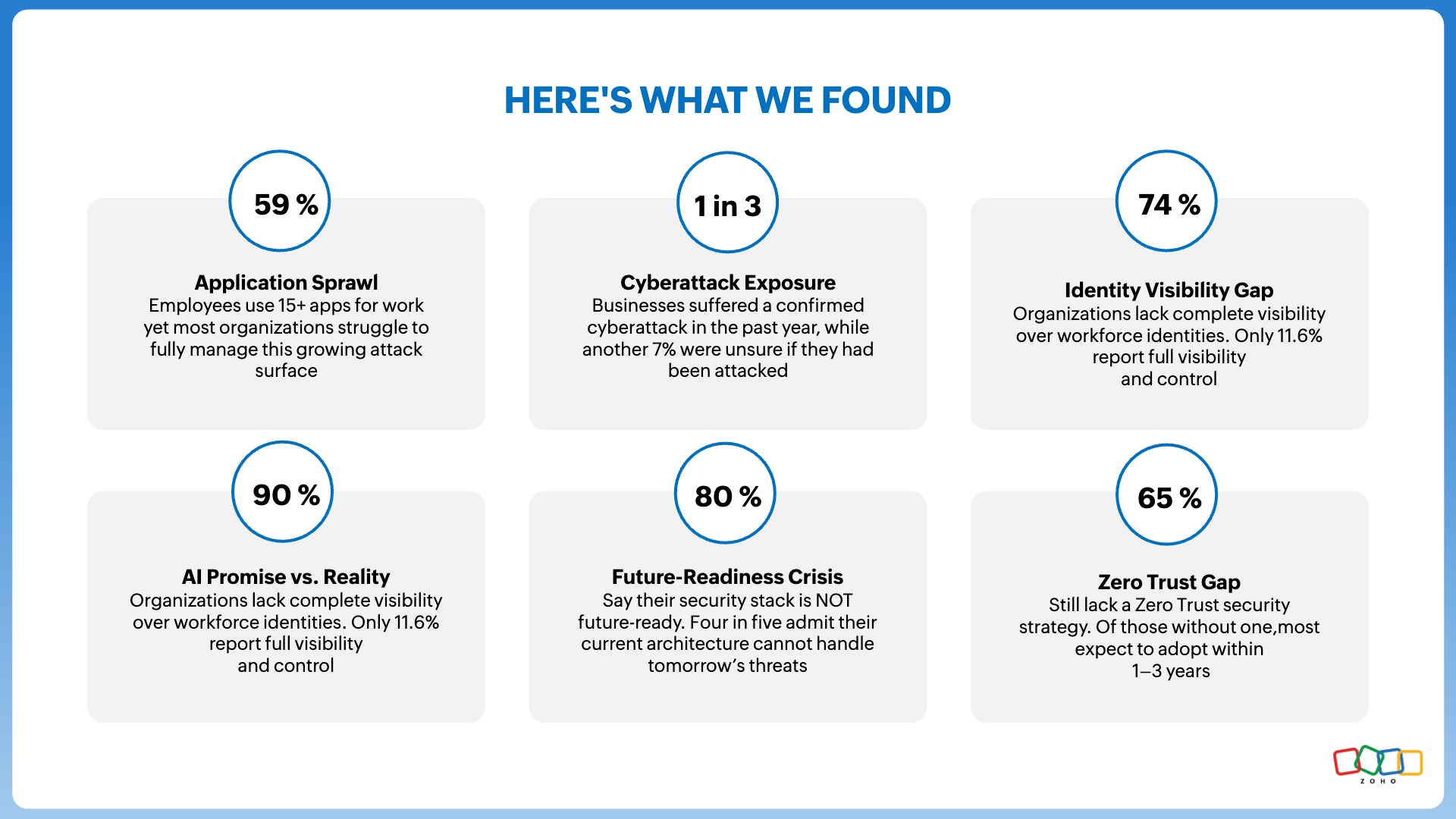
Our research found that 59% of employees now use more than 15 applications in a typical workday. Each application requires credentials. Each set of credentials represents a potential access point into your environment.
The challenge isn’t just volume, it’s visibility. As organizations adopt more SaaS tools, embrace hybrid work, and grow their contractor and partner networks, the identity perimeter expands in ways that traditional access management wasn’t designed to handle. Employees spin up tools without IT approval, share credentials across teams for convenience, and leave organizations with accounts that remain active long after their last day. The result is an attack surface that is both large and largely unmapped.
A third of organizations were breached and some don’t even know it
One in three organizations confirmed a cyberattack in the past 12 months. More concerning is the 7% that couldn’t answer the question at all—no confirmed breach, but no confidence they were clean, either.
From a security standpoint, that uncertainty is itself a serious finding. An organization that cannot determine whether it’s been compromised is operating without the basic situational awareness that effective incident response requires. It points to gaps not just in prevention, but in detection and monitoring.
The visibility crisis hiding in plain sight
Our research found that 74% of organizations have incomplete visibility over their own workforce identities, meaning they cannot fully account for who has access to what systems, at what permission level, and why. Only 11.6% of security leaders said they had a genuinely complete picture.
This matters because visibility is the foundational requirement for every other security control. Least-privilege access, zero trust architecture, anomaly detection, incident response—none of these work if you don’t know who holds access to what.
AI confidence is high. AI readiness is not.
90% of security leaders believe AI will meaningfully improve their organization’s security posture in the coming years through better threat detection, faster incident response, and more scalable identity governance.
The problem is the gap between belief and execution. Only 8% of organizations are operationally ready to deploy AI-powered security. Everyone else is building the business case, evaluating vendors, waiting on procurement, or simply hoping the timeline works out before the next serious incident. Meanwhile, attackers are already deploying AI to stuff credentials at scale, probe for vulnerabilities automatically, and craft phishing campaigns tailored to individual targets.
Budgets are growing, but most stacks are already obsolete
72% of organizations plan to increase security spending over the next five years. At the same time, 80% acknowledge that their current security architecture isn’t equipped for the threat environment ahead. That combination, increased investment into an architecture most leaders admit is inadequate points to a structural issue. The problem for many organizations isn’t budget; it’s fragmentation. Too many disconnected point solutions, too little centralized oversight, and no unified view of identity and access across the environment.
The organizations pulling ahead aren’t necessarily spending more. They’re consolidating vendors, building platform-level visibility, and treating identity security as a foundational capability rather than an add-on.
Zero Trust is the answer, but most stacks aren’t built for what’s ahead
65% of businesses have no Zero Trust architecture in place. Most of those who lack it say they anticipate adoption within one to three years. But that window is precisely when credential-based attacks are most likely to land.
The problem is implementation complexity. Zero Trust requires a clear inventory of identities and access rights, strong authentication across every touchpoint, and ongoing monitoring of access patterns. None of that is quick or simple. But every month of delay gives attackers more time to exploit the gaps organizations assume are secure.
Download the full report
The State of Workforce Password Security in 2026 report goes deeper on every finding covered here. It breaks down the top attack vectors organizations are facing right now, how leading security teams are restructuring their budgets, surfaces region-wise security trends, and maps out what a credible path to unified identity security actually looks like in practice—along with expert recommendations you can act on, not just benchmarks to worry about.
Download the full report to see where your organization stands and what the road forward looks like.
About the author
Helen Yu is the Founder & CEO of Tigon Advisory Corp. and Host of CXO Spice. A globally recognized thought leader at the intersection of cybersecurity, digital transformation, and artificial intelligence, she is ranked among the Top 50 Global Thought Leaders in Cybersecurity & AI and serves as a Board Director across multiple organizations.
With over 15 years of executive experience spanning Fortune 500 companies and high-growth startups, Helen brings a rare operator’s lens to complex security challenges. Her expertise bridges technical depth with strategic leadership, making her a trusted advisor to organizations navigating today’s rapidly evolving threat landscape.
A prolific author, sought-after keynote speaker, and board director, Helen advises enterprises worldwide on building resilient security architectures that scale with modern workforce demands.

Comments