Every event planning team needs to find the most flexible, convenient, and scalable event management software to fit your unique needs and budget. Here are 4 factors to help decide which plan works best for you now, and when it's a good time to switch to a bigger pricing tier.
1. What is the scale of your events?
The "scale" of your event isn't just about total headcount; it's about how many moving parts your team manages per event.
Scale = volume + frequency + complexity.
As the event scale rises, operational complexity grows exponentially—think more check-ins, more sessions, more vendor coordination—that a single tool with a basic module cannot fully support.
This, in turn, decides whether you end up using a purely execution-based tool, or a comprehensive event management software that unifies workflows like registrations, ticketing, workflows and marketing.
What to ask:
- How many events are we hosting?
- What is the primary event format, is it virtual, in-person, or hybrid?
- What is the average event size?
These questions help you understand the exact features and tech stack you actually need— streaming tools, AV setups, activity trackers and more—concluding whether a free tool can manage it all for you.
Remember, a 100-attendee leadership summit with four parallel sessions and sponsors can easily outgrow the same tools that handle a 500-person webinar.
- Free software is built for smaller setups—one-off events, single tracks, or a handful of sessions. Use free software if your event strategy is for very small-scale events, i.e., 3–5 events a year with <100 attendees each. However, keep in mind the limitations of free tools. Choose one that allows you to scale up easily, retain your data, and integrate seamlessly with your existing setup.
- Paid software supports growing portfolios: recurring events, multi-day or hybrid formats, complex ticketing structures, and multi-organizer collaboration. Once your team manages 8+ events a year, automation in paid tools can help save crucial productive time for the event team and support staff.
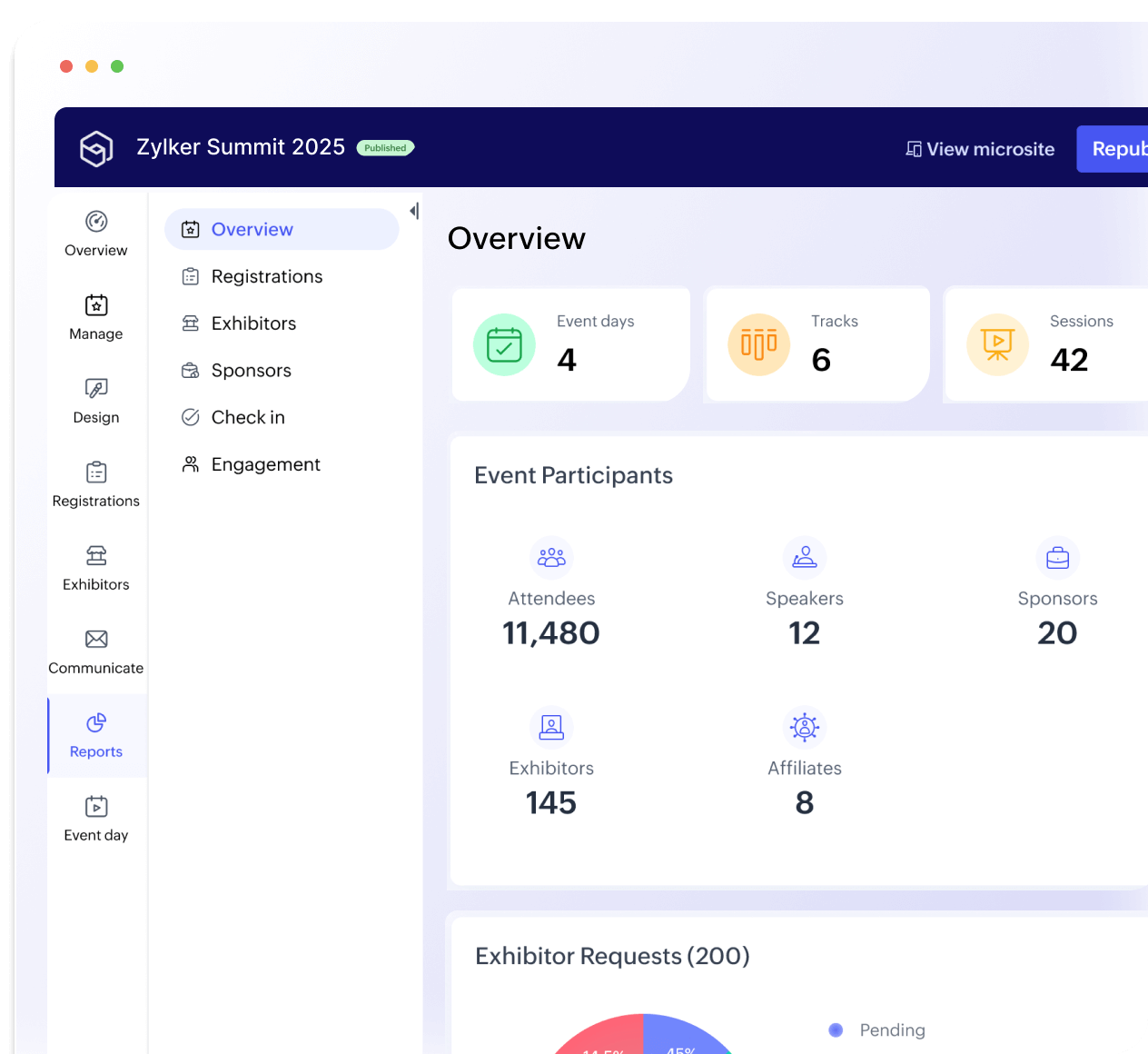
Pro tip: Start with the free plan of a freemium-model event management software to experience the fully-loaded platform and explore how it fits best to your event needs like with Zoho Backstage, where the free plan allows you to plan the entire event with no charge on a trial basis.
2. Enhanced features, AI capabilities, and more
The previous example makes this clear—free tools can be used for event execution, but a paid event management software transforms this into comprehensive event management.
This differentiation is brought about by the availability of rich features and capabilities between the two options.
What to ask yourself:
- What are the non-negotiable features you need?
- Do you need to purchase external tools?
- Are you looking for AI capabilities to support you?
Free software or platform versions offer the basic features— for example, ticketing software could support ticket creation, registration forms and a tracking dashboard.
A paid platform, on the other hand, offers significantly better experiences and more powerful capabilities (or advanced versions of free features). For instance, in Zoho Backstage, you can create tickets across multiple classes and pricing, offer promo codes, track sales in real time and more.
Features battle card: free vs paid software
| Decision factor | Free software | Paid software |
|---|
| Centralized workflows and team collaboration | ✅ | ✅ |
| Integrations (CRM, email, marketing tools) | ⚠️ (basic) | ✅ |
| Ticketing and payment gateways integration | ✅ | ✅ |
| Real-time analytics and ROI tracking | ⚠️ (basic) | ✅ |
| AI features and smart attendee engagement | ❌ | ✅ |
| Branding and customization options | ⚠️ (limited) | ✅ |
| Enterprise-grade data security (GDPR/HIPAA) | ❌ | ✅ |
| Dedicated technical support | ❌ | ✅ |
| Predictable long-term cost efficiency | ⚠️ (hidden costs add up) | ✅ |
Each of these capabilities in paid software enhances a different outcome like attendance count, attendee experience, net revenue etc., throughout your event. For instance, paid software brings various built-in tools such as streaming services, polling trackers, floor planners and more—each of which supports better audience engagement.
- Free plans are good if your event can be run smoothly with basic features scattered across different tools. Ex: ticketing via emails, registration on software, payment with some other software etc.,
- Paid platforms are for you if you're looking for a holistic solution. They create workflows with integrated technology, AI and other advanced capabilities. Ex: in Zoho Backstage, you can launch a native mobile app exclusively for your event, complete with Zia, an AI networking matchmaker.
Remember, if you're not paying for a specific set of features within your event management platform, but purchasing it with external tools—that's still losing money on the table!
Chances are, the combined cost of all your add-on features might be much greater than getting a paid event management platform (we will explore this in detail in the upcoming section).
3. Budget & Cost Structure
Even the largest of event teams are always on a budget. So when it comes to paid software, you're not just spending on the event—the software also needs to "pay for itself".
Your software, therefore, needs to be an efficiency multiplier. The right plan typically saves hundreds of hours a year for your team, while also enabling sponsorship, ticketing revenue, and cleaner data analytics.
What to ask:
- What's your budget for event software?
- Are you paying monthly, per event, per attendee?
- What hidden costs exist (commission on ticket sales, add-ons etc.,)?
Scenario: For a series of ticketed virtual learning sessions, let's battle out the cost between free vs paid software.
Free vs paid software: the real cost
| Capabilities | Free software (monthly) | Paid software (monthly) |
|---|
| Cost | $0 | $100-$150 |
| Website builder | ~$25–$50 (no code builder/outsource to devs) | $0 (built-in) |
| Ticketing | 5–10% commission/ticket | $0 |
| Payment gateway | $30–$50 (outsourcing or custom integration) | $0 (Built-in multiple gateways) |
| Time on manual ticketing | 20–30 hours (resolving queries reconciliations etc.,) | < 1 hour (edge cases only) |
| Scalability | Usually capped at 100 attendees | More scalable, up to 5000 attendees |
Free software appears budget-friendly, but the hidden costs (hours spent on manual work, payments on extra tools, the multiplying inefficiencies) severely limit your revenue outcomes from your events.
With paid software, you have built-in flexibility and cross-functional integrations across various modules.
- Free plans are a good choice if your overall event budget is <$1000, and if your events are one-time, small-scale and not a major revenue driver for your business. This way, you can focus on execution tasking and use single-use tools to run your event.
- Paid plans are for you if your event spend (software + team + tools) is large and you need predictable costs. Once your event revenue crosses $1,000–$1,500 per event, the efficiency and commission savings of a paid plan usually offset its cost, making it the more cost-effective choice in the long run.
Event management software like Zoho Backstage have built-in modules for ticketing, marketing and promotions, RSVPs and more—so you get a whole bundle of essential, pre-integrated digital tools at the cost of one.
4. Customization, support, and security
As your event strategy evolves, you'll find that the need for an adaptive, customized event management solution becomes a pressing necessity.
When you're crafting the attendee experience, every single touchpoint—from the event website to the check-in kiosk—should seamlessly speak your brand language.
That's where the question of customizing your event management platform arises. Imagine hosting an event where you can replace boring name tags with custom branded badges right from your event management software. Where you can launch a detailed mobile app with your event floor space and agenda pre-synced.
And, imagine being able to customize and configure your software to your exact needs: from building detailed rulesets and workflows to having instant dedicated technical support from experts.
With free software, this option is rare—you cannot easily personalize your platform as per your needs, either in-app or with the help of a support team. With paid software, however, you have an authorized support team at your disposal to customize the platform, handle complex integrations, and even support your event team on the ground during events.
There's also the security consideration: paid plans include enterprise-grade security such as data encryption and HIPAA or GDPR compliance, which protect attendee data and maintain trust.
What to ask:
- Do you need white-label branding (custom domain, mobile app)?
- Do you need integrations (CRM, marketing tool, payment gateway)?
- What level of vendor/support do you need (dedicated support, SLA, 24/7 availability)?
- Free software can conveniently support your team if you do not need any customization or heavy technical configurations with external software or tools.
- Paid plans are a better choice if you're hosting larger events, if you need extensive integrations, customization and support from a larger technical team on top of your plans.
For instance, in Amazon's case, they chose to go for the paid version of Zoho Backstage for Smbhav, a flagship event that brought in 4,000+ attendees. They didn't just have the full-fledged capabilities of the software itself at their disposal—they were also able to access support directly from the Zoho team.
"With an event of this magnitude and the various uncontrollable variables, the Zoho team sprang into action at every available instance. The microsite launched in partnership with Zoho leveraged the company's backend technology and ensured that over 2000+ SMBs that attended the event were provided a seamless experience throughout their Smbhav journey."
- Satish Upadhyay, Head, Seller Marketing, Amazon India