- HOME
- BI & Analytics
- AI Can Build a Chart. It Can't Run Your Analytics (Yet)
AI Can Build a Chart. It Can't Run Your Analytics (Yet)
- Last Updated : April 30, 2026
- 307 Views
- 6 Min Read
This is the first in a series on why businesses need a deep analytics platform in the AI era.
Most companies now have someone on the team who pastes data into ChatGPT or Claude and calls it analytics.
You upload a CSV, ask a question, get a chart, ask for an explanation. It works. The output is based on the data you gave it, and if that data is accurate, the answer is accurate. No argument there.
So the question isn't whether AI can do this. The question is whether this is what analytics actually is (It isn't!).
Getting a chart from a file you uploaded is the easy part. It was always the easy part. The hard part of analytics is everything that happens before you have something worth analyzing, and everything your organization needs after you have the answer. AI tools solve neither of those problems.
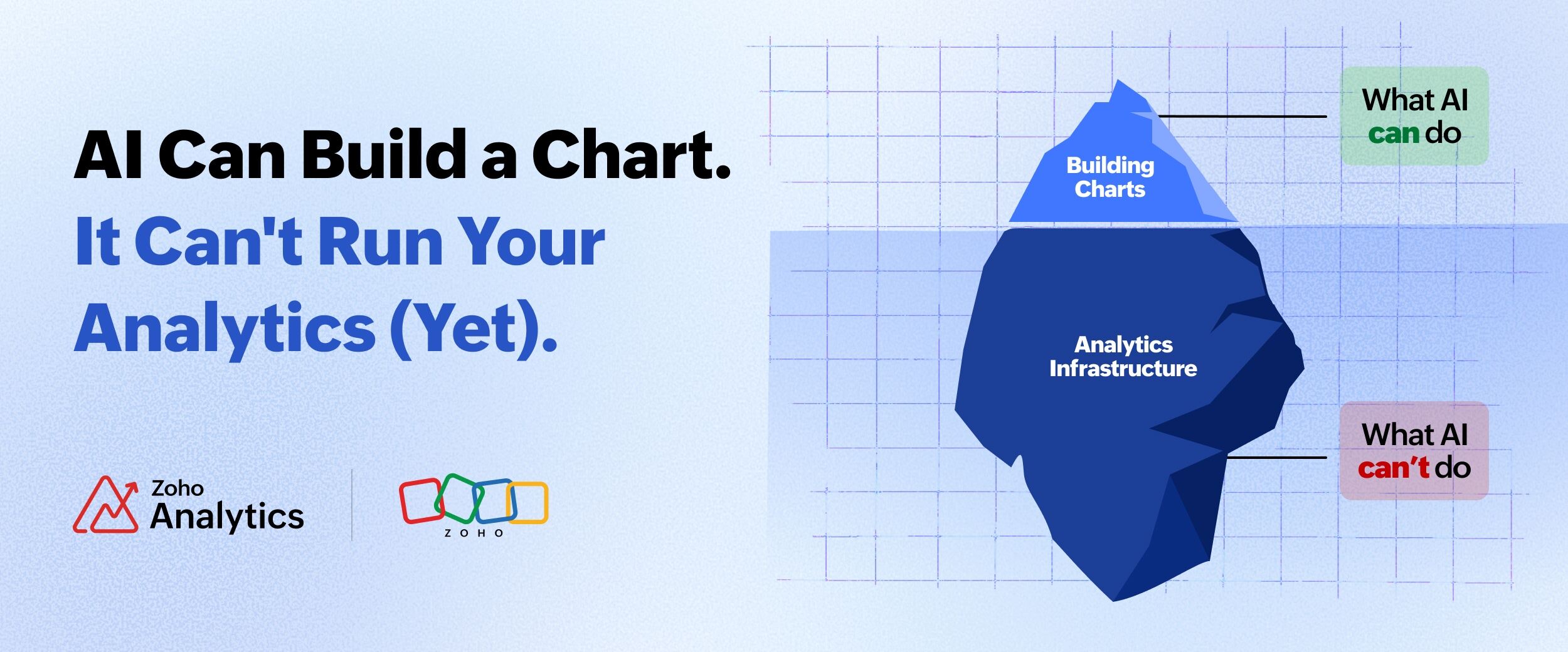
The chart is not the product. The infrastructure is.
Before any chart appears on a screen, a chain of things had to work. Something had to connect to your actual data source. Pull from it on a schedule. Join it to other tables correctly. Apply the right business logic. Enforce who sees what. Make sure "revenue" means the same thing in this report as it does in the one your CFO looks at every Monday.
Many analytics projects fail somewhere in that chain. Not at the dashboard.
When you paste a spreadsheet into an AI tool, you hand it a slice of data that was accurate at the moment you exported it. That's it. The AI has no idea your sales team updated 40 deals this morning. No idea your "revenue" column uses a different accounting treatment than the one finance uses. No idea your export missed three subsidiaries because of how your permissions were set up.
The AI answers the question correctly. The question is whether it was the right question, asked with the right data.
But there's a more fundamental issue. A BI platform isn't primarily a chart-building tool. The reason most serious businesses invest in one is unification. Your CRM, your support tool, your marketing platform, your financial system, and probably six other tools all hold different slices of what's actually happening. Connect any one of them to an AI tool and you get answers about that slice. It's useful but limited.
Put all of it in one place and something different becomes possible. You can see that customers with the highest support ticket volume have the lowest renewal rates, and that both correlate with deals that closed in a specific quarter under a specific rep. You only get this level of insight when the data is unified.
Six things AI tools don't do
The gap between AI tools and purpose-built analytics platforms isn't about visualization quality or how fast you can get a chart. It's structural. Here's what's missing, and each of these will be covered in depth in this series.
- Live connections: AI works with what you give it. A BI platform pulls directly from your databases, SaaS tools, and data warehouses on a schedule you control, or in real time. The difference matters when someone makes a decision on Friday numbers on a Monday morning.
- Metric definitions: Ask two people in your company what "active users" means. You'll probably get two different answers. A BI platform lets you define it once, certify it, and make sure every report draws from the same definition. An AI recalculates from scratch every time. Phrase the question slightly differently and you may get a different number. Worse, sometimes the same question might get a different answer. Nobody flags such an inconsistency because there's no system to flag it.
- Row-level security: A BI platform knows whether the person looking at a report is a regional sales rep or the CFO, and shows each of them only what they're supposed to see. An AI-generated chart is a file. Share it and you share everything in it.
- Governance and audit trails: In regulated industries, "who saw this number and when" is a compliance question. In every industry, it's an accountability question. A BI platform tracks it. It manages approval workflows, maintains data lineage, and keeps a record of who published what. An AI conversation does none of that.
- Scheduled refresh: A BI dashboard updates automatically. Your AI chart is frozen at the moment you asked. Want current numbers? Ask again with fresh data. For a report that 12 people check every week, that process does not scale.
- Data lineage: When a number in a BI report is wrong, you can trace it. Which source, which transformation, when it last refreshed, who certified the dataset. When an AI-generated number is off, the AI answered correctly for the data it had. The problem is you may not know which data that was, or whether it was the right data for the question you were actually asking.
What "good enough" actually costs you
Let's say a finance team is preparing for a board meeting. Someone uses an AI tool to generate a regional revenue breakdown from a data export. Clean output. Clearly explained. Accurate for the data that was provided.
But the export was pulled two weeks before quarter-end close adjustments. No one knew. The AI certainly didn't.
In the meeting, the regional figures don't match what the sales team submitted. Two sets of numbers, both internally consistent, no shared source to reconcile them against. Nobody knows which export the AI summary came from. Nobody knows what happened to the adjustments.
This is not an AI failure. The AI did exactly what it was asked. The failure is structural. There was no single governed source both outputs drew from. No refresh cycle that would have made the discrepancy impossible. No lineage trail connecting the summary back to a verified dataset.
A BI platform doesn't make people smarter. It makes the chain of custody for every number visible, so when something doesn't match, you can find out why before the board meeting, not during it.
AI makes BI better. Not unnecessary.
The wrong takeaway from all of this is that AI and BI platforms are competing. They're not.
AI solves a real problem: the people who most need data are often the furthest from it. They depend on analysts who have a queue. They wait. They make decisions without information, or they make decisions with outdated information. AI changes the access problem. Anyone can ask a question in plain language. Anyone can get an explanation without knowing SQL. That matters.
What AI doesn't solve is the infrastructure problem. It doesn't know where your data actually lives. It can't enforce who should see what. It can't guarantee that "churn rate" means the same thing across your sales deck, your investor update, and your customer success dashboard.
When AI runs on top of governed, unified data in a BI platform, both problems get solved. The access problem and the trust problem. Questions get answered faster. More people can work with data without depending on someone else to pull a report. And the answers are grounded in the same verified source your entire organization has agreed to use.
That's a meaningfully different outcome than pasting a CSV into a chat window.
BI platforms like Zoho Analytics didn't wait for AI to arrive
Modern BI platforms like Zoho Analytics had natural language querying and AI-generated insights long before ChatGPT made those terms mainstream.
Today, that's gone much further. Agentic AI capabilities built into Zoho Analytics, lets anyone ask ad hoc questions and get a chart, a full dashboard, an explanation of why something happened, or a recommendation on what to do next. You ask, you get an answer, you move.
And if you want to stay in AI tools like ChatGPT and Claude, that works too. Zoho Analytics MCP server connects directly to it. The difference from uploading a CSV is significant. You're not working with a static file. You're querying the actual data, across all your connected and blended sources, from inside the chat interface you already use. The BI platform still handles the infrastructure underneath: the live connections, the access controls, the governance, the metric definitions. You just don't have to leave your workflow to get to the data.
That's the right version of AI and BI working together. Faster access to answers, without stripping out the infrastructure that makes those answers trustworthy.
The question was never whether AI can build a dashboard. It can. The question is whether it can build a decision system your entire organization relies on, where the numbers are always current, access is controlled, and "revenue" means exactly the same thing in every report, every team, every quarter.
That's still a BI platform's job. And, Zoho Analytics is doing both.
If you want to experience agentic AI analysis firsthand, sign up for a 15-day free trial of Zoho Analytics with no feature limitations.
No credit card required.
 Pradeep V
Pradeep is a product marketer at Zoho Analytics with a deep passion for data and analytics. With over eight years of experience, he has authored insightful content across diverse domains, including BI, data analytics, and more. His hands-on expertise in building dashboards for marketing, sales, and major sporting events like IPL and FIFA adds a data-driven perspective to his writing. He has also contributed guest blogs on LinkedIn, sharing his knowledge with a broader audience. Outside of work, he enjoys reading and exploring new ideas in the marketing world.