- HOME
- More
- Best Practices
- Refund email templates 2026: Downloadable samples and best practices
Refund email templates 2026: Downloadable samples and best practices
- Published : March 30, 2026
- Last Updated : March 31, 2026
- 854 Views
- 8 Min Read

For every business owner, the perfect situation is never having to issue a refund to their customer. While hopeful, it’s not the reality for most businesses. Whether processing returns for faulty products or honoring a change of heart, refunds are intrinsic part of a business-customer relationship. Despite not being ideal, a refund process and various touchpoints through the process can be vital for customer satisfaction. One study says that approximately 70% of customers expect to be able to return an item without having to wait more than two weeks for a refund.
With the right refund process and emails, even a retreating customer can be converted into a loyal customer or a future purchase. One email at the center of a refund process is the refund email.
Refund emails are one of the most critical yet overlooked transactional emails. Whether you run an ecommerce store, a SaaS platform, subscription business, or marketplace, a well-written refund email can turn a potentially negative experience into a trust-building moment.
In this article, you’ll learn what a refund email is, why it matters, best practices, and—most importantly—get ready-to-use refund email samples and refund email templates you can customize for your business.
What is a refund email?
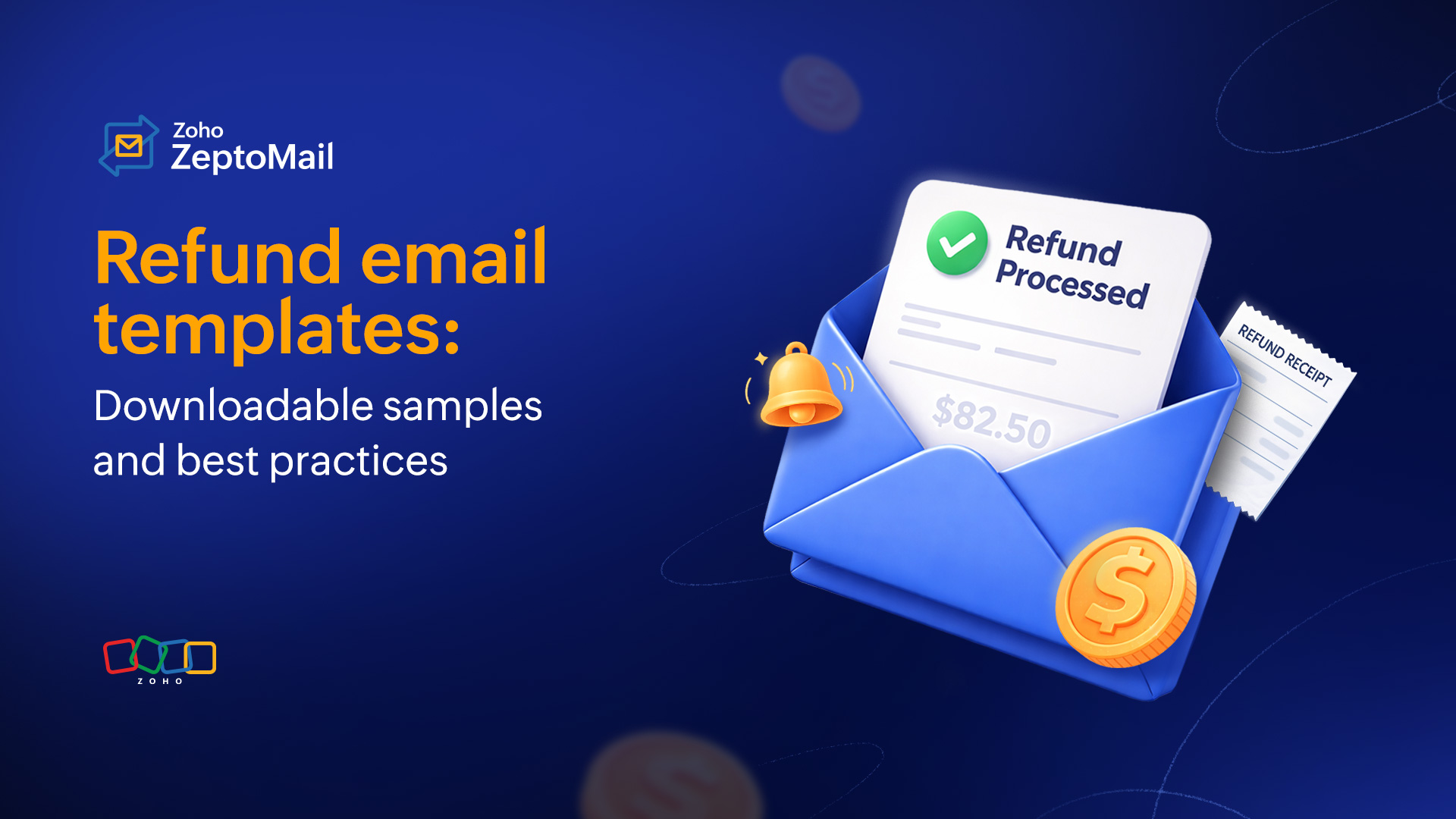
A refund email is a transactional email sent to a customer to confirm that their refund request has been successfully processed. It typically includes details such as:
Refund amount.
Payment method.
Reference or order ID.
Expected refund timeline.
Unlike marketing emails, refund emails are expected, time-sensitive, and trust-critical. Customers often search their inbox immediately after requesting a refund, making clarity and deliverability essential.
Why refund emails matter
Refund emails are often treated as a routine system notification that’s sent automatically, rarely reviewed, and quickly forgotten. But in reality, refund emails sit at one of the most emotionally sensitive points in the customer journey. When done right, they can protect your brand reputation, reduce churn, and even influence whether a customer returns in the future.
Here’s why refund emails deserve far more attention than they usually get.
Reassure customers at a high-anxiety touchpoint
When a customer requests a refund, they’re often experiencing uncertainty:
Was my request approved?
Has my money actually been sent back?
How long will this take?
The refund email is the first and most important reassurance that their concern has been acknowledged and resolved. A vague or delayed refund email increases anxiety, while a clear and timely one restores confidence almost instantly. Your business is remembered by how this refund email is handled.
Reduce the need for intervention
Poor refund communication is one of the top drivers of “where is my refund?” support tickets.
A well-written refund email proactively answers common questions such as:
How much was refunded?
Which payment method was used?
When will the amount be reflected in the account?
By setting clear expectations upfront, refund emails can significantly reduce angry customer emails, the need for follow-up, and escalations. This in turn reduces the load on your support team, lowering support costs and speeding up resolution time.
Influence brand trust
Customers may forget a promotional email but they won’t forget how your brand handled their refund.
A transparent, professional refund email signals that:
Your business is honest and accountable.
You respect the customer’s time and money.
Your billing and systems are reliable.
Your process is hassle-free even when something goes wrong.
In contrast, unclear or delayed refund emails create doubt, even if the refund itself is processed correctly. Trust, once lost during a financial interaction, is extremely difficult to regain.
Reduce churn and increase return purchases
Unlikely as it sounds, refund emails can actually increase the likelihood of a customer coming back. Customers are more willing to try your product again, recommend your brand, and leave a neutral or positive review when the refund process feels smooth and respectful. A calm, informative refund email helps close the loop gracefully, turning a failed transaction into a positive exit experience rather than a frustrating one. This experience of a refund safety net means that the customer is willing to give your business or your products another chance.
Critical for payment transparency and compliance
In many regions, consumer protection laws require businesses to clearly communicate refund confirmation, refund amount, and refund timelines. A properly structured refund email helps you meet these expectations while creating an audit-friendly record of the transaction. This is especially important for:
Subscription-based businesses.
Marketplaces.
Fintech and digital services.
Clear refund emails protect both the customer and your business.
Reinforce your brand voice in a high-stakes moment
Refund emails aren’t just about information—they’re about tone.
A well-crafted refund email:
Avoids sounding robotic or defensive.
Uses calm, empathetic language.
Reinforces your brand’s professionalism.
This is one of the few transactional emails where brand voice truly matters, because customers are paying attention to every word.
Refund emails could be the last impression
For some customers, the refund email is the final interaction they have with your brand.
That last impression determines whether they:
Leave quietly.
Leave frustrated.
Return later with renewed trust.
A thoughtful refund email ensures that—even if the customer leaves—you part ways on good terms. It leaves the door open for future relationships.
Key elements of an effective refund email
Every high-performing refund email template should include the following elements:
1. A clear subject line
The subject should instantly confirm action and stand out in the customer’s inbox for quick discovery.
Examples:
“Your refund has been processed”
“Refund confirmation for order #45821”
2. Greetings
Start the email with a personalized and warm greeting to set the tone of the email.
3. Refund confirmation
Open with a direct confirmation; don’t make users hunt for reassurance. Be direct with the customer and communicate that their refund has been issued/confirmed in the first few lines of the email.
4. Refund details
Include details about the refund that has been issued and other details related to the refund for reassurance and future accountability:
Refund amount
Payment method
Order or invoice number
5. Refund timeline
One of the customer’s pain points of a refund process is the anxiety of not knowing when they’ll receive the refund. Make sure to address this in your refund email. Explain how long it may take for the amount to reflect (especially important for cards and wallets).
6. Support contact
To avoid customers reaching out to the wrong channel and piling on unnecessary tickets, offer help proactively. Point them to resources that have answers to their questions or for channels dedicated to refund processes.
Refund email subject line samples
Before we get to the templates, here are some straightforward subject lines you can use for refund emails:
Refund processed successfully.
Your refund is on the way.
Refund confirmation—[Brand Name].
Update on your refund request.
Refund issued for your recent order.
Dynamic refund email samples for common use cases
1. Unhappy customer/product issue
Subject: Your refund has been processed for Order {{Order ID}}
Hi {{Customer Name}},
We’re sorry to hear that your experience with {{Product Name}} didn’t meet your expectations. We’ve processed your refund as requested and want to assure you that your feedback has been noted.
Refund details:
Refunded amount: {{Refund Amount}}
Order ID: {{Order ID}}
Payment method: {{Payment Method}}
You should see the refunded amount in your account within {{X}} business days, depending on your bank or payment provider.
We truly appreciate you taking the time to share your experience, it helps us improve. If you’d like assistance choosing a better-fit product in the future, our team is always happy to help.
Warm regards,
{{Company Name}} Team
2. Service failure (e.g., shipping delay)
Subject: Refund issued due to shipping delay
Hi {{Customer Name}},
We apologize for the inconvenience caused by the delay in delivering your order. This delay fell short of the service standard we aim to provide. To make things right, we’ve processed a refund for your order.
Refund summary:
Refund amount: {{Refund Amount}}
Order ID: {{Order ID}}
Refund method: {{Payment Method}}
The refund should reflect in your account within {{X}} business days.
Thank you for your patience, and we hope to serve you better in the future.
Sincerely,
{{Company Name}} Team
3. SaaS subscription cancellation
Subject: Subscription refund confirmation
Hi {{Customer Name}},
Your {{Plan Name}} subscription has been successfully cancelled, and the applicable refund has been processed.
Refund details:
Refunded amount: {{Refund Amount}}
Billing period covered: {{Billing Period}}
Invoice ID: {{Invoice ID}}
The amount will be credited back to your original payment method within {{X}} business days.
We’re grateful you tried {{Company Name}}. If you ever decide to return or need help in the future, we’ll be here.
Best regards,
{{Company Name}} Team
4. Partial refund
Subject: Partial refund issued for Order {{Order ID}}
Hi {{Customer Name}},
We’ve processed a partial refund for your recent order based on the resolution discussed.
Refund details:
Refunded amount: {{Refund Amount}}
Amount retained: {{Charged Amount}}
Order ID: {{Order ID}}
The refunded portion should appear in your account within {{X}} business days.
If you’d like further clarification please feel free to reach out to us at {{support ID}}.
Kind regards,
{{Company Name}} Support Team
5. Refund issued as store credit
Subject: Refund issued as store credits
Hi {{Customer Name}},
We’re sorry you’re not satisfied with your purchase. We’ve issued your refund in the form of store credit, which has now been added to your account.
Store credit details:
Credit amount: {{Credit Amount}}
Credit ID: {{Credit Reference}}
Expiration date (if applicable): {{Expiry Date}}
You can apply this credit at checkout on your next purchase. If you need help using your store credit or have any questions, just reply to this email.
Thanks for choosing us,
{{Company Name}} Team
6. Overpayment refund email
Subject: Refund issued for overpayment on your account
Hi {{Customer Name}},
We’ve identified an overpayment on your account and have processed a refund for the excess amount.
Refund details:
Overpaid amount refunded: {{Refund Amount}}
Transaction reference: {{Transaction ID}}
Payment method: {{Payment Method}}
The refunded amount should reflect in your account within {{X}} business days.
Thank you for your understanding, and please let us know if you have any questions regarding your billing.
Regards,
{{Company Name}} Team
7. Billing issue refund email
Subject: Refund processed for billing issue
Hi {{Customer Name}},
We reviewed the billing issue you reported and have completed the necessary correction.
Refund summary:
Refunded amount: {{Refund Amount}}
Reason: {{Billing Issue Description}}
Invoice ID: {{Invoice ID}}
The refund will be credited back to your original payment method within {{X}} business days.
We apologize for the inconvenience and appreciate you bringing this to our attention.
Sincerely,
{{Company Name}} Team
8. Refund not accepted with reason
Subject: Update on your refund request
Hi {{Customer Name}},
Thank you for reaching out regarding your refund request. After reviewing the details, we’re unable to approve the refund at this time.
Reason for this decision:
{{Clear Reason – e.g., outside refund window/non-refundable item/usage exceeded policy limits}}
You can find more information about our refund policy here: {{Refund Policy Link}}.
If you believe this decision was made in error or have additional information to share, please reply to this email and our team will be happy to review your case again.
Thank you for your understanding,
{{Company Name}} Team
Downloadable refund email templates
To make it easy, here’s a downloadable file of the ready-to-use refund email templates.
Download file
Refund email template best practices
Confirm the refund clearly upfront. State immediately that the refund has been processed.
Share complete refund details. Include the amount, payment method, and order or invoice ID.
Mention refund timelines. Clearly state when the refund will reflect in the customer’s account.
Use calm, empathetic language. Be professional and reassuring without sounding defensive.
Explain the refund type. Clearly differentiate between full, partial, store credit, or subscription refunds.
Provide a support contact. Make it easy for customers to ask follow-up questions.
Keep it transactional. Avoid promotions or marketing content in refund emails.
Be prompt. Make sure to send the refund confirmation email instantly after the refund request is raised or approved.
Wrapping up
A refund email is more than just a confirmation. It’s a chance to reinforce trust, reduce churn, and leave a positive final impression.
By using a clear refund email sample or a reusable refund email template, you ensure consistency, transparency, and a better customer experience, even when things don’t go as planned.