
Most NGOs have a good record of what their donors do. They know how much someone gave, when the donation came in, and which campaign brought them in. What they may not know is why that person decided to keep supporting them in the first place, or what might eventually make them stop.
That is where donor surveys can be useful. A short survey gives supporters a chance to say what they think, what they value, and where the organization could do better. It isn't another fundraising message or a satisfaction question added to the end of an email. It is simply a way for NGOs to hear from donors directly, while there is still time to do something with what they say.
Why donor relationships need more than a thank-you email
The nonprofit sector's retention numbers make the case on their own. The Fundraising Effectiveness Project, a joint initiative of the Association of Fundraising Professionals and the Urban Institute, reported that overall donor retention across the sector stood at 42.9% for 2024, down 2.6% from the year before. First-time donor retention fared worse still, with fewer than one in five new donors giving again the following year, the lowest rate the project has recorded.
Numbers like that usually get read as an acquisition problem. So, organizations respond by spending more on bringing new donors in. That response treats the symptom and not the cause.
The organizations with the strongest retention tend to be the ones that understand their existing donors well enough to keep them. A supporter who feels heard behaves differently than one who feels like a line item, and there's no way to know which one a donor feels like without asking.
What a donor survey actually needs to do

A donor survey isn't one thing. It covers a range of formats, from a two-question pulse sent after a gift to a longer annual relationship survey sent to an organization's most committed supporters, and each format serves a different purpose. The mistake most NGOs make is treating every survey like a satisfaction check, when the more useful question is almost always about relationship.
Does this donor feel informed about where their money goes? Do they feel like the organization knows anything about them beyond their giving history? Would they notice, and care, if they stopped hearing from the organization altogether?
A donor feedback survey, specifically, is the version most NGOs are missing. It's shorter and more frequent than an annual survey, triggered by a specific moment such as a first gift, a lapsed renewal, or a major campaign. That timing is what makes it useful. Feedback collected while an experience is fresh reflects what actually happened. Feedback collected months later reflects whatever the donor half remembers, which is a much thinner signal to build a relationship strategy on.
Donor survey questions that build understanding
There isn't much value in asking every donor the same set of questions. Someone who donated for the first time yesterday has a very different experience from someone who has supported the organization for five years. The survey should reflect that.
With a first-time donor, ask the following:
- What brought them to the organization
- How easy the giving process was
- What kind of updates they would like to receive.
With a long-time donor, the conversation can go deeper by asking questions like:
- Do they still feel connected to the mission?
- Are the organization's updates actually useful?
- Is there anything that would make them want to increase their support?
For donors who have stopped giving, it's worth asking what happened. There may be a reason the organization hadn't considered, and the only way to find out is to give the donor room to say it.
One detail worth building into almost every version of the survey is a communication-preference question, asking how a donor wants to be contacted and how often. It sounds minor next to questions about mission alignment. Still, donors who are reached through their preferred channel, at a frequency they actually chose, are measurably easier to retain than those left to figure out an organization's default cadence on their own.
Building a donor survey template that doesn't feel transactional
A donor survey template should be easy enough for someone to finish without having to set aside a chunk of their day. It should also feel like a natural conversation with the organization, rather than a standard form that happens to appear after someone makes a donation.
For a post-gift survey, four questions can be enough. Ask:
- What prompted the donation
- How the giving process went
- What else the donor would like to share
- How they would prefer to hear from the organization in the future.
Most people can get through those questions in less than a minute, which is important when you're trying to get a decent response rate. An annual donor survey can go a little further, asking about connection to the mission, communication, and interest in other ways of getting involved, such as volunteering. Even then, keeping it to fewer than ten questions is usually sensible.
Zoho Survey's nonprofit templates can give NGOs a starting point for both types of surveys, rather than making the team build one from scratch each time. Organizations can also add their own branding so that the survey feels like part of the donor experience instead of a form coming from somewhere else. That small detail can make a difference when you're asking supporters to share honest feedback.
Donor survey best practices worth building into the process
A donor survey is only useful if the organization actually gets something from it. A big part of that comes down to when the survey is sent.
For a post-gift survey, don't wait too long. Sending it a day or two after the donation gives the donor a chance to share a fresh reaction. Leave it for a month, and you're much more likely to get vague answers or no response at all.
Match the length of the ask to the depth of the relationship. A first-time donor doesn't owe an organization ten minutes of their time. A donor who's given consistently for five years would welcome the chance to say more, especially if they can see that their input from the last survey led somewhere.
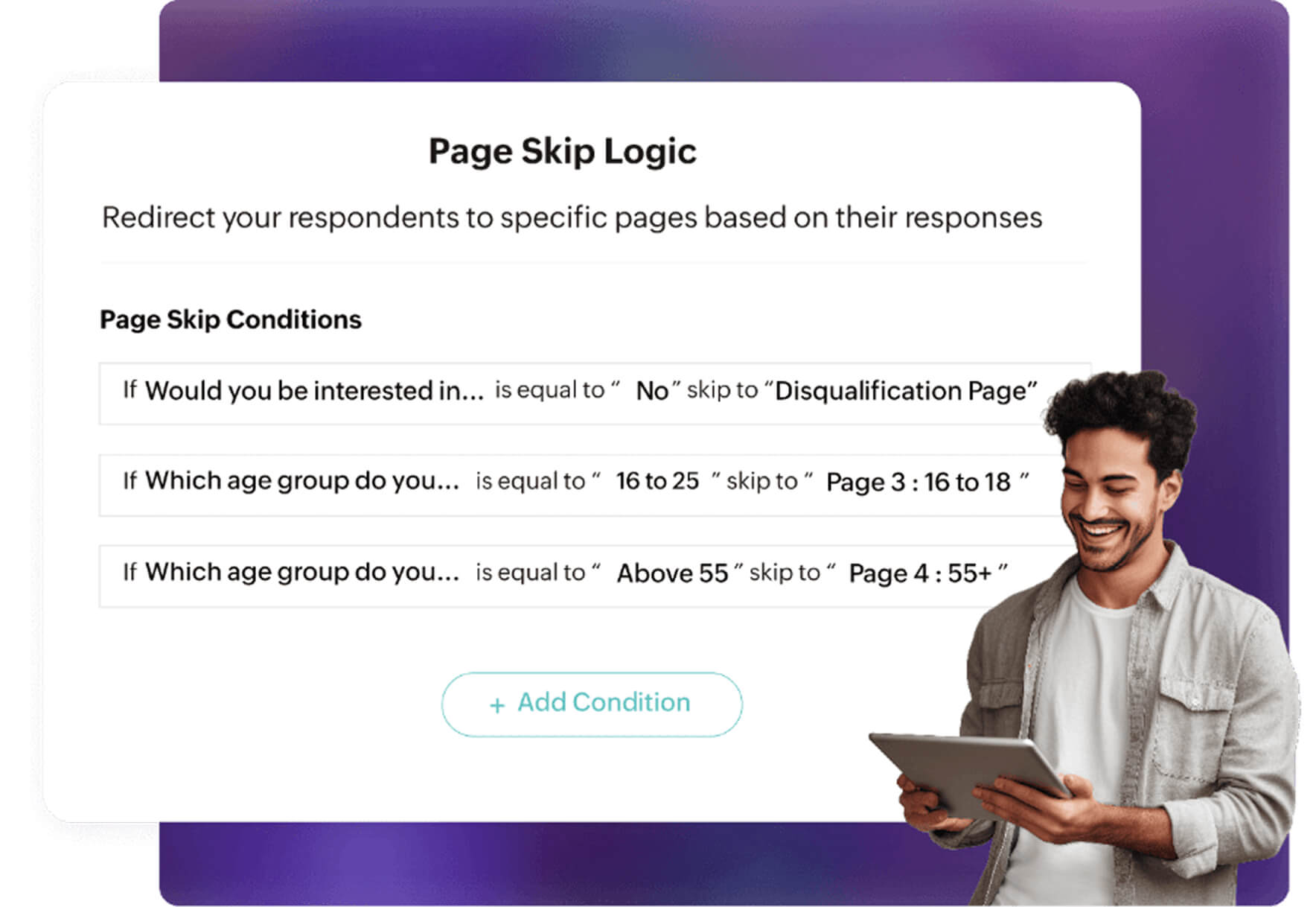
Donors don't all need to receive the same survey. Looking at giving history and the channel they used to donate can help an organization make the questions more relevant. With Zoho Survey's skip logic, for example, a follow-up question can change depending on someone's earlier answer. A donor who has stopped giving can be taken down a different path from someone who makes a donation every month.
It's also important to do something with the feedback once it comes in. If a response raises a concern, it could be sent directly to the right person on the team. Survey responses can also be pushed into a CRM record through an integration so that the feedback doesn't end up sitting in a separate spreadsheet. Donors are less likely to fill out another survey when they've shared feedback before and never heard anything back. Closing that loop shows them that someone actually read what they said.
Not every survey is going to be completed from a laptop with a reliable internet connection. NGOs often collect feedback at events or out in the field, where getting online can be difficult. Being able to use the survey offline means the responses can still be recorded and synced later when a connection is available.
Turning survey responses into an actual relationship strategy
A single low response from one donor is just one donor's experience. A pattern showing up across dozens of responses (the same communication complaint, the same confusion about how a gift was used, or the same request for more frequent updates) is a signal worth acting on organization-wide.
Getting to that level of clarity depends on how the responses get reviewed. Reports that break results down by donor tenure and giving level tend to surface far more than a single aggregate satisfaction score ever could, since a pattern that's true for new donors is often completely different from what's true for an organization's longest-standing supporters.
Donors need to see that their feedback went somewhere. If someone asks for clearer impact updates and those updates actually improve, they notice. The same goes for changing the way communications are sent or addressing an issue a donor had raised. Small changes like these show that someone was listening, which makes a donor more likely to share feedback again and stay connected to the organization.
That's really the point of the survey. Sending the survey alone doesn’t build the relationship. Acting on what donors say does. The survey just gives the organization a place to start.