- HOME
- Design & deliver
- Crafting and delivering engaging classroom presentations (+ free templates you can customize)
Crafting and delivering engaging classroom presentations (+ free templates you can customize)
- Last Updated : January 30, 2026
- 309 Views
- 5 Min Read

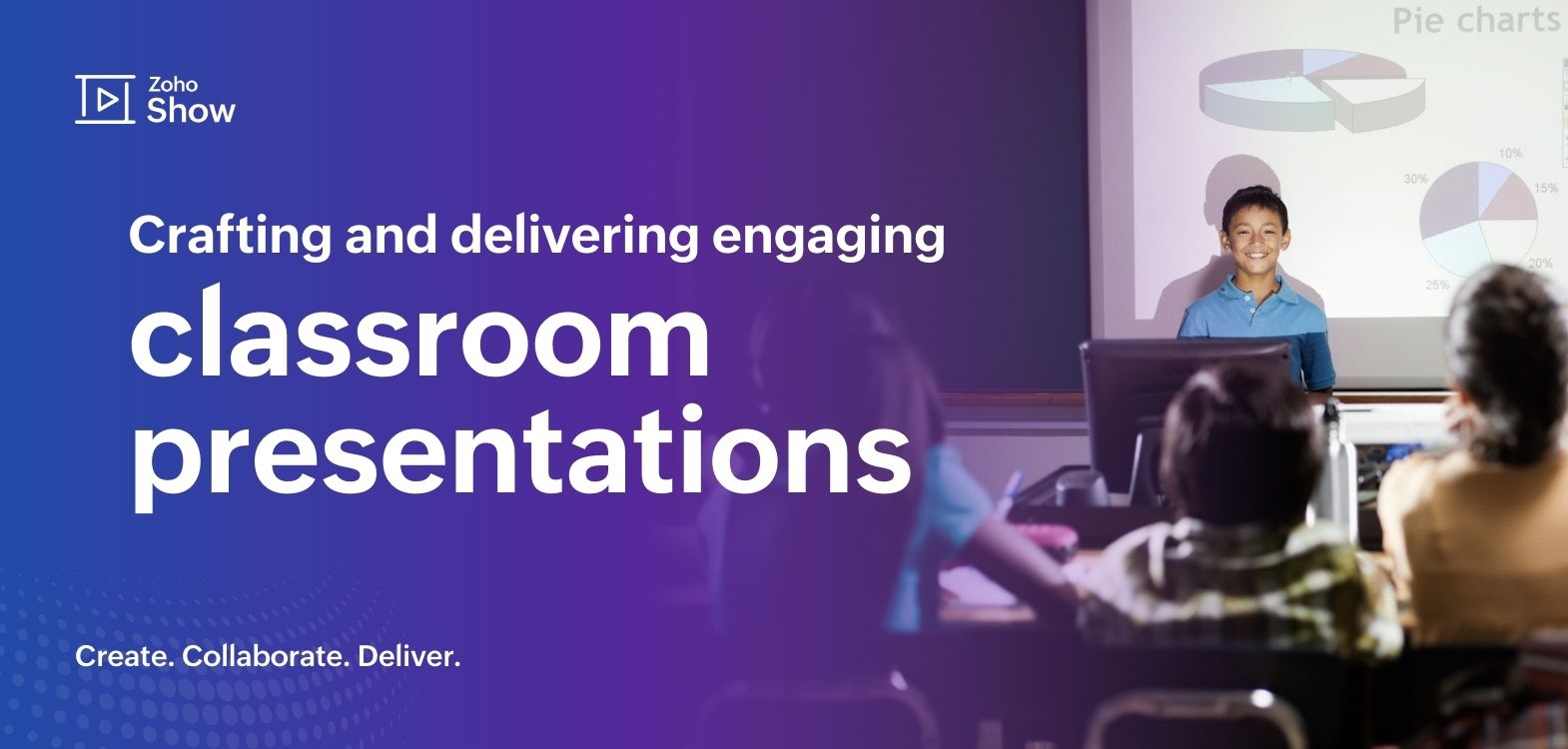
You know that moment just before you begin, when the room goes quiet, eyes turn toward you, and your mind suddenly starts racing faster than your slides? Classroom presentations usually have that effect. It’s not just about knowing the subject. It’s about holding attention, explaining clearly, and staying steady when questions or distractions pop up.
Confidence in the classroom isn’t a personality trait. It’s built with the help of structure, preparation, and a few smart choices that make the presenting feel less overwhelming.
In this blog, we’ll start by looking at how classroom presentations are evaluated, share practical tips for creating and delivering better presentations. We'll also explore how you can manage your preparation time effectively.
How are student presentations evaluated?
Before thinking about how to present, it helps to know what you’re being judged on. Most classroom presentations are evaluated on a few consistent factors, regardless of the subject.
Common evaluation factors
- Clarity of explanation
How easily can your classmates understand your main ideas? - Logical structure and pacing
Does the presentation follow a clear flow and use the given time effectively? - Voice, body language, and presence
How calm, confident, and engaged do you appear while speaking? - Visual support and relevance
Do your slides support your explanation (without distracting from it)? - Engagement and responsiveness
How effectively do you respond to questions, reactions, or changes in the room?
Keeping these factors in mind makes it easier for you to prepare a presentation that hits the mark.
Tips to create and deliver a winning classroom presentation
Know your audience
It's always important to present the topic in terms that make sense to your audience. Know how familiar your classmates are with the subject and what they will find interesting. Decide what needs more explanation and what can be kept brief.
Use relatable references to shape your examples and explanations, so your presentation feels clear and relevant.
Set one clear takeaway
Decide on one key idea you want your audience to remember when your presentation ends.
For example, if your topic is climate change, one clear takeaway could be how human activities contribute to rising global temperatures. A single focus makes your presentation easier to follow and more impactful.
Keep your content short and focused
Classroom attention spans are limited, and presentation time is often short. With many of your peers presenting, it’s even harder for your message to stand out.
Start with a strong idea and explain it in a memorable way: a simple example, a relatable situation, or a clear comparison.
Use simple language
Avoid complicated words while preparing and presenting. If something is hard to explain, it will be just as hard for your audience to understand and remember.
Simple language helps you maintain flow, explain ideas clearly, and stay confident throughout your presentation.
Use slides to support your explanation
Slides should support what you’re saying, not repeat it. They work best for visualizing data, explaining case studies, or reinforcing key points.
Avoid overcrowding slides with text. Too much content can pull attention away from your explanation instead of strengthening it. Following a few similar design tips can easily elevate your slides and make them look clear and engaging.
Focus your practice on key aspects
Practice isn’t about memorizing every line. It’s about becoming familiar enough with your content that you don’t panic when something goes off plan.
Saying your points out loud, practicing transitions, and presenting without relying heavily on slides helps you trust yourself more.
Handle situations with confidence
During the presentation, forgetting a point or losing momentum isn’t a failure, it’s normal. Pause, take a breath, and move on.
The same goes for questions. Listening carefully and taking a moment before answering helps you maintain your composure and stay in control of the session. Small adjustments and a steady demeanor are what make a presentation feel deliberate and effective, even when it isn’t perfect.
Manage your preparation time smartly
Time is usually limited, so how you divide it matters. A clear split helps you focus on what actually improves your presentation instead of getting stuck on details that don’t.
You can spend up to 60% of your time on content planning. This is where you decide what you want to say, the main points you need to cover, and the order that makes sense. When your message is clear, everything else becomes easier.
Slide creation shouldn't take more than 10% of your preparation time. With built-in templates you can find this can never be much of a challenge. Apart from that, you can now also generate complete presentations using AI, which can help you save much of your time.
Use the remaining 30% of time for practice and refinement. This is where you run through the presentation out loud, check your timing, smooth out transitions, and make small changes based on what feels unclear. This time helps you feel more prepared and less rushed on the final day.
Classroom presentation templates you can customize for free
Research review presentation template
A structured presentation template made for research, analysis, and topic-based discussions. With clear section dividers, data slides, comparisons, timelines, and summaries, this template helps you present both sides of a topic in an easy-to-follow way.
History presentation template
Ideal for explaining history topics that need structure, this template helps break content into early background, important events, key moments, and final outcomes. It helps keep timelines clear and prevents information from feeling scattered.
Science experiment presentation template
Made for academic and science projects, this template helps students organize ideas. From initial plans and predictions to results, analysis, and conclusions, the science experiment template makes it easy to clearly explain the process, findings, and learning outcomes in one cohesive presentation.
Chemistry presentation template
Deliver a well-rounded chemistry presentation with a template designed to inform and inspire. Covering the history of chemistry, fundamental concepts, major branches, and career pathways, this resource is ideal for academic and professional settings alike.
Psychology presentation template
Explore the world of cognitive psychology with this dynamic and informative presentation template. Consisting of shades of blue, this template is structured to highlight topics like problem solving, decision making, and key applications of cognitive psychology.
Biology presentation template
Designed specifically for students, this presentation template can be used to present a scientific research project, from introduction and hypothesis to methods, results, and conclusions. It helps structure experiments, compare data, and explain findings in a logical way, making complex research easier to communicate and understand.
Study guide presentation template
This study guide presentation template is created for students to review and explain a biology chapter in a clear, structured way. It helps organize key concepts, terminology, timelines, and practice questions so information is easier to understand and remember. Ideal for chapter reviews, exam prep, or student-led presentations.
Final thoughts
Presenting confidently in a classroom doesn’t come from memorizing every line or having perfect slides. It comes from knowing what you want to say and structuring it clearly. When your content is focused, your language is simple, and your visuals support your message, confidence follows naturally.
Classroom presentations will always come with a bit of pressure. But with the right preparation, that pressure turns into presence. Keep it clear, stay steady, and trust your preparation.
Sending good vibes for your next presentation.
Happy presenting!