How to respond to Google reviews (with examples for every star rating)
- Last Updated : April 9, 2026
- 490 Views
- 9 Min Read

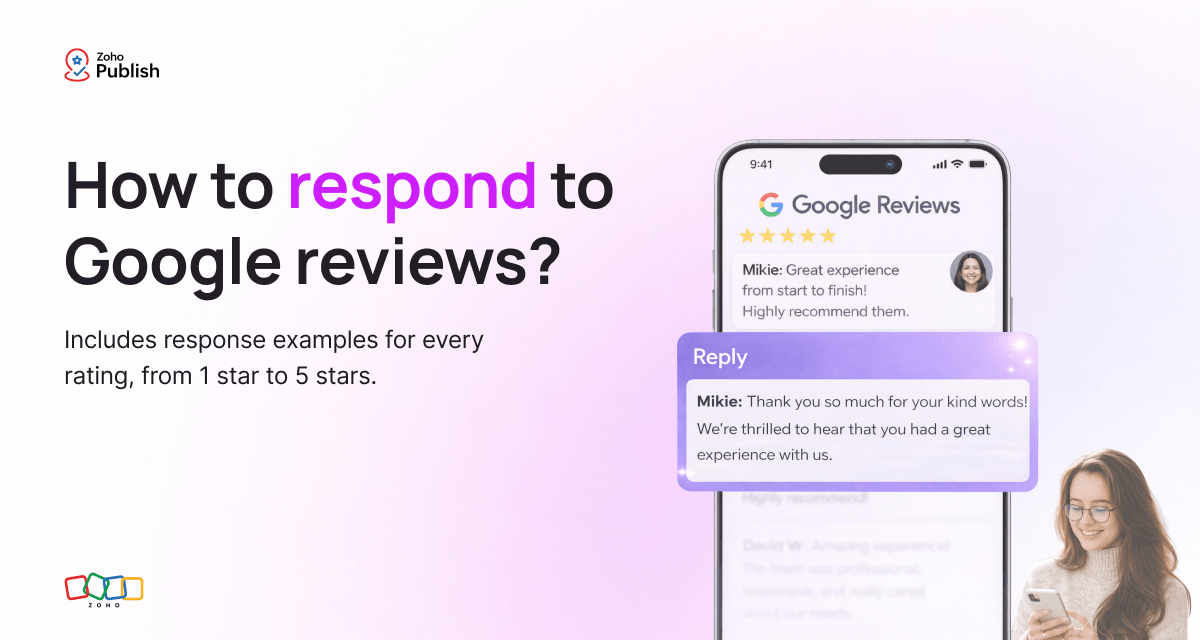
Most businesses put a lot of effort into getting good reviews, but very few put the same effort into responding to them.
That's a missed opportunity, and a costly one.
Your responses are public. Every potential customer who reads your reviews also reads how you handle them. A thoughtful response to a bad review can be more reassuring than a dozen five-star ratings, and a cold, copy-pasted reply to a glowing review can make even your happiest customers feel like a ticket number.
The good news? Responding well isn't complicated. It just takes a bit of intention.
89% of consumers expect business owners to respond to reviews.
You're not just talking to the reviewer, you're talking to everyone who will ever land on your profile. Keep that in mind every time you type.
Before we get to the examples, stop making these mistakes
These are the patterns I see across hundreds of Google Business profiles, and they quietly hurt businesses every day.
Copy-paste responses. Customers notice when every review gets the same reply. It signals that nobody is actually reading what they wrote.
Going silent on bad reviews. Ignoring a one-star review doesn't make it disappear. It tells every future reader that you had no answer. And, response time affects both customer trust and your local rankings.
Fighting back publicly. Even if the customer is wrong, a combative response looks bad to everyone reading it. It's never worth it.
Responding weeks later. A response that comes six weeks after a review reads as an afterthought. Respond within 48 hours, always.
The only rules you actually need
Use their name if they gave it. And when they don't (since anonymous reviews are now a thing on Google), a warm generic opener still beats "Dear valued customer".
Mirror their energy on positives, not negatives. Match enthusiasm for great reviews; don't match anger for bad ones.
Never apologize for something that didn't happen. Acknowledging frustration is not the same as admitting fault.
Move heated things offline, fast. Include a phone number or email in your response so the conversation can continue privately.
Keep it under 100 words. Readers skim. Be clear, be warm, be done.
Write like yourself. If you don't use the word "patronage" in real life, don't use it in a response.
5-star reviews: Don't just say thanks and walk away
Five stars feel like a victory lap, so it's tempting to just drop a quick "Thanks so much!" and move on. But this is actually your best marketing moment. Someone just told the internet they love you. Honor that by saying something real.
"A great response to a five-star review isn't just gratitude—it's an invitation for everyone reading to imagine themselves having that same experience."
Example #1: The enthusiastic regular
⭐⭐⭐⭐⭐
Customer review: "Amazing service! The team went above and beyond to help me find the perfect gift. The store was beautifully organized, and everyone was so friendly. I'll definitely be back!"
Your response: Sarah, this genuinely made our morning. Thank you! Helping people find that perfect gift is honestly our favorite part of the job (especially when the look on your face tells us we nailed it). We'll pass this along to the team. They're going to love hearing it. See you next time!
Why this works: It's specific, warm without being over the top, and "we'll pass this along to the team" signals that real humans are reading these reviews, not just a scheduler on autopilot.
Example #2: Staff shoutout review
⭐⭐⭐⭐⭐
Customer review: "Best pizza in town, hands down. The margherita is perfection: crispy crust, fresh basil, and that wood-fired flavor. Maria at the front was super helpful with recommendations too!"
Your response: Ha, "best pizza in town" is something our chef is going to screenshot and frame, I'm sure of it. The margherita dough gets a 48-hour cold ferment, so really glad you could taste the difference! And yes, Maria is an absolute gem. I'll make sure she sees this. Next time, ask her about whatever's seasonal. She has a knack for finding the thing people didn't know they wanted.
Why this works: The "screenshot and frame" line adds real personality, the detail about the 48-hour ferment shows genuine pride in craft, and teasing a next visit plants the seed naturally.
4-star reviews: The "almost" you can actually fix
Four stars means the person liked you, but something held them back from the fifth star. Usually they'll tell you what it was. Don't ignore it; don't get defensive. Just acknowledge it and show them you heard it.
Example: Good but slow service
⭐⭐⭐⭐
Customer review: "Really enjoyed the food and atmosphere. Service was a bit slow on Saturday night, but the staff was apologetic and the meal was worth the wait. Would come back on a weeknight."
Your response: So glad the food delivered, and fair point on Saturday night. We've been adjusting our kitchen flow for peak hours, and honestly, we're not quite where we want to be yet. Weeknights genuinely are a different, calmer world in here. If you do come back, try the Thursday special. It's new and the kitchen has a bit more room to breathe. Hope to see you again!
Why this works: "Honestly, we're not quite where we want to be yet" is refreshingly honest and humanizes the business. People respond really well to that kind of self-awareness. The Thursday tip is a natural nudge toward a return visit.
3-star reviews: The ones most businesses handle worst
Three stars is a shrug. The customer isn't furious; they just weren't wowed. And weirdly, this is the rating businesses seem most unsure how to handle. They either respond with hollow corporate-speak or get strangely defensive about things that were clearly mediocre.
Here's the thing: three-star reviewers are often the most convertible. They're not burned; they're just not convinced. Your job is to give them one good reason to come back.
Example: Shipping letdown
⭐⭐⭐
Customer review: "Product quality is decent but shipping took way longer than expected. Customer service was helpful when I reached out though. Just wish it arrived on time like promised."
Your response: You're right. A promised delivery date is a promise, and we didn't keep it. We've been dealing with a carrier issue we're actively sorting through, but that's context, not an excuse. I'm glad our team was responsive when you reached out. If you're willing to give us another shot, reach out directly at hello@company.com and mention this. I'd like to make the next experience a lot better than this one.
Why this works: "A promised delivery date is a promise" reframes the situation on the customer's terms, which is exactly right. "That's context, not an excuse" disarms people. It shows you understand the difference, which most businesses don't.
2-star reviews: Something went wrong. Own It.
A two-star review means the customer is genuinely disappointed. The gap between what they expected and what they got was wide enough that they took time out of their day to say so publicly.
Don't minimize it. Don't explain it away. The only thing that works here is genuine accountability and a clear path forward.
Example: The ruined anniversary
⭐⭐
Customer review: "Very disappointed. Made a reservation for our anniversary and they 'lost' it. Had to wait 45 minutes for a table. Food was good once we got seated, but the experience was ruined. Won't be returning."
Your response: I'm so sorry. An anniversary dinner is one of those nights that's supposed to be easy and lovely, and we dropped the ball entirely. Losing a reservation is inexcusable; full stop. We're overhauling how we log reservations because of situations exactly like this. I know "won't be returning" is probably where you are right now, and I completely understand. But if you ever change your mind, please reach out to me personally at manager@restaurant.com. That evening deserved better, and so did you.
Why this works: Acknowledging "won't be returning" directly rather than glossing over it shows real emotional intelligence. Most people expect spin; when they don't get it, they're caught off guard in a good way.
1-star reviews: The most valuable feedback you'll ever get
A one-star review, handled well, is watched by more potential customers than almost any marketing you'll run. Everyone clicks the one-star tab. It's human nature. They want to see what went wrong and, far more importantly, they want to see how you handled it. That's where trust is built or destroyed.
"Nobody expects perfection. They just want to know that when things go wrong, someone real is paying attention."
Example #1: Genuinely bad experience
⭐
Customer review: "Absolutely terrible experience. Order arrived damaged, customer service ignored my emails for a week, and when they finally responded they offered no solution. Total waste of money. DO NOT ORDER FROM HERE."
Your response: I read this and I'm genuinely sorry. A damaged order is bad. A week of silence from our team is worse. And offering no solution after all that, there's no defense for any of it. I'm the owner, and this is not the business I want to run. Please email me directly at owner@company.com with your order number. I'll fix it today; not "look into it," not "escalate it." Fix it. You shouldn't have had to write this.
Why this works: "This is not the business I want to run" is personal and real, and the distinction between "fix it" vs. "look into it" signals that this person isn't giving you corporate runaround. Other readers notice that.
Example #2: The suspicious one (possible fake review)
⭐
Customer review: "Worst place ever!!! The staff was SO RUDE and the owner literally screamed at me for no reason. Never going back and telling everyone I know to avoid this dump!!!"
Your response: This description doesn't match anything we can find on our end. We've gone back through our records and team notes and found no incident that resembles what you've described. That said, we never want anyone leaving us feeling this way. If there's something we missed, please reach out directly at contact@business.com so we can understand what happened. Our door and our ears are genuinely open.
Why this works: You're not calling them a liar. You're calmly presenting the facts. "We've gone back through our records" sounds thorough and credible. Ending warmly rather than combatively lets anyone reading draw their own conclusions.
Three situations nobody talks about
When they praise a competitor in your review
This happens more than you'd think. Someone leaves a 3-star review and says, “It was fine, but honestly the place on Fifth Street is so much better.” Good review management means resisting the urge to respond with shade. It never reads the way you think it does.
What to say instead: "Ha, we know those guys. Great spot! We'd love to show you what we're about on a different day. Come back and try [specific thing]; it's what regulars keep coming back for. No pressure."
High road, every time. You look confident, not threatened.
When the complaint is completely out of your hands
Parking. Weather. A highway closure that delayed delivery. Sometimes the frustration genuinely isn't your fault. Still, don't say, "That's not our fault." Solve around it instead.
What to say instead: "Parking on this block is genuinely rough; we hear this a lot and we wish we could fix it. Quick tip: the garage on Maple lets you validate with a $10 purchase, and it's usually half the hassle. We also do curbside now if that's easier next time. Thanks for the patience."
When they're right and you know it
Your prices went up, the portions got smaller, or the wait times are longer than they used to be—and someone noticed and called it out. This one requires real honesty, not performed honesty.
What to say instead: "You're not wrong. The price increase last quarter was painful for us to make and I imagine more painful for regulars who remember what it was before. It came down to ingredient costs we couldn't absorb anymore. Whether that math works for you or not, I completely respect it. We're still here if you want to give us another shot."
The last thing I'll say
The businesses people trust most aren't always the ones with 300 perfect reviews; they're the ones where you can scroll through and see a real human being making mistakes, owning them, celebrating wins, and treating every reviewer like they actually matter.
That's what Google reviews let you do that no ad campaign can: prove that you're real.
So respond consistently, write like a person, and stop treating your review inbox like a task to get through. It's a conversation worth having.
Before you close this tab:
Set a reminder to check reviews every morning. Five minutes is enough.
Save two or three of these templates somewhere easy to grab and customize.
If you have a team, designate one person to own this. Ambiguity means nobody does it.
Your goal: respond to every review within 48 hours, every single week.
Revisit your responses after 30 days and ask: "Does this sound like me?"
Good luck out there. And if a review ever really stumps you, read it like a message from a customer giving you one last chance to win them back—because that's usually exactly what it is.