A step-by-step guide to building your 2026 payroll calendar
- Last Updated : December 12, 2025
- 1.5K Views
- 5 Min Read

Payroll processing requires a variety of key information: employee details, tax forms, deductions, bank information, reimbursement claims, leave balances, timesheet data, and more. These details are vital for calculating net pay, distributing payslips, and maintaining records for compliance. Payroll teams do all this while coordinating with finance and HR teams. Given the complex, interdepartmental nature of this function, it's important to have a straightforward payroll calendar in place that keeps everyone on top of essential data, including pay periods, pay and cut-off dates, payroll deadlines, and holidays. This is your ultimate guide to designing your payroll calendar for 2026 so that you can enter the new year with clarity and confidence.
Different types of payroll calendars
Here are some of the common types of payroll calendars:
Monthly
In this pay schedule, employees are paid once a month, typically on the last working day or within the first few days (usually between the 1st and the 5th). This is a popular pay schedule because it requires only 12 pay payroll runs a year, which is much lower than other options. It's especially suitable for salaried employees whose pay doesn't change often.
Semi-monthly
In a semi-monthly approach, employees are paid twice a month—either on the 1st and 15th or the 15th and final day of the month—for a total of 24 payouts per year. Since the dates are consistent, HR teams may find this method effective for hourly employees or those who have heavy overtime hours.
Bi-weekly payroll calendar
In this pay schedule, employees are paid on the same day once every two weeks for a total of 26 paychecks a year. In specific months, employees may even receive three paychecks instead of two. Planning cash flow during these months may prove challenging for employees.
Weekly payroll calendar
In a weekly payout, employees are usually paid at the end of every week, which totals 52 times a year. This can be most suitable for hourly workers, but it can also increase the administrative load on the HR teams due to frequent processing.
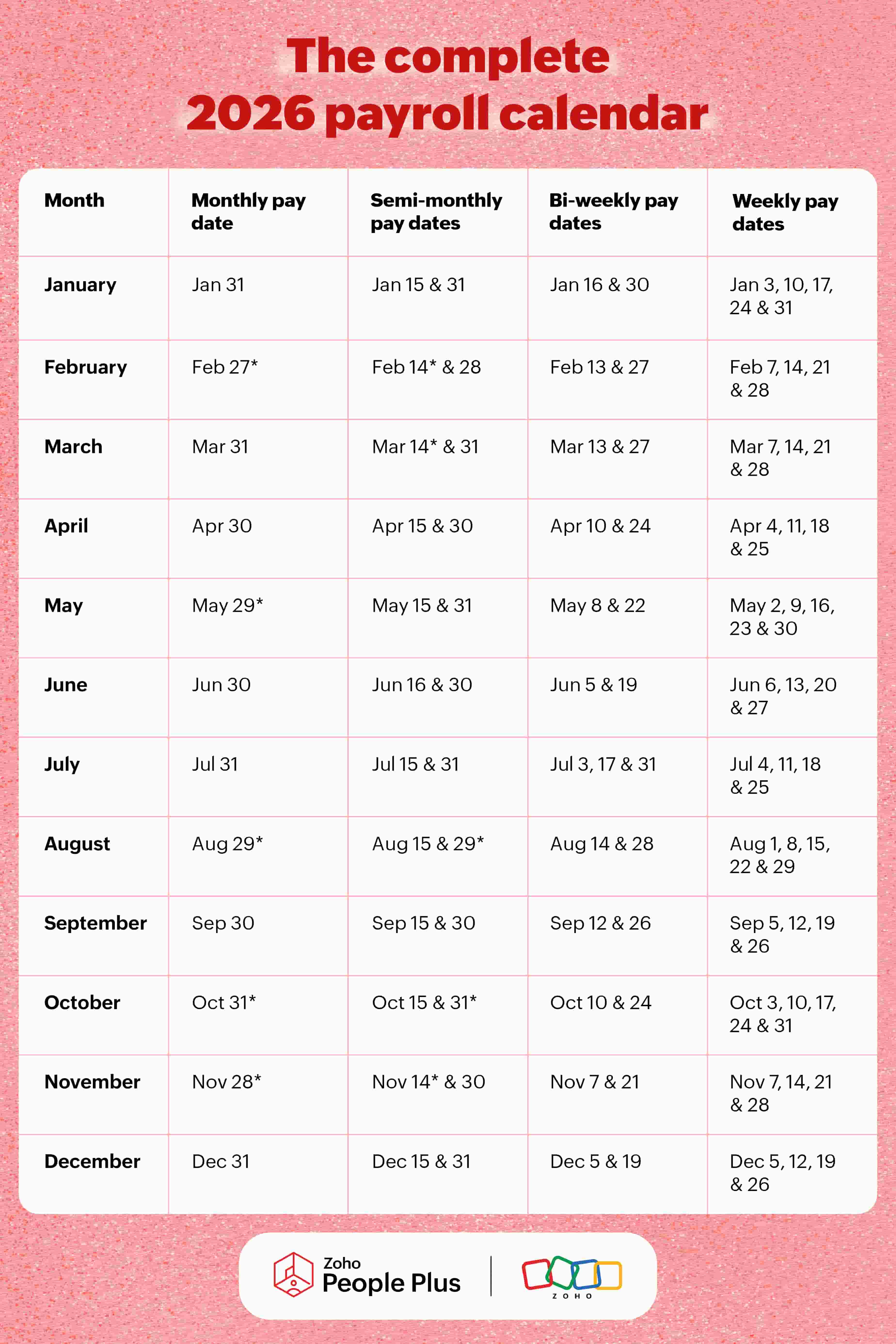
Disclaimer: Holiday dates can vary across countries, states, and regions, and weekend days may differ depending on local labor rules or organizational practices. Please cross-verify these dates based on your location before finalizing your payroll calendar.
Understanding the key components of a payroll calendar
Here are some of the key elements that need to be accounted for in a payroll calendar:
Pay frequency
Pay frequency determines the timeframe for tracking employee working hours and earnings. As detailed in the previous section, an organization can have any pay structure—monthly, semi-monthly, bi-weekly, and weekly—which define how often employees are paid.
Cut-off date
The cut-off date in a payroll calendar is the final day for gathering all required payroll inputs, including attendance, leave records, timesheet data, LOP details, reimbursement claims, and more. This date varies based on the pay frequency and should be selected strategically to allow a buffer for miscalculations. For instance, in a monthly pay schedule that pays employees on the last working day, the cut-off date typically falls between the 20th to 23rd of the month.
Actual pay date
The actual pay date refers to the day when employees receive their pay. Payroll teams should make sure that this date doesn't clash with weekends, holidays, bank holidays, and other public holidays. Having a consistent and predictable pay date helps avoid errors and provides the space for employees to plan their expenses accordingly.
Statutory deadlines
Statutory deadlines refer to the deadlines set by the government to help organizations file Tax Deducted at Source (TDS), income tax, PF, ESI, and other statutory contributions on time. These deadlines can differ based on your organization's region. For instance, in India, the government-mandated deadline for depositing TDS is the 7th of the month following the payroll cycle.
Holidays and weekends
National holidays, state holidays, and weekends can have a huge impact on payroll processing, especially since bank closures mean payroll teams cannot disburse employee salaries. Having these dates neatly laid out in your payroll calendar can help your HR, finance, and payroll teams plan ahead to adjust their pay dates and ensure that employees are paid accurately and on time.
How to create your payroll calendar for 2026
Here's how you can create your payroll calendar for the year 2026:
1. Define your pay frequency
Since pay frequency sets the foundation for all key payroll deadlines, it's essential to define this right at the start. Choose a pay schedule that aligns with your organization's cash flow and financial patterns. Go through applicable regional and national labor and payroll laws to check if there are any government-mandated pay frequencies. If there aren't, go for a pay schedule that is consistent with the nature of your workforce. While hourly and gig workers may be comfortable with a semi-monthly or weekly pay schedule, salaried employees may prefer a monthly pay schedule. You should also factor in the administrative burden that your HR and payroll teams can handle, since weekly pay cycles may require them to process payroll four or five times a month.
2. Map out the key dates
Once you define your pay frequency, create your payroll calendar with the pay period for each payroll cycle and the corresponding pay dates. Mark holidays and weekends in your calendar to ensure that your pay date doesn't clash with any holidays or weekends. If any sort of clash occurs, adjust the pay date to the nearest last working date. Having this documented in your payroll calendar during the beginning of the year can help you avoid delays, ensure compliance, and make sure that employees are paid on time, all the time.
3. Add the cut-off deadlines
Adding cut-off deadlines ensures that you have all the required payroll inputs, including attendance, leave, timesheets, LOP data, new hire details, and exit information, before payroll processing begins. When these timelines are well-defined, HR and finance teams can share the required details on time. This way, payroll teams can work with complete and accurate data for payroll calculation.
4. Include buffer days
Having three to five extra days between the final cut-off date and the actual pay date can provide ample time for payroll teams to handle any errors, late approvals, and other exceptions. These days can be really useful when there are many new hires onboarded or when there are multiple holidays. This way, even when there are discrepancies, payroll teams can still stick to their timelines.
5. Share the calendar
Once you have your payroll calendar ready, make sure that you share it across the entire organization—not just payroll, HR, and finance teams. Employees should be able to access it on the go through their intranet or HR system so that they know the deadlines to submit their reimbursement claims and timesheets. This gives everyone the data they need for smooth payroll processing.
Wrapping up
Using a straightforward payroll calendar with accurate pay frequencies, cut-off dates, pay dates, statutory deadlines, and buffer days makes your payroll process consistent and clear. Keep your payroll calendar handy to avoid last-minute hassles and align your HR, finance, and payroll teams.