5 AI prompting strategies for marketers
- Last Updated : July 9, 2026
- 142 Views
- 7 Min Read
Prompting has quietly become a core marketing skill. Every day, marketers reach for ChatGPT, Claude, Gemini, or DeepSeek to brainstorm campaigns, draft copy, review reports, and clear smaller tasks off the list. But the quality of what AI gives back depends almost entirely on how you ask — and a generic prompt usually returns a generic output. At Zoho, our marketing team has refined a handful of prompting techniques that consistently produce sharper results while keeping our brand voice intact. Here are five of them, with real examples you can use for your own work.
1) Specific prompts beat general ones
AI outputs are only as good as the prompts you write. The more context and detail you give, the sharper the response — because the model has more to work with. Say you want AI to review a blog post on the best summer outerwear. A vague prompt will get you a vague critique. A specific prompt — one that names your target audience (teens and young adults, all genders), your business goal (driving sales, brand awareness), the CTA variations, and the success metrics you're tracking, etc.. — lets the AI run a deeper synthesis. The feedback comes back grounded in your actual context, not a textbook idea of "good content."
Before:
Review this blog post on summer outerwear and tell me how to improve it.
After:
Review the blog post below.
Target audience: teens and young adults, all genders, shopping for summer outerwear in the $40–80 range.
Primary goal: drive product page clicks, not just brand awareness.
Current CTAs in the draft: "Shop the look" and "Add to cart."
Success metrics we're tracking: click-through rate to product pages and add-to-cart conversion rate. Flag any section that doesn't move the reader toward those CTAs, suggest sharper hooks for the intro, and rewrite weak transitions. Keep the tone conversational and Gen-Z friendly — no corporate language.
2. Show examples to AI
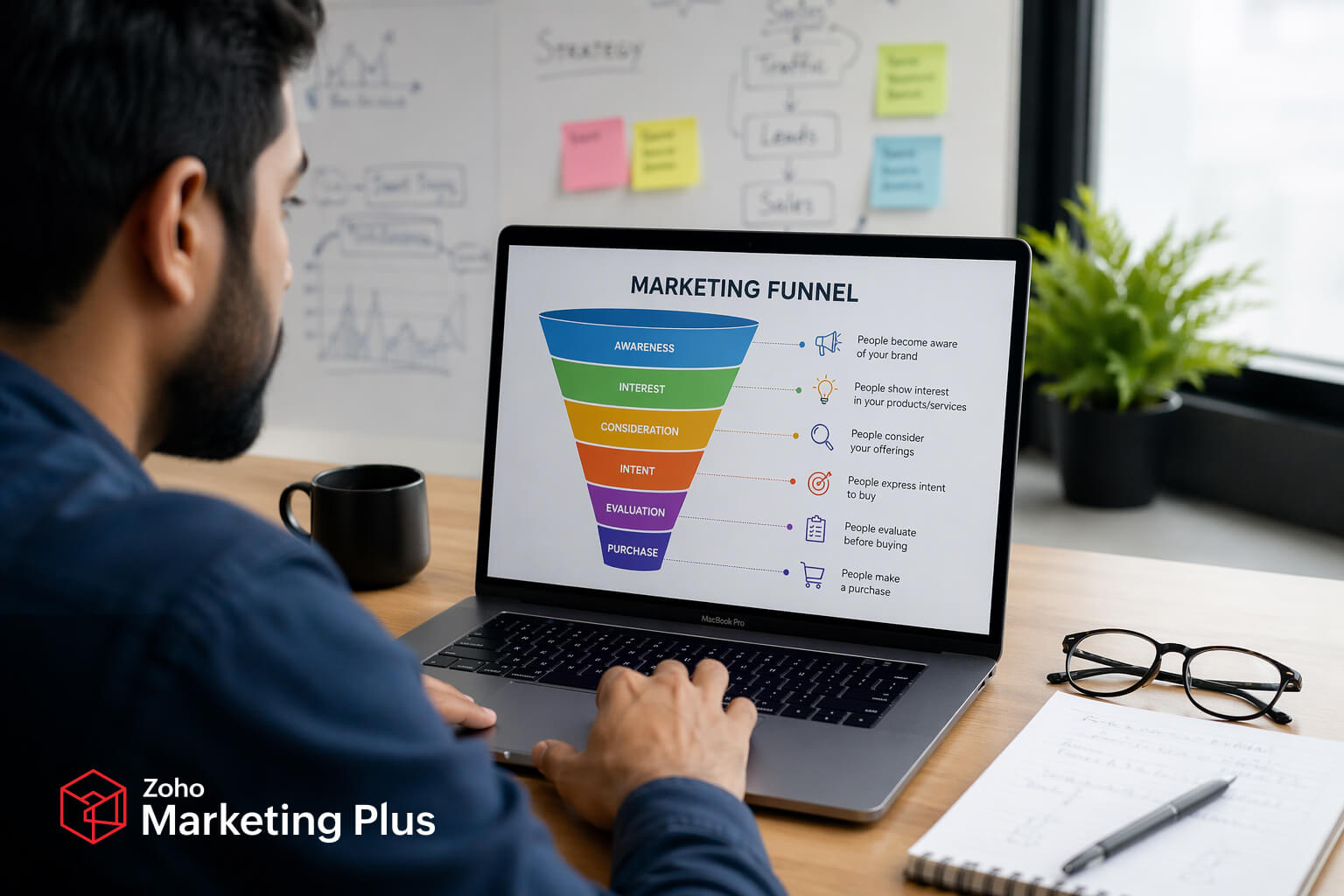
AI tools are excellent mimics. When you share an example of the output you want, the model has a pattern to follow — and the next response lands far closer to your expectations. Say you analyze campaign performance through a marketing funnel lens. Your usual structure to track marketing funnel looks like: TOFU metrics (impressions, reach, clicks, bounce rate), MOFU metrics (ebook downloads, demo requests, form fills), and BOFU metrics (sign-ups, purchases, revenue). Instead of asking the AI to "analyze this report, "share a past analysis you've done in that exact structure, upload the new report, and ask it to follow the same format. The output comes back in your shape — funnel stage by funnel stage — instead of a generic summary the AI thinks you want.
Example of a prompt:
Attached is last quarter's campaign analysis I wrote, structured by TOFU, MOFU, and BOFU. I'm now sharing this quarter's raw performance report. Analyze the new report in the exact same structure and tone. For each funnel stage, flag the two biggest shifts from last quarter, explain what likely caused them, and suggest one experiment we could run next quarter to improve that stage.
The AI now has three things it didn't have before: your preferred structure, your tone, and a benchmark to compare against. That's the difference between a report you can use and one you have to rewrite.
Zoho Marketing Plus visualizes your entire marketing funnel out of the box, so you can pull stage-wise performance without building dashboards from scratch — and feed those views directly into your AI workflow.
Note: Treat AI tools the way you'd treat any third-party platform. If you're sharing proprietary campaign data, customer information, or financials, use an AI tool your organization has signed up for and vetted — not your free personal account. When in doubt, run it past your security or IT team before you upload.
3. Lead the AI — don't outsource to it
AI is your assistant, not your strategist. The moment you start asking it "what should I do?" instead of "here's what I'm doing — pressure-test it," you've handed over the thinking. And AI is genuinely bad at thinking for you. It's excellent at thinking with you.
The shift is small, but everything changes downstream. Bring your point of view to the prompt: your goal, your hypothesis, your competitive read, your constraints. Then let the AI stress-test it, fill in the gaps, and surface angles you missed. The output becomes a sharper version of your thinking — not a generic answer the AI guessed you wanted. Say you're trying to grow market share for your product. Don't ask: "How do I grow market share?" You'll get a textbook answer that could apply to any company in any industry. Instead, walk in with a draft and ask the AI to interrogate it.
Example:
I'm working on a 90-day plan to grow market share for our project management tool among SMB teams (10–50 employees).
Here's my current thinking:
Goal: 15% increase in paid sign-ups from the SMB segment by the end of Q2.
Approach: Double down on integrations content (we have 40+ integrations vs. competitors' 15–20), run a free-migration campaign targeting users of competitor X, and partner with three SMB-focused communities for co-marketing.Top competitors: [Competitor X] — stronger brand, weaker integrations. [Competitor Y] — cheaper, but limited features. [Competitor Z] — comparable features, stronger in enterprise.
Constraints: Limited paid budget, two-person marketing team, three-month window.
Pressure-test this plan. Where are the weak assumptions? What's missing? What would a marketer at [Competitor X] do to defend their share? Suggest one tactic I haven't considered that fits our constraints.
Notice what's happening: you brought the strategy. The AI brought the second opinion. That's the right division of labor.
The opposite pattern — asking AI to generate the strategy and then validating it yourself — sounds similar but produces worse work. AI defaults to the average answer, which means your campaigns end up looking like everyone else's. Your judgment about your market, your customers, and your brand is the part no model can replicate. Use it as the starting point, not the rubber stamp.
4. Never settle for the first output — iterate
Most marketers treat the AI's first response as the answer. It almost never is. The first output is a starting point — a rough sketch the model produces by defaulting to the safest, most average response it can generate. The good stuff comes out in rounds two, three, and four.
AI models work by predicting the next token — roughly, the next word or fragment of a word — based on everything in the conversation so far. The more you push back, clarify, or add context across turns, the more the model has to work with, and the less it falls back on generic patterns. That's why iteration genuinely improves output, not just because you're being pickier.
So when the first response lands, don't accept it. Interrogate it. Ask the AI to explain its reasoning. Challenge the parts that feel weak. Ask it to try a sharper angle, a different tone, or a contrarian take. Each round narrows the gap between what the AI gave you and what you actually want.
The same rule applies when you're using AI to polish a draft, write copy, or finalize anything that goes out under your brand. Don't ship the first output. Don't even ship the third without editing. Treat AI as a collaborator that needs direction across rounds, not a vending machine you press once.
5. You're the magician — AI is just the wand
Strip away the tools and what's left is the actual work: understanding people. Their fears, their objections, the small frictions that stop them from clicking. The unsaid reasons they pick one brand over another. AI can't do that. It has never sat across from a customer, never read a room, never felt the weight of a campaign that flopped.
What AI can do is construct sentences, check grammar, run the math, summarize the report, draft the variation, hold the structure. Those are real, useful jobs — the kind that eat hours of a marketer's week. Handing them off frees you up for the part only you can do: thinking, feeling, deciding, and shaping the story.
That's the right mental model.
You are the magician. AI is the wand. The wand doesn't cast the spell.
Keep that order straight and AI becomes one of the most valuable members of your team. Flip it, and you'll quietly stop sounding like yourself your campaigns will start to look like everyone else's, your copy will lose its edge, and your audience will feel it before you do.
The marketers who win with AI aren't the ones with the cleverest prompts. They're the ones who still know what they're trying to say.
FAQ
1. What AI tool is best for me? Should I be using all of them?
Pick one as your daily driver and learn it deeply — ChatGPT for general drafting, Claude for long-form and editing, DeepSeek for budget-conscious reasoning, etc.. Switching tools mid-task usually costs more time than it saves.
2. What data can I share with AI tools, and what should I never share?
Safe: public content, anonymized examples, brand voice docs, generic frameworks. Never share customer PII, unreleased product details, financials, or anything under NDA — and for sensitive work, use a tool your organization has officially vetted, not your personal account.
3. Can I run my marketing fully on auto-pilot with AI?
No — AI handles execution well but is poor at judgment about your audience, brand, and timing. A realistic split is AI doing 60–70% of the mechanical work while you handle the 30% that decides whether the campaign lands.
4. What areas of marketing work well with AI automation?
Strong fit: content drafting, copy variations, subject lines, report summaries, campaign ideation, A/B analysis, segmentation, and personalization. Weak fit: brand positioning, original concepts, customer relationships, and any judgment-heavy decision.
5. How can I prompt AI tools better?
Be specific, show examples, lead the AI instead of outsourcing to it, iterate across rounds, and keep the final judgment human. The full breakdown with real prompt examples is in the five habits above.
 Bala
BalaBala is a product Marketer for Zoho Marketing Plus. He is passionate about discussing MarTech, Customer Experience, Omnichannel Marketing, and Marketing Analytics.
You can start a conversation with Bala by leaving a comment on any of his blog posts.Bonus information - Bala likes cats, coffee, and G-shock watches :)