Five ways to build your marketing funnel in AI-driven search
- Last Updated : May 11, 2026
- 229 Views
- 3 Min Read
Search is no longer just a list of links. It’s becoming AI-driven answers Today, your audience doesn’t just search—they ask questions, compare options, validate choices, and often make decisions within AI interfaces like ChatGPT, Gemini, Claude, or Perplexity.
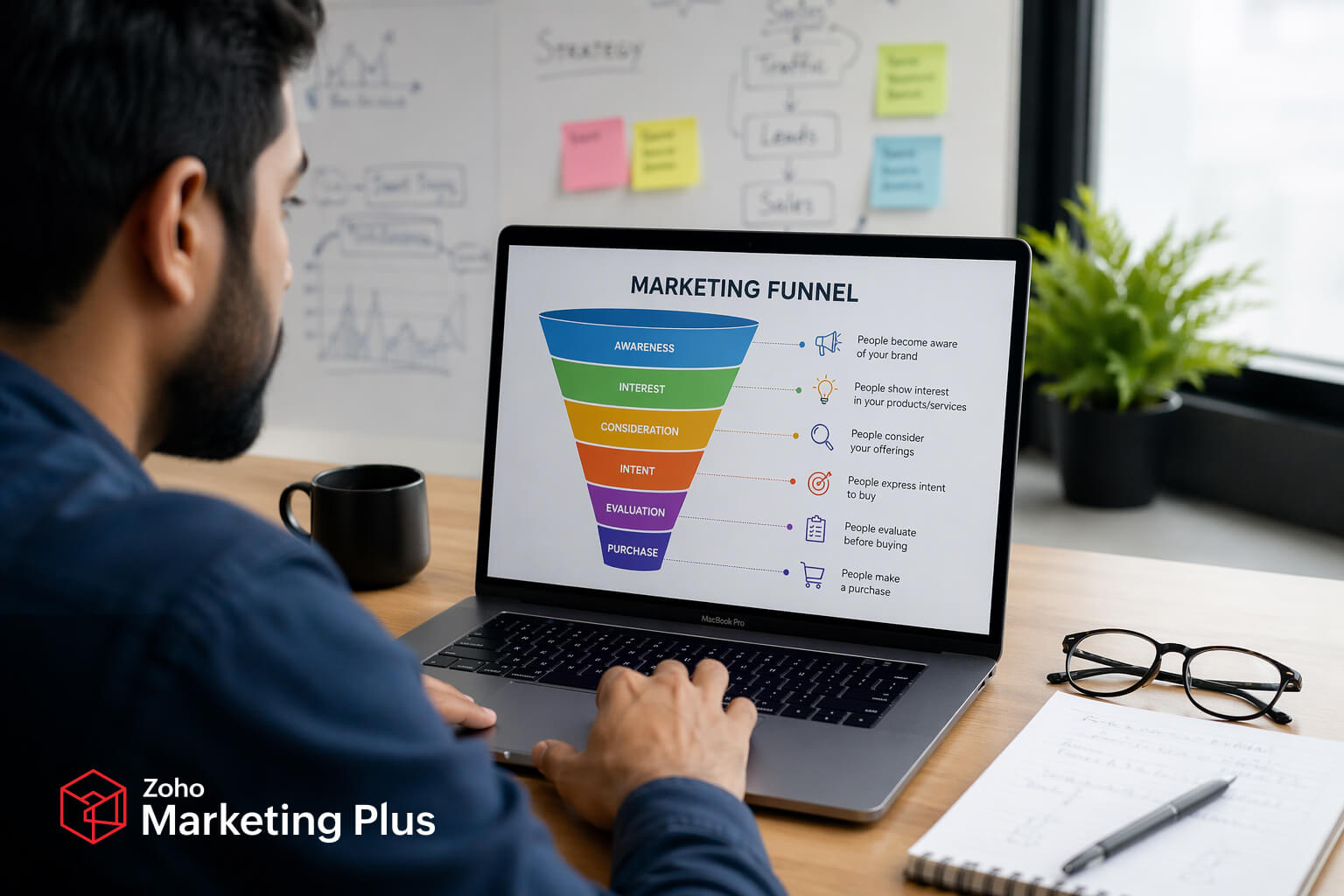
This shift means your marketing funnel is no longer linear. Instead, it is distributed across search engines, answer engines, and generative AI platforms. This is where Answer Engine Optimization (AEO) comes in.
Your goal is no longer just to rank on a results page, but to be selected as the answer inside AI-generated responses.
Suggested reading: Build AI-ready marketing funnels with Zoho Marketing Plus
So how do you build a funnel that actually works in this environment?
1. Start with questions, not keywords
Traditional SEO begins with keywords. AI-driven discovery begins with intent-rich questions. Instead of targeting broad phrases like “email marketing tools,” your content should answer specific queries such as what the best email marketing tool is for small teams, or how someone can automate email campaigns without coding. AI systems prioritize direct, contextual answers, which makes question-based content far more effective.
In practice, this means turning each core keyword into multiple real user questions and answering them clearly and early in your content. Structuring your posts in a conversational format also helps. You are no longer optimizing for clicks alone—you are optimizing to be quoted.
2. Redefine Top-of-the-funnel (TOFU) for AI discovery
Top-of-the-funnel content used to focus on visibility and reach. Now, it needs to focus on being selected by AI systems. AI does not browse your page the way a human does—it extracts information. That means your content must be structured, easy to scan, and capable of delivering self-contained insights. It also needs to cover topics comprehensively, answering what, why, and how in one place. Formats like explainer posts, list-based articles, and complete guides tend to perform well in this environment.
Think of TOFU not just as awareness, but as your AI visibility layer—content that AI systems can confidently pull from.
3. Build Middle-of-the-funnel (MOFU) with depth, not persuasion
Middle-of-the-funnel content has traditionally been about nudging users toward a decision. In AI-driven search, its role shifts toward building trust. AI systems prioritize depth, context, and consistency across sources. As a result, shallow comparison pages or surface-level content are less likely to be surfaced. What works better are detailed guides, real-world use cases, and structured comparisons that go beyond feature lists to explain when and why something works. At this stage, your goal is not just to persuade. It is to become a reliable source that both users and AI systems trust when evaluating options.
4. Turn Bottom-of-the-funnel (BOFU) into validation content
Bottom-of-the-funnel behavior has changed the most. Users now rely on AI to validate their decisions by asking questions about value, trade-offs, and common choices. This means your BOFU content needs to shift from being purely promotional to being genuinely informative and balanced. Content such as honest pros and cons pages, real-world scenarios, and FAQs that address common concerns becomes critical. The closer users are to making a purchase, the more they look for reassurance rather than persuasion. Content that feels objective and credible is more likely to be surfaced by AI systems.
5. Connect your funnel with AI-driven feedback loops
Traditional funnels are static, but AI-driven funnels are dynamic and continuously evolving. Modern marketing systems can track user behavior, identify patterns, and adapt messaging in real time. This means your funnel should not just guide users forward—it should learn from their interactions. By analyzing drop-offs, feeding insights back into your content strategy, and continuously updating high-performing pages, you create a system that improves over time.
Unified marketing platforms like Zoho Marketing Plus can help unify campaigns, content, and analytics, making this process more seamless and measurable. Your funnel is no longer a pipeline. It is a feedback loop. Bringing it all together AI-driven search does not replace your marketing funnel—it reshapes it.
Top-of-the-funnel content becomes discoverable answers.
Middle-of-the-funnel content becomes trusted context.
Bottom-of-the-funnel content becomes decision validation.
Everything in between is powered by structure, data, and adaptability.
The brands that succeed will not be the ones producing the most content, but the ones creating content that AI systems can understand, trust, and surface. Because in AI-driven search, visibility is not just about ranking. It is about being chosen.
Unified marketing platforms like Zoho Marketing Plus enable your team with powerful tools to build and manage your entire marketing funnel in one place.
Try Zoho Marketing Plus free for 15 days.
Watch: What is a marketing funnel?
 Bala
BalaBala is a product Marketer for Zoho Marketing Plus. He is passionate about discussing MarTech, Customer Experience, Omnichannel Marketing, and Marketing Analytics.
You can start a conversation with Bala by leaving a comment on any of his blog posts.Bonus information - Bala likes cats, coffee, and G-shock watches :)