Why trust is the real currency for Nigerian SMEs and how to build it at scale
For many Nigerian SMEs, growth discussions often focus on sales targets, marketing budgets, expansion plans, and customer acquisition. While these matter, long-term growth depends on customer trust. It shapes every stage of the customer journey, from the first purchase to customer retention, referrals, and long-term loyalty. In today's retail environment, where consumers have more choices than ever, trust has become the real driver of sustainable growth.
The hidden cost of broken trust
Many businesses invest heavily in attracting new customers, but what happens after the first sale?
That's where many growth strategies begin to fall apart. Customers leave because the experience disappointed them, whether that's a delayed response, an unanswered message, a delivery update that never arrived, or a complaint that went unresolved. These moments may seem small, but they are often the difference between a one-time sale and a loyal customer.
According to Salesforce, 52% of consumers say poor-quality service is the primary reason they won't make a repeat purchase. The same research found that 72% of customers remain loyal to businesses that provide faster service, while 65% stay loyal when companies offer more personalised experiences.
The message is clear: the customer experience determines loyalty. For retail SMEs, retaining existing customers is far more cost effective than constantly acquiring new ones.
Why trust matters more than ever in retail
Traditionally, trust in commerce was built face to face. Customers knew the shop owner, visited the same store, and developed relationships that kept them coming back.
Today, that dynamic is changing. Customers discover businesses through social platforms such as WhatsApp, online marketplaces, websites, and digital advertisements. Interactions begin before a customer ever steps into a store, making every digital touchpoint an opportunity to build or lose trust.
Consider these questions:
Does your team respond to customer inquiries quickly?
Can customers switch between channels without repeating themselves?
Do sales and support teams have access to the same customer information?
Are customer complaints resolved consistently?
If the answer to any of these questions is "not always," trust gaps may already exist within your business. These gaps often become visible only after customers stop returning.
The trust signals customers look for
Customers rarely tell businesses that they trust them. Instead, they look for signals. These signals help them decide whether your business is reliable enough to buy from again.
Fast responses : When customers ask questions, they expect answers. Long response times create uncertainty. Quick responses communicate reliability and respect for the customer's time.
Consistent communication : Customers want updates. Whether it's an order confirmation, delivery notification, or service follow-up, proactive communication reduces anxiety and builds confidence.
Personalised experiences : The best customer experiences feel personal. When businesses remember previous purchases, preferences, and conversations, customers feel recognised rather than treated like another sale.
Reliable problem resolution : Mistakes happen in every business. What matters is how quickly and effectively they are resolved. Trust grows when businesses take ownership and act quickly.
Consistency across every channel : Customers don't think in departments. They see one business. Whether they contact sales, support, or marketing, they expect a seamless experience.
"For growing businesses, trust is built in the moments between transactions. Customers remember how quickly you respond, how consistently you communicate, and how well you understand their needs. The businesses that can deliver those experiences at scale will be the ones that earn lasting loyalty and sustainable growth."
— Ogundare Kehinde Seun, Regional Manager, Zoho - West Africa
The real reason many SMEs struggle with customer trust
Here's the challenge: most trust issues begin with operations.
As businesses grow, customer information often becomes scattered across spreadsheets, messaging apps, email threads, notebooks, and disconnected software. Sales teams maintain one set of records, marketing another, and customer support something entirely different.
The result is that customers receive inconsistent experiences depending on who they speak with. A support agent doesn't know what sales promised. A salesperson can't see previous complaints. Marketing sends irrelevant promotions. Customers become frustrated, and trust begins to erode. The root cause is a lack of visibility across the business.
Trust is built through consistent and reliable experiences. That starts with a few core business practices that shape every customer interaction.
The building blocks of customer trust
Trust is built through hundreds of small interactions. The businesses that get it right focus on:
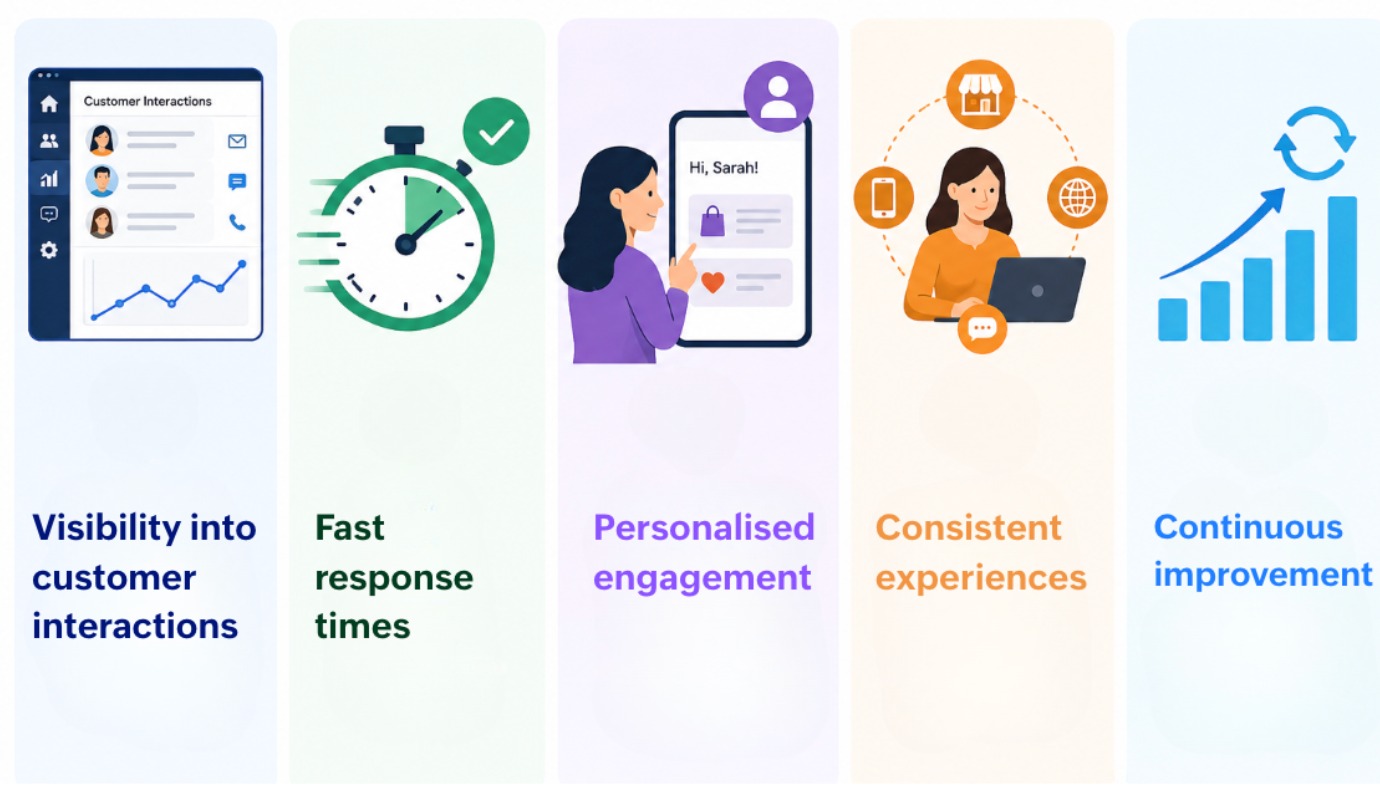
As businesses grow, maintaining these standards becomes increasingly difficult when teams work in silos. Technology helps bridge those gaps without replacing the human relationships that build trust.
Building trust at scale with Zoho CRM Plus
Trust can take months or years to build and only moments to lose. Customers judge businesses by how they handle every interaction, from resolving issues quickly to delivering a seamless experience across channels. As businesses grow, delivering that consistency becomes harder when customer information is scattered across systems. Maintaining trust at scale requires every team to work from the same customer story.
This is where platforms such as Zoho CRM Plus become valuable. This platform brings customer-facing functions—including sales, marketing, customer support, analytics, social media engagement, and customer communication—into a unified platform. This gives businesses a complete view of the entire customer journey.
Instead of managing customer relationships across disconnected tools, teams can:
Respond to inquiries faster
Track conversations across multiple channels
Deliver personalised customer experiences
Resolve support issues efficiently
Keep every customer interaction aligned across departments
Understand the full customer journey from first interaction to repeat purchase
"Zoho CRM Plus offers endless possibilities to companies of every size to automate every single process involved in marketing, sales, and customer experience. It has enabled our clients to have a 360-degree view of their customers by integrating all the different touchpoints of the customer journey."
— Manolis Labovas, CEO and Co-Founder, Repath
Trust is the new competitive advantage
Across Africa's rapidly evolving retail landscape, sustainable growth is becoming less about attracting more customers and more about keeping the customers you already have. The businesses that thrive will be the businesses that deliver reliable, personalised, and connected customer experiences every time.
Trust is built one interaction at a time. Succeed in scaling that trust, and growth follows.
FAQs
1. Why is customer trust important for SMEs?
Trust helps businesses increase customer loyalty, repeat purchases, and referrals.
2. How can SMEs build customer trust?
By providing fast responses, consistent communication, personalized experiences, and reliable support.
3. How does Zoho CRM Plus help businesses understand customers better?
Zoho CRM Plus provides a 360° customer view, giving teams access to customer interactions across sales, marketing, and support.
4. Can Zoho CRM Plus help manage customer conversations across multiple channels?
Yes. Zoho CRM Plus brings customer interactions from email, phone, social media, live chat, and other channels into one platform.
5. How does Zoho CRM Plus improve collaboration between teams?
It enables sales, marketing, and support teams to work with shared customer information, helping them deliver more consistent customer experiences