What POPIA and NDPA really mean for growing African businesses
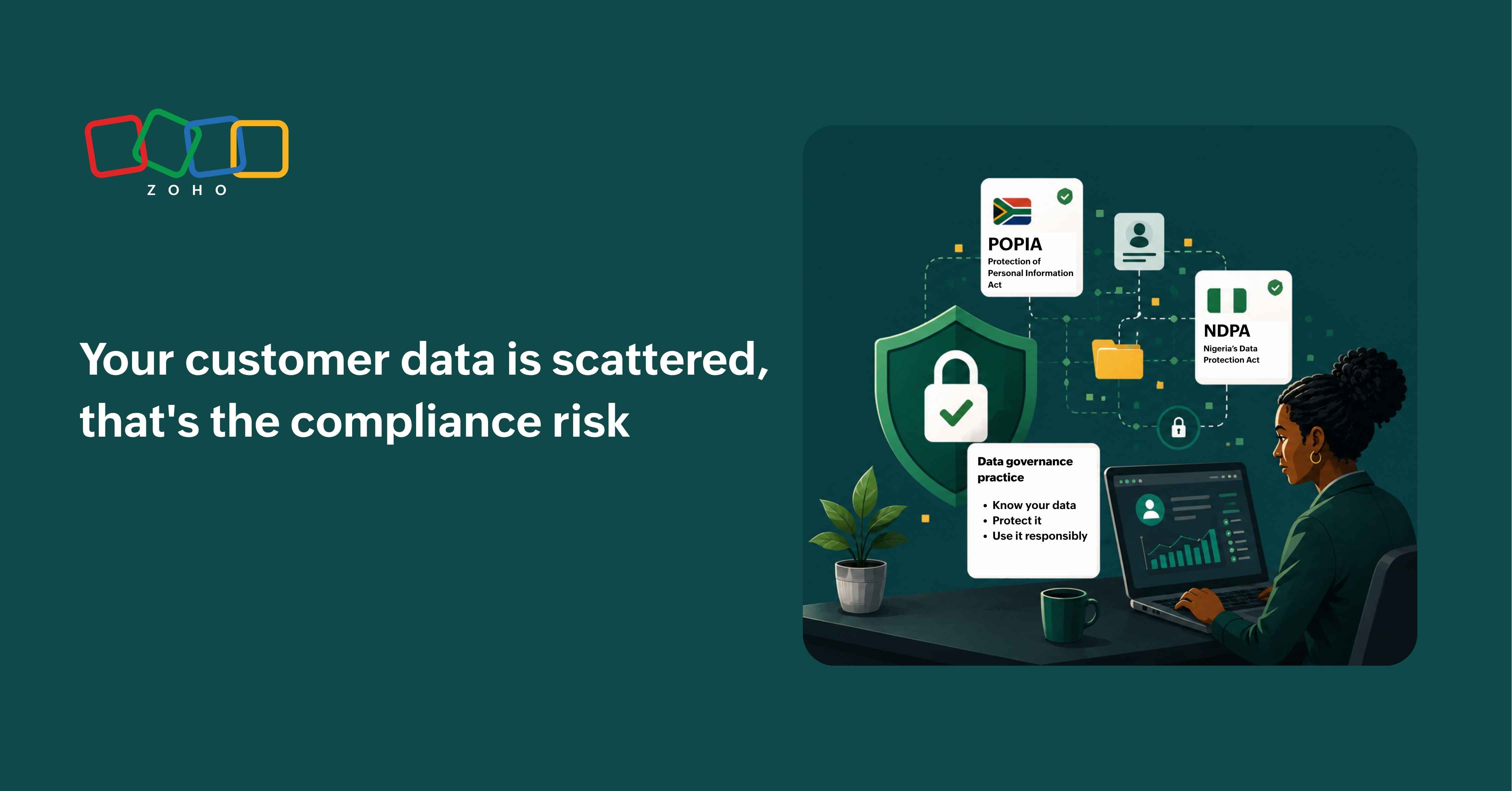
For many businesses today, the first customer interaction happens on a digital platform, whether through a website or a support request. As SaaS adoption grows, so do expectations around how organisations handle customer data. As a result, regulations such as South Africa’s Protection of Personal Information Act (POPIA) and Nigeria’s Data Protection Act (NDPA) are redefining how companies collect, store, and manage personal data.
Quick overview
- POPIA and NDPa share common principles but differ in their operational expectations.
- Compliance is less about legal paperwork and more about everyday data practices.
- Businesses that embed governance early often gain a trust advantage.
Why data privacy compliance is difficult for African businesses
Many African businesses struggle with compliance for a simple reason: they adopt digital tools faster than they build governance processes. Customer data quickly spreads across CRM systems, email platforms, support tools, and analytics software, often without clear visibility into where that data resides. Simultaneously, the regulatory environment is fragmented. Unlike regions with a single overarching privacy framework, Africa’s data privacy landscape is governed through national laws. South Africa enforces POPIA, while Nigeria regulates personal data through NDPA.
For service businesses, consultancies, and SaaS providers operating across markets, this raises an important question: which rules apply when customer data crosses borders?
A common misconception is that compliance only affects large enterprises. In reality, regulators are also likely to scrutinise smaller businesses where governance gaps are more likely to appear.
Understanding POPIA and NDPA
For a business owner, the main difference between these two laws comes down to where you are doing business and how much paperwork you have to file with the government each year.
Both laws aim to protect personally identifiable information (PII), including names, email addresses, ID numbers, and addresses. If you handle this data, you are legally responsible for keeping it safe.
Quick comparison for business owners
| Feature | South Africa (POPIA) | Nigeria (NDPA) |
| Who is protected? | People and companies | Only individual people |
| Who is in charge? | You must appoint an Information Officer. | You must appoint a Data Protection Officer. |
| The "middleman" | You handle compliance yourself or with a consultant. | You must use a licensed firm (DPCO) to file your audits. |
Things to know
1. The company factor
According to POPIA, personal information covers a wide range of data about individuals, including identification or contact details, biometric data, and demographic information. If you’re handling another company’s private data, such as contracts or bank details, in South Africa, you must protect it in accordance with the law. In Nigeria, however, privacy laws primarily protect the personal data of living individuals.
2. The annual audit
Nigeria’s NDPA is much stricter in its reporting requirements. If you handle a certain amount of data (usually over 1,000 or 2,000 people), you have to prove your compliance every year. You are required to hire a licensed third-party firm, known as a DPCO, to check your systems and file a report with the government.
3. Penalties for mistakes
Both countries take this seriously. If there is a data breach or if you ignore the rules:
- In South Africa, you could face fines up to R10 million or even jail time for severe negligence.
- In Nigeria, you could be fined 2% of your global gross revenue or N10 million, whichever is higher.
When both laws apply
Consider a Nigerian SaaS company selling services to South African customers.
- If they're storing Nigerian user data, NDPA applies.
- If they're storing South African customer data, POPIA applies.
A similar situation may occur when an ecommerce store in Lagos sells to customers in Cape Town or when a consulting firm serves clients across both markets. In such cases, the safest approach is to follow the stricter of the two requirements and design policies around shared compliance requirements, such as consent management, access controls, and breach reporting.
For example:
- Consent management: If your SaaS platform collects user data during signup, ensure the consent checkbox clearly explains how the data will be used and stored.
- Data access control: If customer data is stored in a CRM system, only authorised employees should be able to access it through role-based permissions.
- Breach response procedures: If a support database is exposed due to a misconfiguration, the company must investigate the breach and notify regulators and affected users in accordance with legal timelines.
Common compliance gaps in growing companies
Compliance failures rarely come from complex legal issues. They usually arise from basic operational gaps.
Frequent mistakes made include:
- No clear record of what personal data the business collects or where it is stored
- Employees accessing customer information without defined roles
- Vendor contracts missing privacy clauses
- Customer data scattered across multiple tools
If a business cannot clearly track where personal data is stored, who can access it, and how it is shared, compliance efforts are likely to fail.
The 3-control rule for SMEs
A practical starting point for many small and mid-sized businesses is the three-control rule.
- Identity control: Define who can access data.
- Data visibility: Know where data is stored.
- Vendor accountability: Ensure third parties follow security standards.
Building a practical compliance workflow
- Compliance does not necessarily require complex infrastructure. Often, the right workflows inside existing business tools are enough.
A simple implementation path
- Map where customer data enters your systems.
Define access roles across teams. - Enable audit logs for sensitive activity.
- Apply retention policies.
- Establish breach response procedures.
How cloud platforms can help
Many modern business platforms already include governance features that support privacy compliance.
For example:
- Zoho CRM can manage customer consent records and role-based access.
- Zoho Desk centralises support interactions while maintaining audit trails.
- Zoho WorkDrive enables controlled document sharing.
- Zoho Vaultprotects credentials and sensitive access.
For businesses operating in regulated environments, these features translate directly into trust. For example, Johan du Preez, Operations Executive at HTI, noted: “Privacy and security are critical for us. When our clients use our systems, their information must be secure and their privacy protected. With Zoho One, we found exactly that.”
As African businesses expand across markets, strong data governance becomes a business enabler. Organisations that treat privacy as an operational discipline are better positioned to build customer confidence, meet regulatory expectations, and scale sustainably.
- Ogundare Kehinde Seun, Regional Manager, Zoho - West Africa
Compliance as a competitive advantage
As Africa’s digital economy grows, stronger data governance is an important factor for customers and investors. Organisations that comply with regulations like POPIA and NDPA signal reliability and build credibility in the market. AI helps organisations stay compliant efficiently through AI-powered monitoring, such as anomaly detection for unusual data access. For example, an AI system might flag when an employee suddenly downloads thousands of customer records or when a user account logs in from an unfamiliar location. AI tools can also scan company databases and documents to identify PII, helping businesses understand where sensitive information is stored.
These AI capabilities support many of the operational requirements under POPIA and NDPA. According to industry research, organisations that use AI in their security and privacy programs experience breach costs that are nearly $1.9 million lower than those that do not.
The trust-led growth model
Privacy maturity enables faster enterprise partnerships, easier cross-border expansion, and higher customer confidence.
Compliance is not just part of risk management but a core tenet of business strategy.
Final takeaway
The companies that succeed with data privacy in Africa are not the ones with the most complex policies; they're the ones who turn privacy requirements into simple practices built into the tools their teams use every day.
FAQs
Does NDPA apply to small businesses?
Yes. If your company processes the personal data of Nigerian residents, NDPA requirements apply regardless of company size.
Does POPIA affect companies outside South Africa?
Yes. If you process the personal data of South African residents, POPIA may apply.
Do cloud providers guarantee compliance?
No. Cloud platforms provide secure infrastructure, but businesses remain responsible for how they configure and use their systems.
Do Zoho applications support POPIA and NDPA compliance?
Zoho applications are designed with privacy and security in mind, offering features such as access controls, audit logs, and consent management that support compliance with regulations like POPIA and NDPA. While these capabilities provide a strong foundation, compliance ultimately depends on how businesses configure and manage their data and processes.
Does using Zoho make a business fully compliant?
Zoho provides the foundation for compliance, but outcomes depend on how businesses configure and use these tools in their day-to-day processes.