
How risk-averse UAE businesses can move to the cloud without breaking compliance
Cloud migration has become one of the most important business decisions facing organisations across the UAE. Yet for many IT leaders, it still feels like a high-stakes bet.
What happens if systems go down during the move? What if employees can’t access the tools they need? What if customer data ends up in the wrong location, creating compliance issues?
These concerns are real, and they explain why many businesses delay migration even when they know their current systems are holding them back. The good news is that successful cloud migration isn’t about taking on more risk, but reducing it.
The UAE’s digital transformation ambitions show just how quickly expectations are changing. The UAE Digital Government Strategy 2025 aims for 100% end-to-end digitisation of government services and a 90% “very satisfied” rating among citizens and businesses using digital services. As digital experiences become the norm, businesses need technology that can keep pace while maintaining security and compliance. The safest cloud migrations don’t happen overnight. They happen through careful planning, phased implementation, and a cloud platform designed to support regulatory requirements from day one.
Why cloud migration feels risky
Cloud migration has earned a reputation for being complex. But in reality, the cloud itself is rarely the problem. The real challenge is protecting business continuity while modernising critical operations.
For many organisations in the UAE, even a brief outage can disrupt operations, affecting revenue, customer experience, and employee productivity. According to IBM, 70% of organisations that experienced a data breach reported moderate to significant operational disruption. At the same time, evolving data residency and privacy regulations require businesses to maintain clear visibility into where their data is stored and processed.
That’s why IT leaders often ask questions such as:
Will our business experience downtime?
Will employees be able to continue working?
Will customer services remain available?
Will we still meet compliance requirements?
Where will our business data be stored?
These are important questions that deserve clear answers. The organisations that migrate successfully don’t treat cloud adoption as one massive project. Instead, they break the journey into manageable stages. Each phase builds confidence for the next step.
A five-step cloud migration roadmap
Instead of trying to modernise everything at once, successful organisations reduce risk by moving through phases.
Step 1: Review your existing systems
Every successful migration begins with visibility. Before moving anything, take a complete inventory of your technology environment.
Ask yourself:
Which applications does the business rely on every day?
Which systems are business-critical?
What data is sensitive or regulated?
This assessment creates a clear roadmap and helps avoid surprises later. When organisations move from on-premise to cloud, understanding what they have today is often the most important first step.
Step 2: Start with low-risk applications
Many businesses make the mistake of starting with their most important systems. A safer approach is to start small.
Consider migrating:
Internal documents
File storage systems
Team collaboration tools
Development and testing environments
These applications allow IT teams to test migration processes in a lower-risk environment. A phased cloud migration approach helps teams identify issues early, refine workflows, and gain practical experience before moving customer-facing systems.
Step 3: Choose the right migration method
Once you’ve decided what to move, the next decision is how to move it. Not every application requires the same migration strategy.
Some systems can be transferred with minimal changes through a lift-and-shift approach. Others benefit from re-platforming, which involves modernising parts of the application to improve performance, scalability, and long-term efficiency. When evaluating lift-and-shift vs re-platforming, the goal isn’t to choose one method for everything. The goal is to choose the right method for each workload.
Making the right decision early helps businesses avoid unnecessary costs, delays, and future rework.
Step 4: Move business-critical applications
By this stage, the migration process has already been tested and refined. Now it’s time to move the systems that drive day-to-day operations, including:
CRM platforms
Finance systems
HR applications
Customer support tools
These applications often contain sensitive business information and require careful planning.
For many Gulf organisations, data residency in the UAE is a critical consideration during this phase. Hosting applications on local infrastructure can help businesses meet regulatory requirements while maintaining reliable access to essential services. The combination of proven migration processes and local hosting significantly reduces operational risk.
Step 5: Optimise and grow
Migration is not the finish line. In many ways, it’s just the beginning. Once systems are running successfully in the cloud, businesses can focus on creating long-term value by:
Eliminating duplicate software
Improving application performance
Strengthening security
Reducing IT costs
Supporting future growth
This is where cloud cost optimisation becomes important.
Rather than treating migration as a one-time IT initiative, organisations don't just gain a migration to a better performing platform, but also a system that gets better quarter on quarter.
Why local hosting makes cloud migration easier
Even with a well-planned migration strategy, one concern often remains:
Where will our data live?
For organisations operating in the UAE, data residency isn’t simply a technical requirement. It’s a business requirement. Knowing that data remains within approved jurisdictions helps reduce compliance concerns and gives stakeholders greater confidence in cloud adoption.
This is where a local-first cloud strategy matters most.
With Zoho One, businesses can run integrated business and IT applications from data centres located in Dubai and Abu Dhabi. Instead of managing multiple cloud vendors and disconnected systems, organisations can operate from a unified platform while keeping data closer to their operations.
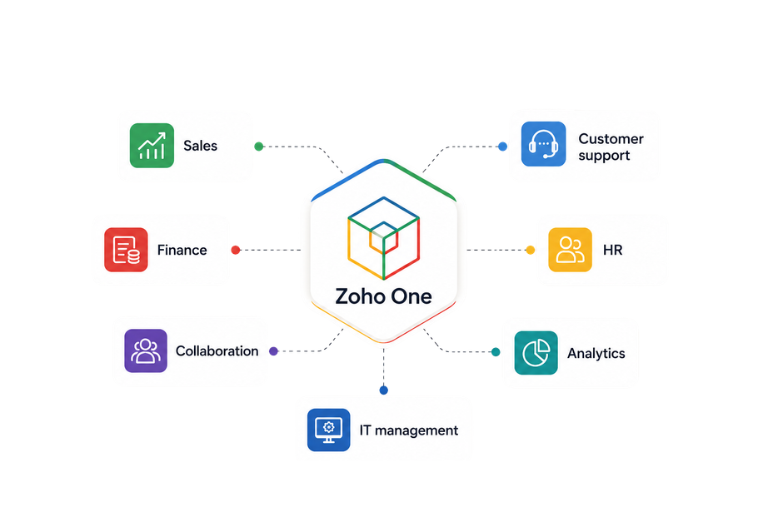
Local hosting also simplifies management. Rather than stitching together separate tools across departments, businesses gain a unified platform that supports sales, finance, HR, customer service, analytics, and operations..
Speaking at the press conference, Hyther Nizam, President – Middle East and Africa, Zoho Corp, said:
“Our growth in the UAE reflects the growing confidence of local businesses in Zoho’s solutions. These new data centres will further strengthen our ability to support customers with secure, high-performance cloud services and contribute meaningfully to the UAE’s digital economy.”
Beyond migration: Simplify the entire business
Many organisations start their cloud journey by moving a few applications. Over time, different departments adopt different software solutions. Before long, the business ends up with disconnected systems, duplicate data, and increased complexity. Migration presents an opportunity to avoid that outcome.
Instead of replacing on-premises software with multiple standalone cloud applications, businesses can simplify operations through an integrated platform.
Zoho One brings together sales, marketing, HR, operation into one singles roof.
With everything connected, employees spend less time switching between systems and more time delivering value. The results can be transformative.
“Before implementing Zoho One, we were just about less than 50 employees; now we are more than 250 employees. Zoho One has helped us to get new customers and retain them through the automations.”
— Salman Sulthan, Product Manager, Battmobile
Cloud migration checklist
Before you begin your migration journey, make sure you:
✔ List all business applications
✔ Identify sensitive and regulated data
✔ Confirm data residency requirements
✔ Start with a low-risk workload
✔ Choose the right migration approach
✔ Select a provider with UAE
✔ Test thoroughly before moving critical systems
✔ Migrate business-critical applications in phases
✔ Review software usage and optimise costs
What a safe migration looks like
By following a phased approach, Gulf businesses can minimise disruption, protect compliance, and modernise with confidence. When that strategy is supported by locally hosted infrastructure and an integrated platform like Zoho One, organisations gain more than a successful migration; they create a stronger foundation for future growth.