Scaling your business is not all about hiring more people
- Last Updated : February 9, 2026
- 230 Views
- 3 Min Read


When a small business starts to grow, the first pressure point is always the same. More enquiries come in, customers ask for support and more invoices go out. The workload increases, and the most common response is to hire more people.
It feels logical. More work means more hands. But this thinking is what gets many small and medium businesses stuck. They grow in size, but not in profitability. Costs go up faster than revenue. Teams feel busy all the time, yet progress slows down.
True scaling does not come from adding people. It comes from fixing how work moves through your business.
Growth exposes how your business really runs
In the early days, manually entering leads, sending follow-up emails, and updating customer records in spreadsheets feels easy enough to manage. You might know every customer by name, so data gaps don't affect sales or service too much.
As the business grows, this type of system starts to crack while information ends up collecting in different places.
- Sales tracks leads in one tool
- Finance manages invoices in another
- Support handles tickets somewhere else
None of these systems talk to each other. People chase updates instead of doing real work. Growth does not create these problems: It reveals them. Hiring more people at this stage only hides the issue for a while.
Why hiring feels like the easy answer
Hiring gives instant relief. Tasks move off your plate. Response time improves for a short period. It feels like progress. But every new hire also adds complexity.
More people means more complexity:
- More handovers
- More internal communication
- More chances for errors
- More dependency on individuals
If your processes are unclear or manual, new hires need time to learn them. They ask questions. They wait for access. They rely on others to move work forward. Instead of speeding things up, work slows down again.
Broken processes do not scale
If a task is manual today, it becomes a bottleneck tomorrow.
For example, if a sales lead requires:
- Manual entry into a CRM
- Manual follow up emails
- Manual handover to finance
That process might work for ten leads a week, but it struggles at fifty and breaks at a hundred. Hiring someone to manage the load treats the symptom, not the cause. The better question is simple. Why does this task need to be manual at all?
Scaling is about increasing capacity, not headcount
Scaling means your business can handle more work without adding the same level of effort and expense.
This happens when:
- Data moves automatically between systems
- Repetitive tasks run in the background
- Teams work from the same source of truth
When systems are connected, one person can do the work of three. Not because they work harder, but because the system does the heavy lifting. That is real growth.
Productivity beats size every time
A small team with clear processes will always outperform a larger team working in chaos.
When tools are integrated:
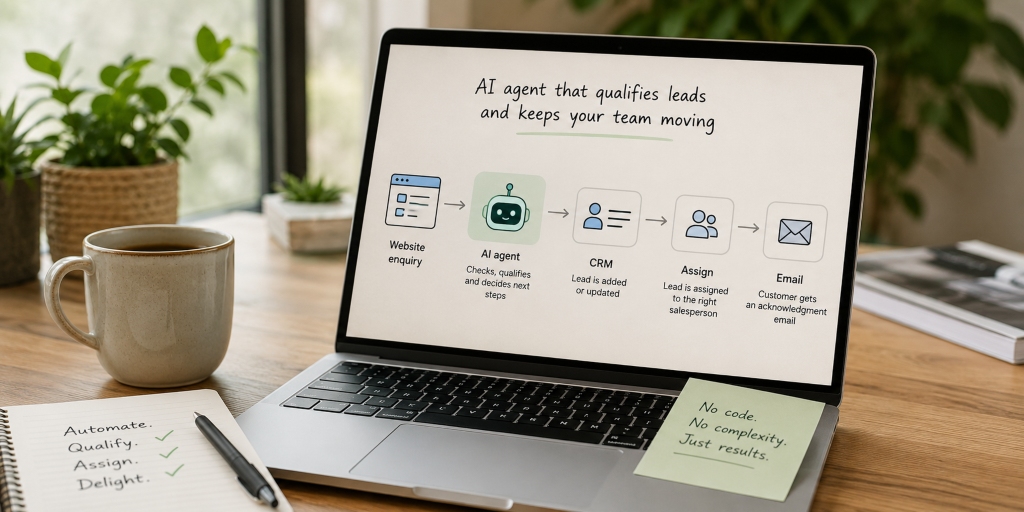
- Leads flow from the website to CRM without delay
- Quotes turn into invoices automatically
- Support teams see full customer history instantly
No one has to ask where information lives. No one wastes time re-entering data. Work moves forward without friction. This is why many high-growth SMBs stay lean even as revenue increases.
The hidden cost of hiring too early
Hiring is one of the biggest costs for a small business. Salary is only one part of it.
You also pay for:
- Onboarding time
- Training
- Management
- Mistakes made during learning
If your business relies on people to move information between tools, every new hire increases cost without improving speed or quality. This creates pressure. Margins shrink. Teams feel stretched. Growth becomes stressful instead of exciting.
When hiring actually makes sense
This does not mean hiring is bad. It means timing matters.
Hiring works when:
- Your processes are clear
- Your tools are connected
- Automation handles routine work
At this stage, new hires focus on value. They talk to customers. They solve problems. They help the business move forward. They are not stuck doing admin.
The mindset shift small businesses need
Scaling starts with better questions, not bigger teams.
Ask:
- Can this task run without manual input?
- Can these tools share data automatically?
- Can one platform replace multiple systems?
Once your systems support your work, hiring becomes a choice. Not a reaction.
Why this matters now
Today, even the smallest businesses run on software. Email, accounting, CRM, marketing, and support tools are all part of daily work. If these tools stay disconnected, growth becomes harder with every new customer. Businesses that scale well focus on flow, not headcount. They fix systems first instead of throwing more people at their problems. That is how growth stays controlled, sustainable, and profitable.