AI agents vs. chatbots: What's the difference and why it matters for businesses?
- Last Updated : July 30, 2026
- 90 Views
- 7 Min Read

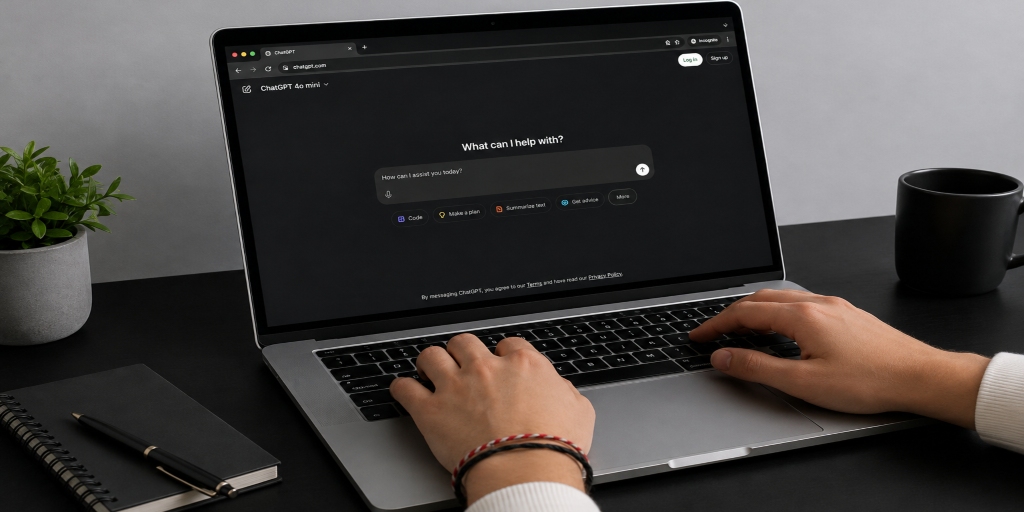
Not too long ago, using AI at work usually meant opening a chatbot, typing a question, and waiting for a response. Whether you needed help summarising a report, writing an email, brainstorming ideas, or explaining a complex topic, AI acted as a tool that responded to instructions. It was fast, often impressive, and could save a considerable amount of time. But once it generated an answer, the responsibility shifted straight back to the user. Someone still had to decide what to do next, carry out the task, and move the work forward.
Today, that picture is changing.
AI is no longer limited to answering questions or generating content when prompted. It is beginning to understand goals, work through a series of tasks, interact with business applications, and complete routine work with minimal human input. This new approach is changing the role AI plays in the workplace. Instead of simply helping people work faster, AI is starting to help businesses get work done.
This shift is why more businesses are talking about AI agents.
While chatbots introduced many organisations to artificial intelligence, AI agents are taking the next step. They're designed to move beyond conversations and into action, helping businesses automate repetitive processes, improve productivity, and free up employees to focus on more valuable work.
AI agent vs chatbot: Quick answer
A chatbot responds to questions and generates information based on user prompts. An AI agent goes further by planning, making decisions within defined rules, interacting with business systems, and completing multi-step tasks to achieve a goal.
What is an AI agent?
An AI agent is an artificial intelligence system that can work towards a goal rather than simply responding to a single prompt. Unlike a chatbot, which waits for instructions one question at a time, an AI agent can break a task into smaller steps, gather the information it needs, interact with different business applications, and complete actions within rules that have been defined by the business.
One simple way to understand the difference is to think about how you work with a colleague. If you ask someone for advice, they'll probably answer your question and leave the next steps to you. If you ask someone to take ownership of the task, they'll work through the process, complete what they can, and come back only when they need your input. That's the role AI agents are beginning to play.
This approach is often referred to as agentic AI, where AI is designed not only to generate responses but also to plan, reason, and complete multi-step workflows. If you'd like to learn more about the concept itself, we've covered it in detail in our article on agentic AI for business.
How AI agents are different from chatbots
Chatbots and AI agents are often mentioned together, but they solve different problems.
A chatbot is designed to answer questions, generate content, or provide information based on a prompt. It responds to each request independently and waits for the user to decide what happens next.
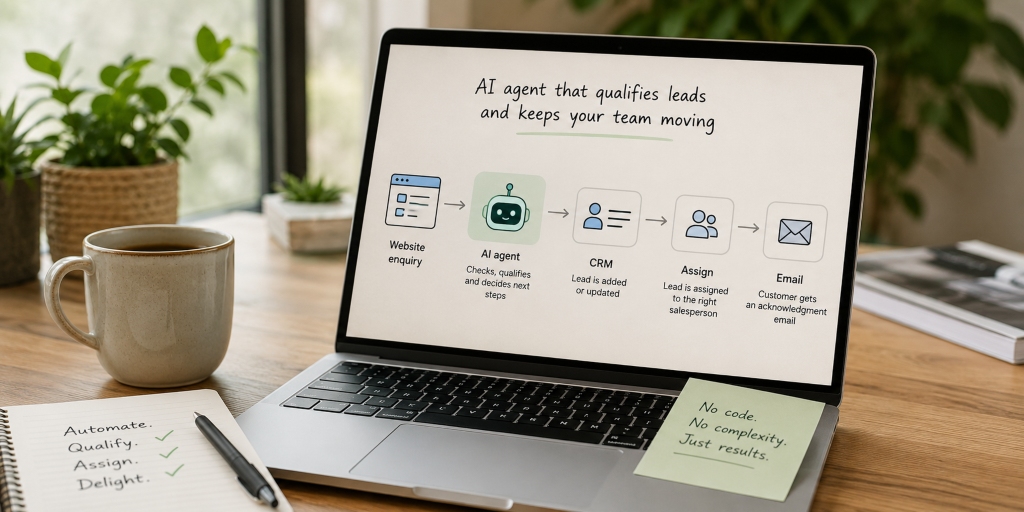
An AI agent, on the other hand, focuses on achieving an outcome. Rather than stopping after generating a response, it can continue working through the steps needed to complete the task. That might involve retrieving information from a CRM, updating records, sending emails, scheduling meetings, creating tasks, or notifying the right people along the way.
Imagine a salesperson wants to follow up with prospects who haven't responded to a proposal. Using a chatbot, they could ask AI to write a follow-up email. The chatbot would generate the message, but the salesperson would still need to identify the right customers, personalise each email, send them, update the CRM, and track responses.
An AI agent can take that process much further. It can identify customers who haven't responded within a certain time frame, review previous interactions, personalise the message using available information, send the follow-up automatically, update customer records, and notify the salesperson only when a prospect responds or requires personal attention.
The difference isn't that one is better than the other. They simply serve different purposes. Chatbots help people complete tasks, while AI agents help complete the process itself.
Why businesses are moving beyond chatbots
Generative AI has already transformed the way many businesses work. Marketing teams use it to create campaign content, sales teams draft customer emails, HR teams prepare job descriptions, and support teams build knowledge base articles. For many organisations, especially those with smaller teams, AI has become a valuable productivity tool that helps people get started faster and spend less time on repetitive writing.
However, creating content is only one part of the job. Writing a follow-up email doesn't mean the customer has been contacted. Summarising a report doesn't automatically update the leadership team. Creating meeting notes doesn't schedule the next meeting or assign the action items. There's often a long list of small administrative tasks that still need to happen after AI has produced its response.
That's where AI agents are creating new opportunities.
Instead of helping employees complete one task at a time, AI agents can connect those individual tasks into complete workflows. They reduce the manual effort involved in moving information between systems, chasing approvals, updating records, or following up on routine requests. The result isn't just faster work; it's less work that needs to be done manually in the first place.
For small and medium businesses across Australia and New Zealand, this can make a significant difference. Teams are often expected to achieve more with limited resources, and employees spend hours every week on work that, while necessary, doesn't directly contribute to serving customers or growing the business. Reducing that administrative workload allows people to focus on the areas where human judgement, creativity, and relationships matter most.
What AI agents look like in everyday business
Although AI agents sound like a major leap forward, many of their most practical applications involve the everyday work businesses already do.
In customer support, an AI agent can retrieve customer details, review previous interactions, recommend the most appropriate solution, update support records, and escalate more complex issues with the relevant context already attached. Customers receive quicker responses, while support teams spend more time solving complex problems instead of handling repetitive requests.
Sales teams can benefit in similar ways. Rather than simply reminding salespeople to contact prospects, AI agents can monitor customer activity, identify buying signals, recommend the best time to follow up, prepare personalised communications, and organise the next steps automatically. Sales representatives remain responsible for building relationships and closing deals, but they spend far less time managing administrative work behind the scenes.
AI agents are also proving valuable for internal operations. Preparing weekly reports, gathering data from multiple systems, organising calendars, updating records, or tracking project progress are all processes that follow predictable patterns. Instead of spending hours collecting information manually, managers can start their day with reports already prepared and insights ready to review.
These examples highlight an important point: AI agents aren't replacing people; they're reducing the repetitive work that often prevents people from focusing on higher-value activities.
AI still works best with people
As capable as AI has become, it isn't designed to replace human judgement.
AI can misunderstand instructions, make incorrect assumptions, or produce results that need to be reviewed. That's why businesses should think of AI as another member of the team rather than a replacement for one.
Like any employee, AI performs best when expectations are clear. It needs access to the right information, defined responsibilities, and sensible boundaries around what it can and can't do. Routine, structured work is often an excellent fit for AI, while decisions involving customers, finances, legal obligations, or business strategy still benefit from human oversight.
The businesses seeing the greatest value from AI are identifying repetitive processes where AI can save time while ensuring people remain responsible for reviewing important decisions. This balance allows organisations to improve efficiency without compromising quality, accountability, or customer experience.
The future of business AI
The conversation around AI is gradually shifting. Instead of asking whether businesses should use AI, the more useful question is how they should use it.
For many organisations, the biggest opportunities aren't found in dramatic transformations. They're found in the everyday tasks that consume hours each week. Following up leads, updating records, preparing reports, organising information, and managing routine customer requests may not be the most exciting parts of running a business, but they are exactly the kinds of activities AI is becoming increasingly capable of handling.
The move from chatbots to AI agents won't happen overnight, and it won't look the same for every business. Some organisations will begin by automating a handful of routine processes, while others will gradually introduce AI across multiple departments as their confidence grows. What's becoming increasingly clear, however, is that AI is moving beyond simply providing answers. It's becoming an active participant in the way work gets done.
Platforms like Zoho are already bringing these capabilities into everyday business applications through intelligent assistants, workflow automation, and AI agents that work across different systems. The goal is to reduce repetitive work, help teams make better use of their time, and allow businesses to focus more of their energy on serving customers and driving growth.
As AI continues to evolve, the businesses that start experimenting today will be better prepared for tomorrow. The technology is no longer just about finding answers faster; it's about helping businesses turn those answers into action.