

- HOME
- Ecommerce insights
- How do you know if customers love you?
How do you know if customers love you?
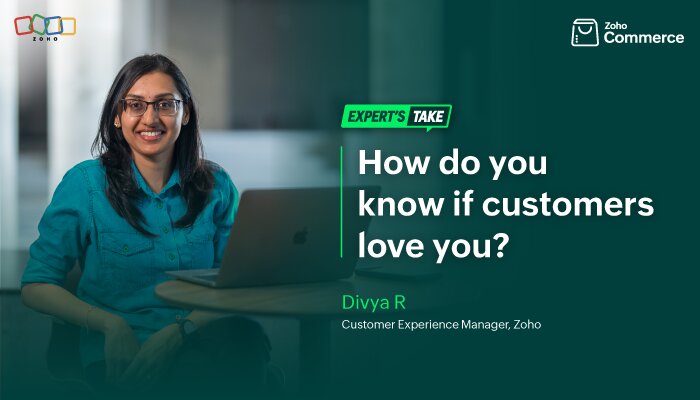
We are all obsessed with the metrics. Retention rates. Repeat purchases. Renewals. Referrals. Every quarter, every month, we're measuring everything, tracking conversions, and optimizing based on the numbers...
And yet, the most powerful indicator of customer love isn't hiding in any dashboard.
For a long time, we believed customer love was something you could quantify. But that belief shifted when we spoke to Divya Raghunathan, a Customer Experience Manager with 8 years of experience across support, community management, product marketing and customer advocacy. She reframed the way we think about customer love.
Her simple answer: "Customer love begins much earlier, in how you show up when they need you."
What customers actually remember
In ecommerce, we obsess over product improvements, integrations, performance metrics, etc. We ship constantly. We iterate relentlessly.
But here's what Divya has observed across her years of customer interactions: When customers talk about why they stay, they rarely talk about features.
"Customers don't remember features. They remember experiences," said Divya.
They remember how quickly someone responded. How patiently an issue was handled. How easy it felt to do business with you. How they were treated when something didn't go as planned.
Divya shared with us a moment that stayed with her.
A support call on Christmas Eve. A customer was in tears because a pending API limit issue was disrupting their business workflow, and he was afraid he might lose his job over it. It was almost midnight, so the developers weren't available for a permanent fix.
She stayed on the call. She calmed him down. She worked internally to get a temporary extension approved so the business wouldn't suffer through the holidays. When she finally told him it was done and sent it as an email so he could inform his manager with proof, she could hear the relief in his voice.
They didn't launch a feature that night. But they protected someone's peace of mind, and his holiday with his family.
"Customer love is built in moments of friction, not perfection," said Divya.
Retention is an outcome, not a tactic
Most brands treat retention like a strategy layered on later. Loyalty programs. Discount codes. Email sequences designed to keep people around.
But that's not how it works, according to Divya.
"Retention starts at first interaction," she explained. "In sales conversations, customers are evaluating your reliability more than your offering. In support interactions, they're evaluating your commitment. In content and marketing, they're evaluating whether you understand their reality. If those early experiences feel transactional, no retention campaign can undo them."
That changes the way we look at retention. Every touchpoint becomes the beginning of loyalty. You can't build it later; you build it from day one. Most companies are playing the retention game backwards.
Celebration builds stronger bonds than promotion
There's a pattern Divya has repeatedly noticed across the brands she's worked with: "Customers respond differently when you spotlight them instead of yourself."
She recalled a decision she made: Instead of posting another testimonial, she once chose to tell a small business owner's full story. She wrote about why he started, what he built, and what it meant to him, and turned it into a simple carousel post.
Later, she saw that post featured proudly on the About Us page of the customer's website.
That's when something clicked for her.
"When customers see that you genuinely care about their journey and not just their subscription or payment, the relationship changes. They don't feel marketed to; they feel acknowledged. And people stay where they feel seen."
Loyalty shows up in silent signals
Customer love isn't always visible in testimonials or reviews. Sometimes it's quieter than that.
A friendly reply to a routine email. A willingness to collaborate. A referral without being nudged. Forgiveness when things occasionally go wrong.
When Divya managed community discussions, she saw what real advocacy looks like. There were moments when frustrated users criticized the product in public forums. But sometimes, before she could even step in, other users defended it. They explained features, shared workarounds, and reassured the person raising concerns.
"We didn't ask them to do that. They simply chose to," Divya said. "These signals are leading indicators of trust. Businesses that pay attention to these subtler signals often build stronger long-term brands."
The evidence isn’t in the dashboard
"In a world focused on visibility, the businesses that endure are often the ones that make their customers feel visible. You don't have to ask if customers love you. You'll see it in how they show up for you," said Divya.
That's the whole thing. You'll see it in warm replies. In unprompted referrals. In moments of forgiveness. In the small ways they choose you, again and again.
Customer love isn't something you measure. It's something you earn. And you earn it by showing up.
