

- HOME
- Ecommerce insights
- When AI does the shopping for us
When AI does the shopping for us
We've all done it. The exhausting ritual of online shopping. Open app. Search. Scroll through dozens of results. Read reviews. Compare prices across three tabs. Check delivery times. Verify seller ratings. Fifty minutes later, you finally decide. It's functional, but it's tedious.
But what if that entire process could be delegated?
What if you could tell an AI, "Find me the best badminton racket under ₹5,000 for regular training," and it did all the legwork for you, checking stores, evaluating reviews, comparing prices, and return your top options in seconds?
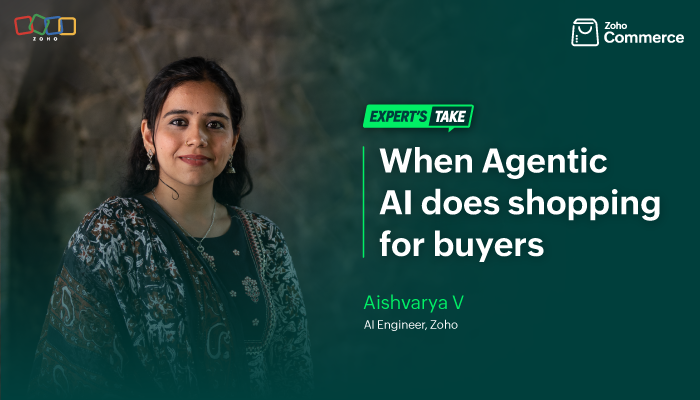
In this edition of Expert's Take, we sat down with Aishvarya, an AI engineer who builds intelligent AI agents, to explore how artificial intelligence is fundamentally transforming ecommerce. What struck me most wasn't the technology itself, it was how this shift reveals something important about what actually drives customer decisions, and what brands need to focus on to survive in a world where AI does the shopping.
From assistants to agents
AI has been on an exponential evolution curve. What started as simple helpers for tasks like drafting emails, summarizing meetings, and answering quick questions is rapidly becoming something far more autonomous. And that shift is accelerating.
According to Aishvarya, "We're moving into an era where AI doesn't just assist with decisions, it makes them. Planning a trip, managing your schedule, comparing complex options, these tasks require reasoning, research, and judgment. And AI is now capable of handling them with increasing sophistication."
Ecommerce is the natural next frontier. Why? Because shopping is fundamentally a series of decisions. What do I need? Where can I find it? What are my options? Which is best for me? These are precisely the kinds of questions AI agents are becoming equipped to answer, at scale, with speed and accuracy that exceeds human capability.
The hidden cost of shopping that we've stopped noticing
We've normalized the shopping routine so thoroughly that most people don't think about how much time it actually takes.
For the average person, this process takes considerable time with each purchase. Multiply that by the dozens of purchases we make annually, and you're looking at hours, possibly days of browsing, filtering, and comparing. Not because shopping is enjoyable, but because we've accepted that we have to do the work ourselves.
Aishvarya highlights a critical insight: "The human attention model for shopping is remarkably inefficient. We're optimized to search, filter, and compare manually. But given the choice, most people would rather spend that time on literally anything else. The question isn't whether AI will eventually do this for us, it's how quickly adoption will happen once the technology reliably works."
Agentic ecommerce: Beyond recommendations
Here's where things get interesting. Traditional recommendation systems suggest products. Agentic ecommerce is fundamentally different; it's about AI that actively participates in the entire buying journey.
Instead of you surfing the internet, an intelligent agent does it for you. The use cases are becoming remarkably clear.
Automatic replenishment: Your AI agent monitors your consumption patterns and automatically reorders essentials like groceries, toiletries, and household supplies before you even realize you're running low.
Real-time price intelligence: An agent continuously compares prices across different marketplaces, accounting for delivery timelines and seller reliability, not just lowest cost. It finds you the genuinely best deal.
Integrated trip planning: Planning a vacation? Your agent bundles everything together. It sources luggage that matches your travel style, suggests weather-appropriate clothing, and finds travel accessories, all before you're even thinking of searching for those things. The entire shopping experience becomes seamless and contextual.
Complete environmental curation: Setting up a home office? An AI agent designs a complete setup, desk, chair, lighting, cable management, ergonomic accessories, all selected based on your budget, workspace dimensions, and verified reviews.
In each scenario, the time we currently spend browsing, filtering, and deciding is replaced by simply delegating. We tell the agent what we need, it does the research, and we choose from its curated options.
How brands win when AI is the buyer
For ecommerce brands, agentic shopping represents a seismic shift in what success looks like. The methodology that worked for years, optimized for human attention, is becoming obsolete.
The old methodology:
Better ads - Capture eyeballs with compelling creatives that stand out in crowded feeds.
Better SEO - Rank higher. Appear first. Be the link someone clicks.
Better positioning - Show up frequently in feeds. Build familiarity through sheer visibility.
But when AI agents evaluate products on behalf of customers, the signals that matter shift dramatically.
Aishvarya explains: "When an AI agent is comparing options, it's not looking at what's prettiest or who has the biggest marketing budget. It's looking for signals of trust and reliability, clear, comprehensive product information, transparent pricing, consistent, authentic reviews from real customers, and strong, reliable fulfillment. These are the signals that matter to machines. And interestingly, they're the exact signals that should matter to humans too."
This is profound. For the first time in ecommerce history, brands can't simply win through clever marketing or visibility. They have to actually be good. They have to prove it consistently through quality, transparency, and reliable delivery.
What brands really need
Here's the insight that surprised me most in my conversation with Aishvarya: despite this technological revolution, the fundamentals of brand loyalty haven't changed.
Technology changes the mechanism; AI agents become the filter through which products are evaluated. But the reasons people (or their agents) connect with brands remain constant.
Good products: Products that work, last, and deliver on their promise. Not products that look good in marketing copy, but products that perform in real life.
Great experiences: Every touchpoint matters. Packaging. Unboxing. Customer support. Follow-up. The entire journey from consideration to usage is important.
Trust built over time: Brands don't win through one transaction; they win through consistency and doing what they promise, again and again.
AI agents might be better at identifying these qualities because they're immune to flashy branding or trendy aesthetics. They simply evaluate what works and what doesn't.
The inevitable transition
Agentic ecommerce isn't a distant scenario. It's already happening. Every month, AI systems get better at research, comparison, and decision-making. Every month, more people grow comfortable delegating their shopping decisions to intelligent systems.
For ecommerce brands, the transition is no longer theoretical, it's imminent. The question isn't will AI change how we shop. The question is how quickly can brands adapt to a world where visibility and marketing spend matter infinitely less, and product quality and reliability matter infinitely more.
Agentic ecommerce will change how we shop. But the brands that win will still be the ones people trust, whether a human or an AI agent is doing the choosing.
