

- HOME
- Ecommerce insights
- What happens when ecommerce brands take customer trust for granted
What happens when ecommerce brands take customer trust for granted
The barriers to launching an ecommerce brand have nearly vanished. Dropshipping, print-on-demand, marketplace platforms, there are a myriad number of tools, waiting to help us. All you need is an internet connection and a product idea. So why do so many online businesses fail quietly even when they have traffic, marketing budgets, and the infrastructure to succeed?
The answer might surprise you. It's not a technology problem or a marketing problem. It's a trust problem.
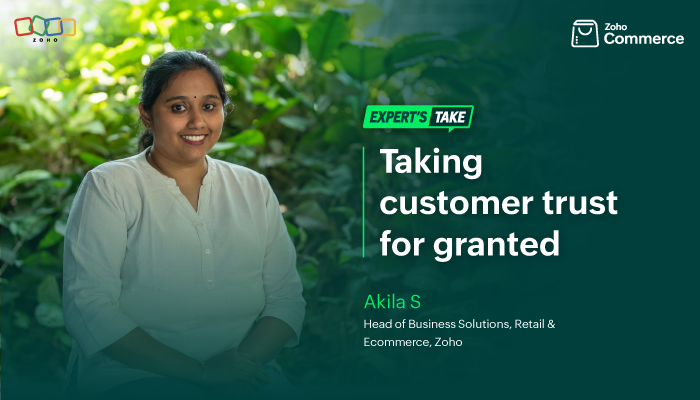
In this edition of Expert's Take we sat down with Akila Sundaresan, Head of Business Solutions for Retail & Ecommerce, to explore a paradox that defines the modern economy. In a world where launching an online brand is easier than ever, the relationship between buyer and seller has become more fragile. The businesses that are suffering or failing are often the ones taking their customers' trust completely for granted.
The false comfort of steady traffic
Here's where many ecommerce businesses stumble. They launch, they optimize, and they finally achieve a steady flow of traffic. The metrics look good. Then, in the pursuit of scaling margins, they make a decision that seeds their downfall, they compromise on product quality.
According to Akila, "Many businesses operate under the assumption that their brand name alone will carry them through. They think that because they've built an audience, they can afford to be less rigorous about the product. That's a dangerous misunderstanding of how digital reputation works."
The risk here is asymmetrical. In the physical retail world, a bad product might disappoint a handful of customers and that stays within the store. But in ecommerce, one defective batch, one wave of poor-quality shipments, can trigger a viral cascade of negative reviews across social media and review platforms. No amount of marketing spend can outrun that velocity of negative word-of-mouth.
The businesses that thrive understand this. Steady traffic is not a license to cut corners. It's a responsibility to maintain, and continually improve, the quality that earned that traffic in the first place.
When support systems become walls
When a customer receives a damaged product. They reach out to support. They get an automated response. They reply again. They're directed to a help article that doesn't address their issue. They try once more and hit a dead end.
At that moment, a transaction fails, a cart is abandoned. But more importantly, trust shatters.
Akila emphasizes, "The expectation in ecommerce used to be that customers would tolerate poor support because of lower prices or convenience. That era is over. Customers now expect responsive, personalized support, and when they don't get it, they assume the company doesn't care. Taking for granted that a customer will 'just deal with it' is a fatal miscalculation."
Many online businesses are becoming thin on customer support, not realizing that a single bad support interaction can erase the goodwill built by months of quality products and great marketing. Support isn't a back-office function, it's the final, most critical touchpoint in the customer journey. It's where trust is either reinforced or destroyed.
The one-and-done illusion
Many struggling ecommerce businesses operate under a silent assumption. There are always more customers in the ecommerce sea. They optimize for new customer acquisition, spend aggressively on ads, and then move on to the next prospect once a purchase is made.
This one-and-done philosophy is mathematically unsustainable. Why? Because customer acquisition costs are rising and, most importantly, they're rising fast.
Akila notes, "With rising customer acquisition costs (CAC), no business can survive long-term by ignoring repeat customers. The economics just don't work. A business that focuses only on acquiring new customers, while failing to retain existing ones, is essentially trying to fill a bucket with a hole in the bottom. Sooner or later, you run out of new customers, and the bucket is empty."
Businesses that are quietly growing are the ones who understand that a second purchase from an existing customer is exponentially more valuable than a first purchase from a stranger. And that second purchase only happens if the first interaction honored the customer's trust.
The amplification effect
There's a considerable difference between disappointing a customer in a physical store and disappointing one online. In the physical store, that disappointed customer might tell ten friends. They might post a negative review somewhere. But the damage is localized, manageable.
Online? A disappointed customer tells thousands of strangers.
They post on Twitter. They leave a one-star review on Google. They film an unboxing video showing the defect. They comment on the brand's Instagram post. The negative experience doesn't disappear, it becomes indexed, searchable, and permanent.
This is the dark side of ecommerce's reach and accessibility. The same digital infrastructure that allows a small brand to reach millions also allows a single disappointed customer to broadcast their disappointment to millions, at once. Businesses that don't account for this amplification effect often find that one viral complaint destroys months of positive brand-building.
The double-edged sword of unlimited reach
The modern ecommerce landscape presents a conflict that Akila articulates clearly.
"The internet gives you unlimited reach, but it also gives your customers unlimited alternatives. In a world where anyone can shop anywhere, taking trust for granted is not just poor business, it's existential risk."
Many struggling businesses have all the signs of success, sophisticated tools, marketing budgets, engagement metrics, but beneath the surface, they've lost the one thing that truly matters, the confidence that when customers buy from them, they're making the right choice.
The result? A slow, quiet fade. Traffic doesn't disappear overnight. Revenue doesn't evaporate in a week, but repeat purchase rates decline. Customer lifetime value shrinks. Eventually, even the surge in new customers can't sustain the business.
Trust you don't take for granted
In an era where technology is commoditized and marketing budgets are competitive, the one thing that remains scarce is genuine customer trust. It's not built through flashy campaigns or clever algorithms. It's built through consistency, quality, responsiveness, and respect.
The ecommerce businesses that are truly thriving, the ones crushing their competitors, are the ones who treat customer trust as their most valuable asset. They properly equip their customer support teams so every support ticket is treated with importance. They measure success not just by new customer acquisition but by the percentage of customers who return too.
Because in a digital world where everything is clickable, searchable, and comparable, the only thing that can't be easily replaced is a customer who trusts you enough to come back.
