- HOME
- Email Marketing
- Email marketing best practices to boost open rates, clicks, and conversions (2026)
Email marketing best practices to boost open rates, clicks, and conversions (2026)
- Last Updated : June 12, 2026
- 351 Views
- 8 Min Read

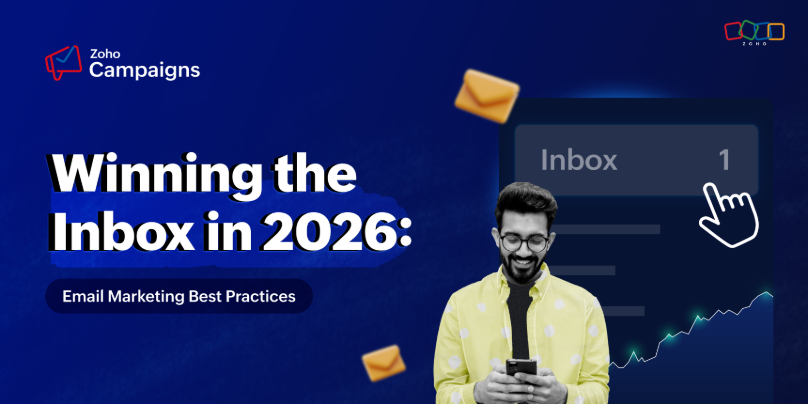
The inbox has never been more competitive. With 392.5 billion emails sent every day in 2026, simply landing in the inbox isn't enough anymore. To stand out, brands must rely on evolving email marketing best practices that help boost open rates and increase email conversions in 2026—not just reach the inbox.
The real challenge now is cutting through—that is, getting noticed, opened, and acted on before your message is buried, summarized, or filtered out by AI-driven inboxes. What makes this shift even more critical is the upside: Despite the rise of social media, email continues to deliver some of the highest returns in digital marketing, generating $36 to $42 for every $1 spent—which means when your emails underperform, it's not just a missed opportunity; it's lost revenue.
A few fundamental shifts are reshaping email marketing. Providers like Gmail, Yahoo, and Microsoft have tightened authentication requirements, making deliverability more demanding than ever. At the same time, AI-powered filters are actively deciding which emails get visibility and which don't—often before a human even looks. And on the receiving end, expectations have evolved. Personalization today isn't about using a first name; it's about sending something that feels relevant in the moment.
In this article, we'll break down seven proven email marketing best practices to help you improve open rates and drive conversions.
TL;DR: 7 email marketing best practices for 2026
Authenticate your domain with SPF, DKIM, and DMARC; this is now mandatory for inbox delivery.
Add BIMI to display your verified brand logo and boost consumer confidence by 90%.
Use the curiosity-urgency-value framework for subject lines, then A/B test every send.
Apply email segmentation strategies beyond demographics; behavioral and lifecycle data drives 30% more opens.
Personalize dynamically; swap entire content blocks based on behavior, not just first-name tokens.
Automate the four essential flows (welcome, abandonment, re-engagement, and post-purchase) to generate 41% in revenue.
Practice email list hygiene quarterly; lists decay by 22% to 23% annually and outdated lists kill deliverability.
1. Email authentication: The non-negotiable foundation
Before you write a single subject line or create a banner, your sending infrastructure needs to be airtight. Since early 2024, Google and Yahoo have required bulk senders to authenticate their domains. Microsoft followed in May 2025.
SPF, DKIM, and DMARC
These three protocols form the trust layer of modern email deliverability:
Sender Policy Framework (SPF) - Tells receiving servers which IP addresses are authorized to send emails from your domain.
DomainKeys Identified Mail (DKIM) - Adds a cryptographic signature to every email to prove it wasn't tampered with in transit.
DMARC - Instructs receiving servers on what to do when SPF or DKIM fails (monitor, quarantine, or reject). A DMARC policy at the enforcement level is a prerequisite for BIMI.
Without authentication, emails go to spam regardless of content quality
Zoho Campaigns simplifies domain authentication with guided SPF, DKIM, and DMARC setup—helping you strengthen deliverability and ensure your emails are trusted from the moment they're sent.
2. BIMI: Boost open rates with your brand logo in the inbox
Brand indicators for message identification (BIMI) display your verified brand logo next to authenticated emails in Gmail, Yahoo, and Apple Mail. Research shows BIMI-verified senders see 4% to 6% higher open rates and a 90% increase in consumer confidence.
Three-step BIMI quick-start:
Step 1: Set DMARC to enforcement level (p=quarantine or p=reject).
Step 2: Prepare your logo as an SVG file (Tiny PS specification).
Step 3: Publish a BIMI DNS TXT record pointing to your hosted SVG logo.
Zoho Campaigns' domain settings make BIMI readiness achievable.
3. Subject lines that earn opens
Your subject line matters and this isn't up for debate. The most effective subject lines in 2026 follow three proven patterns:
The curiosity-urgency-value framework
Curiosity: Withhold just enough to make the reader want to know more. ("What we found after analyzing 1M sends")
Urgency: Create genuine time-limited value. ("Final six hours: Your exclusive offer expires soon")
Value: State the benefit clearly and immediately. ("5 templates to cut your email creation time in half")
Before vs. after: Five subject line transformations
# | Before (Weak) | After (Strong) |
1 | Newsletter #47 | The inbox trick that doubled our reply rate |
2 | Check out our new features | 3 new features saving our users 5+ hours/week |
3 | Special offer inside | Your exclusive offer expires in 6 hours |
4 | Thank you for signing up | Your journey starts now; here's what to do next |
5 | Monthly update from us | What we learned after sending 1M emails this year |
The rule: Test one variable at a time, use a minimum of 1,000 recipients per variant, and only declare a winner at 95% statistical confidence.
Zoho Campaigns' A/B testing enables you to optimize email performance by testing variations of subject lines, sender details, or content on a subset of your audience.
4. Advanced email segmentation strategies
Segmented campaigns generate 30% more opens and 50% more click-throughs than unsegmented sends. Yet most teams still segment by little more than geography or acquisition source. In 2026, the highest-performing senders use behavioral and lifecycle segmentation.
Behavioral segmentation
Segment your list based on what subscribers actually do, not just by who they are:
Email engagement level (active openers vs. 90-day inactives)
Purchase history and product category affinity
Website activity (visited pricing page, viewed specific products)
Cart or lead abandonment triggers
Lifecycle stage segmentation
Map your messaging to where each contact sits in their journey:
New subscriber: Prioritize value delivery and trust-building over selling.
Active customer: Cross-sell, upsell, and gather zero-party data.
At-risk: Trigger re-engagement campaigns before they fully churn.
Churned: Send win-back offers with clear value.
Zoho CRM deal stages map directly to email segments in Zoho Campaigns. Show how a lead in the "Demo Scheduled" segment gets a different email than one in the "Closed Won" segment.
B2B vs. B2C segmentation strategies
B2B segmentation works best when built around firmographic and pipeline data like company size, industry vertical, job title, and CRM deal stage. In contrast B2C segmentation relies on behavioral RFM signals like how recently a customer purchased, how often, and how much they spend.
5. Personalization at scale
Personalization no longer means just inserting a first name; in 2026, it means dynamically changing entire sections of an email based on each recipient's behavior, preferences, and history.
Dynamic content blocks
Instead of sending one email to your entire list, use dynamic content blocks to serve different content to different segments within the same campaign. A retail brand might show winter apparel to cold-weather subscribers and summer collections to warm-climate recipients—same campaign, radically different relevance.
Use dynamic content in Zoho Campaigns to automatically tailor your email templates to each contact's data—and save time while boosting relevance and conversions.
Predictive send-time optimization
Generic advice suggests sending on Tuesdays at 10 AM. But your best send time depends entirely on when your specific audience opens emails. Predictive send-time optimization uses individual contact behavior—including timezone, past open times, and engagement patterns—to deliver each email at the optimal moment per recipient, not per time zone.
With Zoho Campaigns, you can send emails at your recipient's optimal open time.
6. Automated flows that increase email conversions in 2026
Email automation workflows yield one of the highest-ROI investments in email marketing, consistently outperforming one-off campaigns by delivering timely, relevant messages that drive engagement and repeat purchases. These are the four essential flows every sender needs:
Welcome series (three to five emails): Send the first email within five minutes of signup, followed by a sequence of value delivery, social proof, and a soft call-to-action.
Cart/lead abandonment: Trigger after one hour, 24 hours, and 72 hours. Feature the specific product or offer with a single, friction-free CTA.
Re-engagement flow: Target subscribers who have been inactive for 60 to 90 days. with the goal to enable them to purchase.
Post-purchase sequence: A well-structured post-purchase sequence—starting with a thank-you email, followed by usage tips, a review request, and a cross-sell recommendation—can transform one-time buyers into loyal, repeat customers.
Zoho Campaigns' visual automation builder lets you chain these flows using a drag-and-drop editor, with branching logic based on open, click, and CRM data.
7. List health and deliverability hygiene
Your sender reputation is your most valuable email asset—and it's fragile. Email lists decay by 22 to 23% annually through unsubscribes, job changes, and contact inactivity. Without regular hygiene and strong email deliverability best practices, you're steadily eroding deliverability and inflating costs.
The quarterly list-cleaning protocol
Remove hard bounces immediately after every campaign send.
Move contacts with no email engagement in over six months to a re-engagement flow first, then remove them from the list if unresponsive.
Use double opt-in for new subscribers.
Keep your bounce rate below 2% to protect sender reputation scores.
Monitor blacklists and check your domain's sender score quarterly.
Follow the 80/20 content rule: 80% of your sends should deliver genuine value (insights, education, practical tips), while 20% can be promotional. The average unsubscribe rate sits at 0.1–0.3% per campaign; anything above 0.5% is a signal to audit your content or segmentation immediately.
Zoho Campaigns helps maintain list hygiene with automated bounce handling, suppression of invalid or unsubscribed contacts, and double opt-in for verified signups.
Quick-start checklist: Where to begin
These practices don't need to be implemented all at once. Here's a tiered action plan:
This week (quick wins)
Set up SPF, DKIM, and DMARC for your sending domain.
Clean your list; remove hard bounces and suppress contacts who have been inactive for six months.
A/B test your next subject line (curiosity vs. value format).
This month (medium effort)
Build three behavioral segments: active openers, 90-day inactives, and recent purchasers.
Create a three-email welcome automation for new subscribers.
Audit every template for mobile rendering and dark mode compatibility.
This quarter (strategic investment)
Implement BIMI with a verified logo VMC certificate.
Launch a zero-party data preference center to collect subscriber interests.
Build the complete automation suite: abandonment, re-engagement, and post-purchase flows.
Start putting these email marketing best practices to work with Zoho Campaigns
Frequently asked questions
What is a good email open rate in 2026?
Average open rates range from 19% to 43%, depending on the measurement source and industry. Apple Mail Privacy Protection inflates open rates by auto-marking emails as opened. A more reliable engagement metric is click-through rate, which averages 2% to 5% across industries. Use your specific industry benchmark as a baseline and focus on consistent improvement.
How often should I clean my email list?
Every three to six months. Remove hard bounces immediately after each send, suppress contacts who are inactive for over six months, and use double opt-in for new subscribers. Email lists decay by 22% to 23% annually; regular hygiene directly protects deliverability and sender reputation.
What is the best time to send marketing emails?
There's no universal answer. Use your ESP's send-time optimization feature and A/B test different slots with your specific list. Mid-week (Tuesday through Thursday) during business hours is a common starting point, but individual audience behavior always outperforms generic benchmarks.
What is BIMI and does it improve open rates?
Brand indicators for message identification (BIMI) display your verified brand logo next to authenticated emails in Gmail, Yahoo, and Apple Mail. Studies indicate BIMI-verified senders see 4% to 6% higher open rates and a 90% lift in consumer confidence. Full DMARC enforcement is required as a prerequisite.
How do automated email flows compare to manual campaigns?
Automated flows generate approximately 41% of total email revenue while representing only 5.3% of total sends. Revenue per recipient is nearly 18x higher for flows than for manually sent campaigns, making automation the single highest-ROI activity in email marketing.
How do I increase email conversion rates?
Combine segmentation (relevant content to the right audience), A/B-tested subject lines (proven to lift conversions by up to 37%), one clear CTA per email, and automated follow-up flows (63% of non-immediate conversions come from follow-up sequences). Mobile optimization and fast load times remove friction from the conversion path.