What AI agents actually need: A unified data and semantic layer

This is part 2 of the 4-part series on Agentic Data Infrastructure.
Inpart 1, we covered why agents struggle when they pull data directly from source systems. This post is about what the right data architecture actually looks like: a unified data layer paired with a semantic layer. Together, these two layers give agents something they can't get from direct API access. A single, consistent, well-defined view of your business data.
The Unified Data Layer
Instead of every agent independently connecting to every source system, you bring data into one store. Agents query that store. The value comes from what happens during unification. You're not just dumping data from 10 apps into one database. You're resolving conflicts between systems, deduplicating records, defining relationships, and creating a version of the data that represents the actual state of your business.
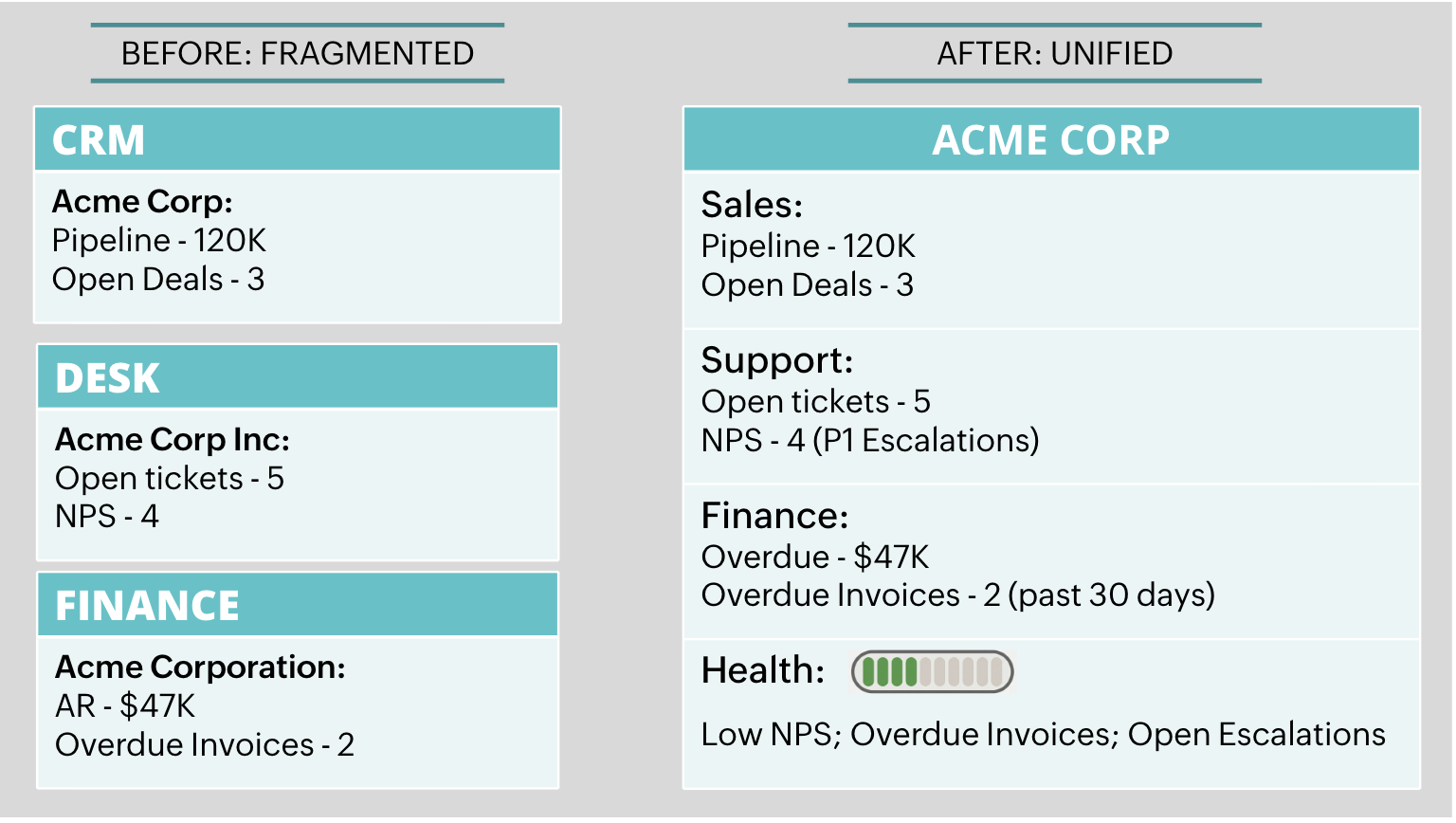
With unified data, an agent answering "How is Customer X doing?" queries one record with the complete picture. It spends its token budget on reasoning, not data wrangling.
But unified data alone isn't enough. Agents take data at face value. They don't bring context the way a human analyst does. They need business meaning encoded explicitly.
The Semantic Layer
Raw data, even unified raw data, isn't agent-ready. Consider a table called Deals with a column called Amount. What does that number represent? Total contract value? Annual recurring revenue? A single transaction? Is it in USD or local currency? Does it include discounts?
A human analyst learns these things over time. An AI agent needs the meaning encoded explicitly. A semantic layer sits on top of your unified data and adds a vocabulary of business concepts. Definitions, relationships, calculations, and context that make data interpretable.
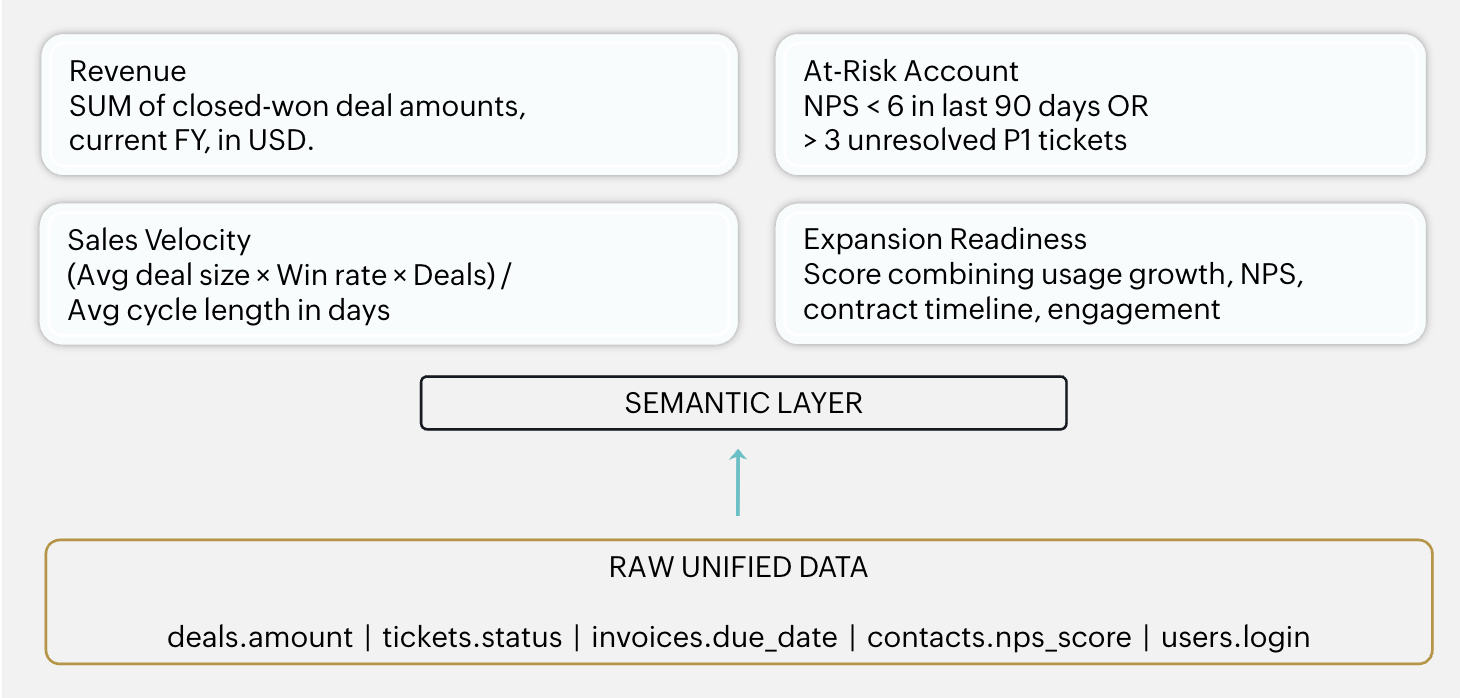
This does three things for agents. It eliminates ambiguity (one canonical definition per metric), enables reasoning (agents can flag at-risk accounts without needing those rules in every prompt), and ensures consistency across every agent in the organization.
Governed Access
When agents connect directly to source systems, each system has its own permission model, its own API keys, its own audit trail. Managing who sees what means checking every system individually. At twenty agents across different teams, that becomes impractical.
A unified data layer solves this by giving you one point of control. Agent access is governed the same way as human access (through a single permission model applied at the data layer).
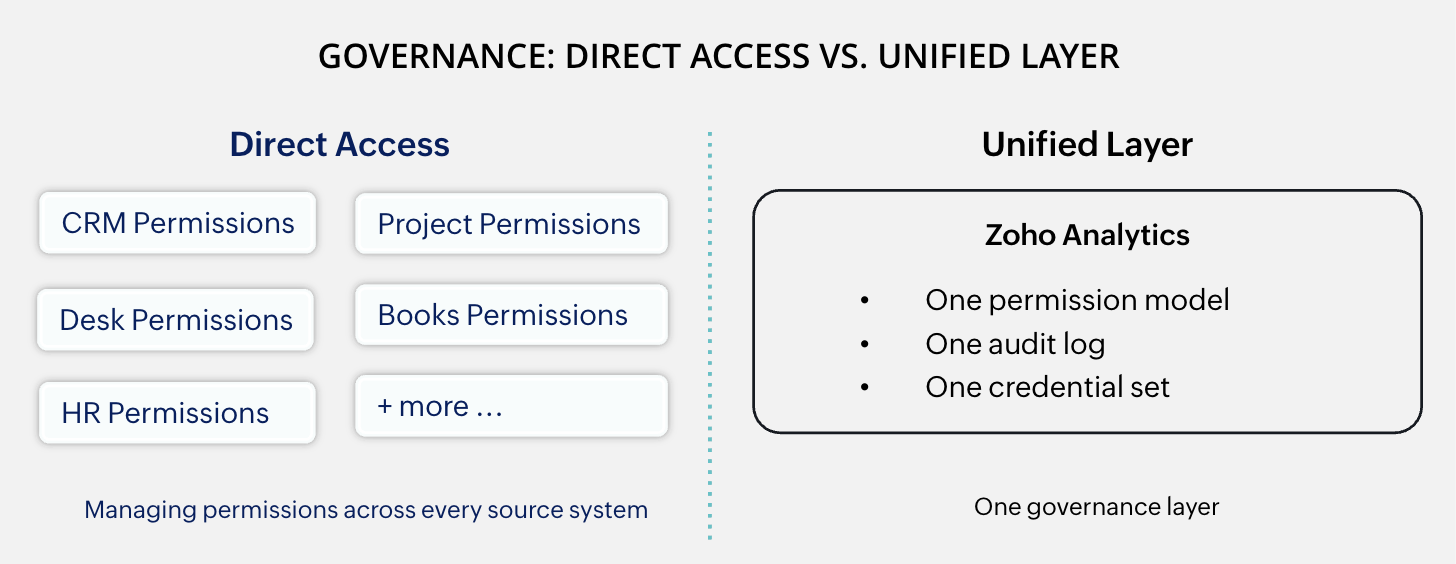
This means a sales agent can be scoped to customer and pipeline data without seeing HR records. An IT ops agent gets infrastructure data without access to financial reports. These boundaries are enforced at the data layer, and not in the agent's prompt where they can be worked around.
It also gives you one audit trail. When an agent pulls data, you can see what it accessed, when, and how often. That traceability is impossible when every agent connects to every source system independently.
The Cost Angle
Without a semantic layer, agents dynamically interpret your data on every query. They figure out which fields to use, what tables and columns to choose and join, how to calculate metrics, and what business rules apply. That interpretation burns tokens. And even after spending those tokens, there's no guarantee the agent interprets things the same way twice. Two queries about "revenue" might produce two different answers depending on how the agent reads the schema that day.
With a semantic layer, the interpretation is done once, at the infrastructure level. Definitions are fixed. Agents query pre-defined concepts instead of reasoning through raw columns every time. Prompts stay short, tokens stay low, and the answers are predictable.
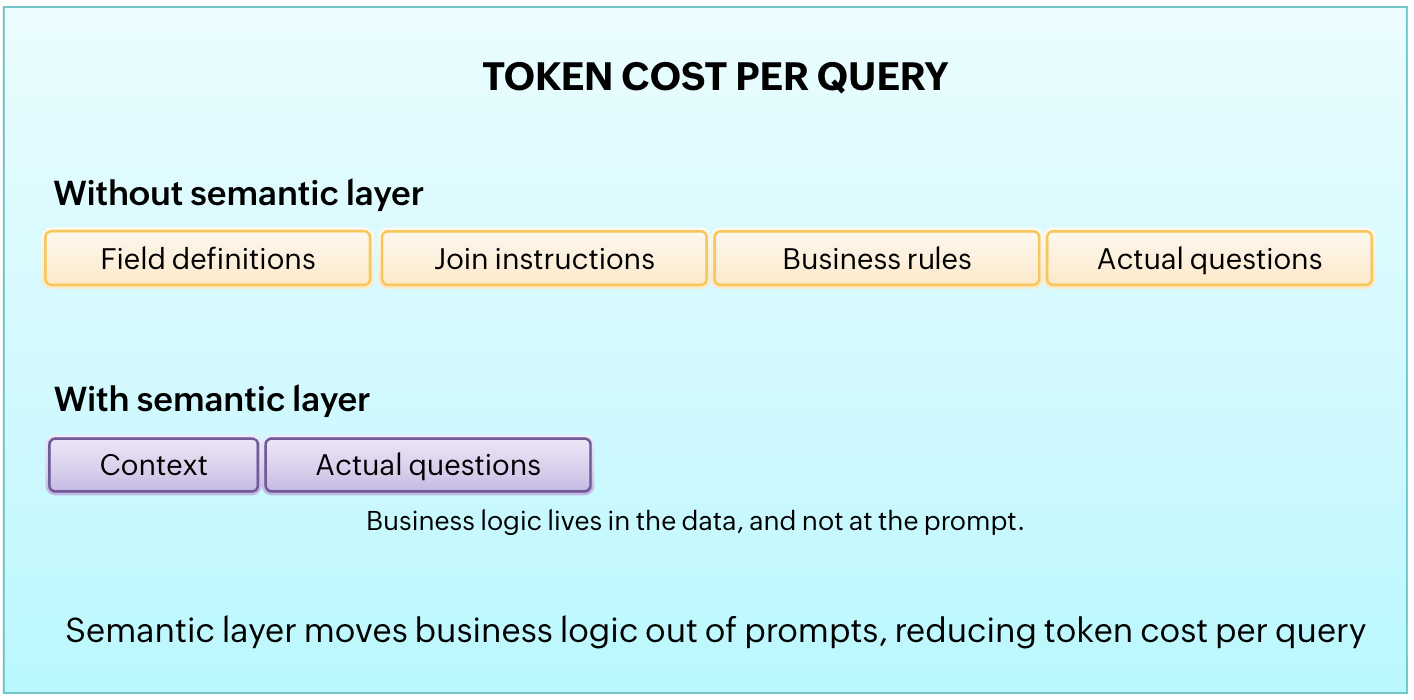
At scale, across multiple agents handling hundreds of queries a day, this is the difference between an LLM bill that keeps growing, and one that stays flat. More importantly, it's the difference between answers you can trust and answers you have to verify.
This Is What Zoho Analytics Already Does
If you are using Zoho Analytics, most of what we've described isn't a future state.
On the data side, Zoho Analytics connects natively to:
- Zoho apps: CRM, Desk, Books, Projects, People, and the full suite
- Third-party sources: Over 500 connectors for cloud apps, databases, file storage, and custom APIs
On the semantic side, Zoho Analytics lets you define calculated fields, build data models with explicit relationships, set up reusable formulas, and create consistent metric definitions across data sources. When you build a "Revenue" metric or a "Customer Health Score" in Zoho Analytics, you're creating exactly the kind of semantic definition agents need. The access controls you've already configured, get applied to agent access too.
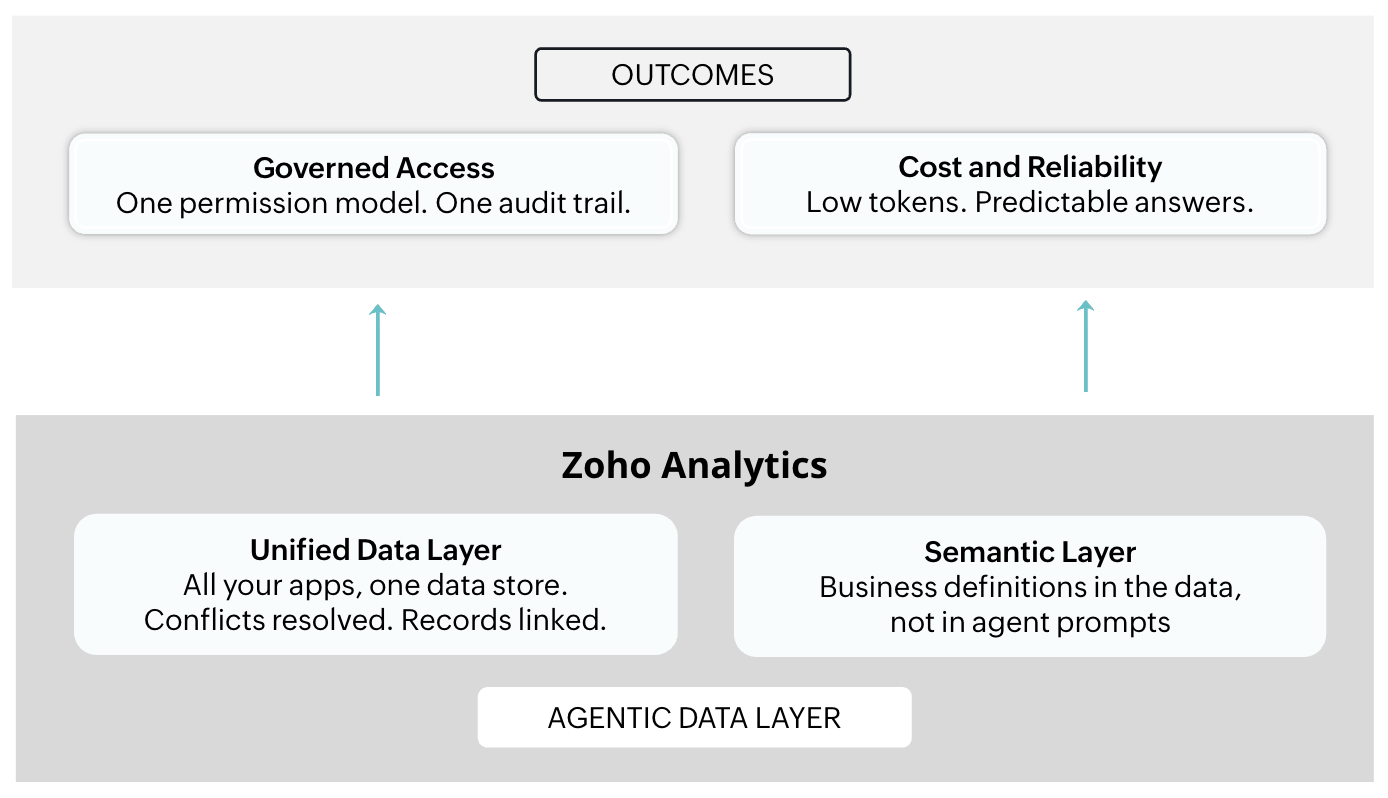
The infrastructure exists already. The shift is in recognizing that the same foundation you built for reports and dashboards is what your AI agents need.
In part 3, we'll walk through how to actually build your agentic data foundation using Zoho Analytics, including data transformations, MCP and API extensibility, and governance.

Comments