5 ways an event management software helps you in event registrations
Event registration is, in many ways, a micro-event in itself. Let's understand how an event registration software can streamline your registrations and how to select the right software for your events.
Traditionally, event registrations have mostly been done by manually maintaining spreadsheets and checklists. On event day, a lot of event organizers end up checking-in attendees, writing out badges, and helping them navigate to seats manually. Well, those days are gone for good.
An event management platform can now automate registrations and handle all the related activities, so that event planners are free to create meaningful attendee experiences instead of managing lists and ensuring reduced human errors in the event registration process.
In fact, event registrations have become faster, smarter, and far more seamless with the rise of AI-driven event management tools. Features like QR-based check-ins, automated approvals, and intelligent attendee tracking are simplifying what used to be one of the most time-consuming parts of running an event. In fact, 65% of event organizers claim they are open to adopting modern check-in tools and AI-powered systems to make registration smoother and more consistent.
Streamlining event registrations with event management software: A complete guide
What is an event registration software?
An event registration software brings everything from attendee registration to ticket sales and post-event analysis on a single platform.
Think of it as a centralized hub that replaces a bunch of scattered registration tasks, checklists and digital tools, eliminating issues like unclear documentation, lack of pre-event insights, or overhiring of external staff and volunteers. It ensures that event organizers have a unified platform to store attendee information, capture live data during check-in, and uncover detailed insights post the event.
Event registration is a core feature of any event management platform. When built as an integrated module, it ensures that attendee data is seamlessly captured, organized, and shared across key processes, from ticketing and planning to check-in and post-event analytics.
Event managers can thus benefit from a unified system that offers complete visibility and control over every stage of the attendee journey.
This means that event planning teams handle signups, pre-event communications, and event-day check-ins efficiently, creating a more enhanced and comfortable attendee experience.
Top 5 advantages of using an event management software for event registrations
Any event manager using an event management software would benefit from automating event registrations. By automating signups, uncovering insights real-time, and building smooth attendee experiences using technology, event managers ensure their events give a professional, no hassle vibe, irrespective of the scale and format.
Let's break down 5 key advantages:
1. It automates signups end-to-end
An event management software allows organizers to capture attendee registrations from every possible touchpoint directly, without any manual intervention. The entire registration flow becomes automated from the moment an attendee signs up. All it takes is for you to create customized registration forms, set up multiple ticket classes, and see registrations pour in via your event website.
Amazon's Smbhav summit is a great example of handling large registration volumes through automation. When Amazon India was gearing up for its annual summit Smbhav, the team had a unique challenge on their hands. They had to manage registrations for thousands of MSME business owners, speakers, and partners joining from across India—all in just a few days' time.
This meant building dedicated landing pages, registration flows and secure check-in protocol on the event day. Instead of doing this in silos, the event planning team created a unified master flow within Zoho Backstage.
With a simplified microsite to handle all registrations, integrate payments and ticketing directly into the portal, and automated QR-based check-ins and badging across multiple kiosks, they managed to avoid long queues, and enabled more than 4,000 participants to check in seamlessly, while the event team could get real-time updates.
That's the power of automating your registrations. All you need to do is build or connect all your registration endpoints to your event planning software, and data is automatically collected and attributed.
Here are some event planning features that help you automate your signup and registration process:
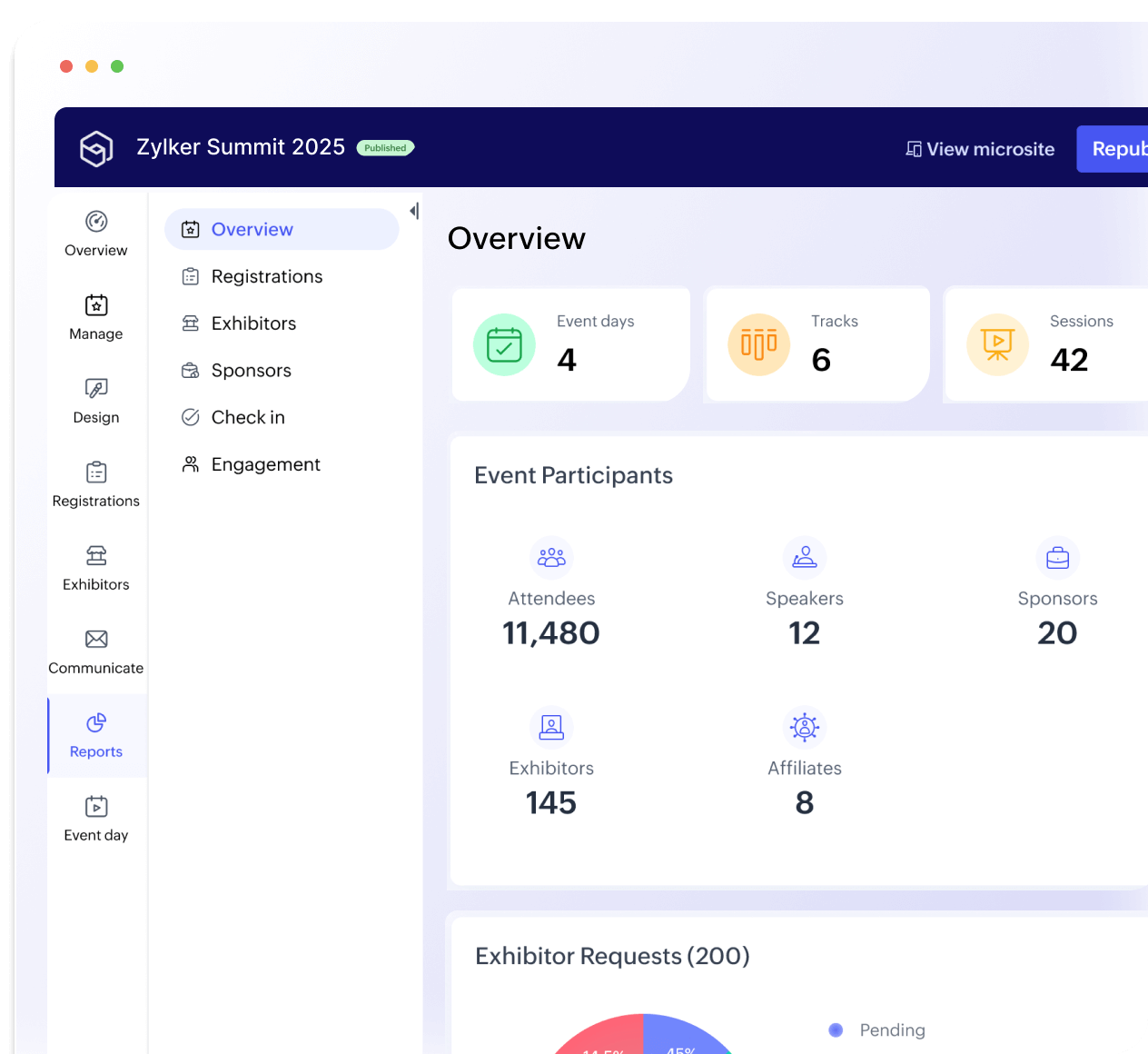
Track incoming signups with attendee details, ticket classes etc., with a clear visual dashboard.
Automate workflows to execute instant attendee communications, assign tasks to event planning stakeholders, and manage your processes better.
Plan registration management in detail by setting attendee limits, creating event timelines and setting pricing classes on ticketing.
Perform all key actions without ever leaving the platform using multiple integrations with ticketing systems, CRMs, payment gateways and more.
Enhance attendee engagement with event reminders, session-level engagement, and other digital tools.
With the right registration software, you can create an enhanced attendee experience,simplify tracking and do more without needing technical knowledge.
2. Ticketing, payments, and approvals in one place
Your event registrations software goes far beyond capturing attendee information. It can be your all-in-one platform for everything from ticketing and payments before the event, to check-ins and badge printing on the event day.
When you use a comprehensive event management software like Zoho Backstage, it covers the entire sequence before and after registrations—think event website builders, multi-class ticketing, registration approvals, payment handling and more.
This is how an event management software helps you streamline ticketing and payments:
Grow ticket sales with advanced options like early-bird, VIP, group tickets, and other event promotion strategies to boost registrations.
Create custom landing pages and mobile apps with flexible forms and easy sign-up flows.
Help attendees make payments without leaving your landing page, by facilitating payments with payment gateways like Stripe, Braintree etc.
Control RSVPs in real-time with an approval layer (by the event planning team), ensuring your corporate events are secure and closely monitored.
Set capacity control and auto-close options to automatically close registrations for when attendee caps are reached.
Create manual registrations on-the-spot by quickly entering details into the database when you have walk-ins.
When organizations move their ticketing process online, the difference is instantly visible. For instance, the BusinessNZ Council transitioned to a fully digital ticketing system and found that tracking sales and managing event details became far simpler.
"Our favorite thing about Zoho Backstage is the ability to track ticket sales and watch the money come in! The ease of use in terms of editing the agenda and speaker details is also impressive."
— Matt, Event coordinator, Business New Zealand
For in-person events (for example a ticketed tradeshow) this ensures you don't oversell your venue capacity, and can easily accommodate last-minute walk-ins.
Similarly for virtual events,only approved and verified registrants get access links, thus enhancing event safety and reducing security risks.
3. Improved attendee experience
The first few interactions your attendees have are during event registrations and these shape their overall perception of the event itself. When the registration process is quick and hassle-free, your overall registration rate, as well as final turnout, grows exponentially.
An event registration software helps you keep every step of event registration quick and convenient. You can use it to create quick RSVP forms, beautiful on-brand event pages and more, all the while tracking registration data from the backend.
Here are other ways an event registration platform helps you improve attendee experience:
Create well-designed branded RSVP forms that reflect your event's identity to capture the attendees' interest early.
Make your RSVP process more customized by capturing intricacies like dietary needs or special accommodation requirements with smart forms.
For mobile-first sign-ups, build responsive forms and one-click registrations reduce drop-offs or delayed registrations for attendees on the move.
Use instant email/SMS confirmations and reminders that send automated messages to help registrants confirm that their spot is secure and keep the event on the top of their minds.
Create faster check-ins with QR-based entry, digital badges, and kiosk check-ins shorten wait times at in-person events.
When the attendee registration experience is built with attention to event-specific details, the overall registration counts, turnouts, and satisfaction scores all increase.
4. Integrations with marketing and CRM tools
Modern event registration platforms can easily connect with your existing marketing and CRM systems. With just a few clicks, your team can promote events across channels, capture and qualify leads automatically, and track ROI metrics such as sales conversions and revenue forecasts, all without juggling multiple tools.
With Zoho Backstage, for example, you can blast pre-event communications to the attendees automatically. This is done with detailed "triggers", which allow you to keep attendees up-to-date by sending out everything from ticket confirmations to reminders.
Here's how integrations with external platforms help your corporate events:
Automatically push registration details into your CRM.
Set up automated WhatsApp communications with built-in triggers for registrations, confirmations, ticketing and cancellations.
Integrate with tools like Google Analytics, Zoho Pagesense, Zoho SalesIQ, and other analytics software.
Map check-in across multiple stages (early check-ins, cancellations etc) to calendars, mobile apps and other engagement tools.
Send enriched information to software like email and networking tools and external products with custom APIs.
The more deeply you connect various event planning interfaces and marketing stack with your registration data, the better your data synchronicity. At the end, this results in seamless tracking, and a more accurate understanding of the "where" and "why" aspects of attendee behaviour.
5. Detailed post-event ROI analysis
An event management software also offers detailed drill-downs and insights once the event is complete and you're sitting with the team to re-trace the proceedings.
It is useful across scenarios. For virtual events, you can track session-level data such as total participants, joining and leaving time etc., in extensive detail. If you're hosting an in-person B2B product launch event, you can track everything from conversions on your landing page to the number of cold, warm, and converted leads in your CRM.
Here's how post-event analysis becomes easier and more precise:
Comprehensive registration-to-attendance tracking that lets you compare total sign-ups against actual check-ins to calculate conversion and no-show rates.
Session-level insights for virtual and hybrid events to analyze metrics like participant count, average watch time, join/exit times, and session engagement.
Lead quality and attribution tracing back registrants from campaigns, to analyze qualified leads in your CRM.
Review user engagement across apps, Q&A, or polls to measure participant involvement.
Consolidate ticket sales, sponsorships, and attendee conversions into a single dashboard.
These analytics help you plan for future events with a lot more clarity and conviction—so you can curate better audiences, activities and budgets.
Streamlining event registrations with event management software
Smooth event registrations are a cornerstone of building a great attendee experience. It leaves a lasting impact on attendees and sets the tone for the rest of the event. If you're trying to scale events for your business, your event registrations process should be reliable and scalable to help you achieve your vision.
Using a comprehensive event management software, like Zoho Backstage, makes every single attendee touchpoint a lot more simplified. You can manage events of every single format, type and scale from a single platform, streamlining operations for your team and provide attendees an enhanced and enriched event experience.
Manual event registrations can result in various mistakes while capturing and tracking attendee information. While doing so, you might miss out on key attendee details, fail to capture registration source, and need to spend lots of effort in building manual registration lists.
Zoho Backstage is one of the best event registration management softwares that has a comprehensive list of modules across registration databases, collateral builders, collaboration, check-in and badging options etc.
The event registration count is an important KPI to measure the total ROI of the event. You can use total count to measure turnout, from which you can estimate lead quality, pinpoint interesting patterns, and also estimate revenue projections. An event management software allows you to do this with ease.
An event registration software helps you easily track and control attendee registrations, estimate turnouts, check-in and host arrivals with ease on event day and more. It is important to have a robust event registration management software to eliminate manual efforts and errors.