Online vs. offline event management software: Key differences explained

Every event type, from large conference, intimate workshop, trade show, to a networking session, demands tailored event management solutions. The right software ensures your event runs smoothly instead of falling into logistical chaos.

As the event landscape shifts toward hybrid events, organizers need to choose whether to stick with traditional offline tools or adopt online event management software. Some organizers may still prefer familiar legacy solutions, but these are increasingly becoming inadequate for today's fast-paced, complex events.

Event organizers who adapt quickly to digital innovation gain a clear edge over competitors. Understanding the differences between online and offline event management software and where each one fits in your event strategy is vital for gaining this advantage and improving flexibility and efficiency.

Online vs. offline event management software

Online vs onsite event tech management: A comparison

A day in the life of an event organizer

Imagine a day in the life of an event organizer. In the offline world, the day starts with manually checking sign-ups entered by team members in a spreadsheet—a time-consuming and error-prone process. As the day goes on, the organizer faces hurdles in coordinating with a dispersed team, relying on emails and phone calls to synchronize efforts. By evening, the pain of manually consolidating attendee feedback and sales data is apparent.

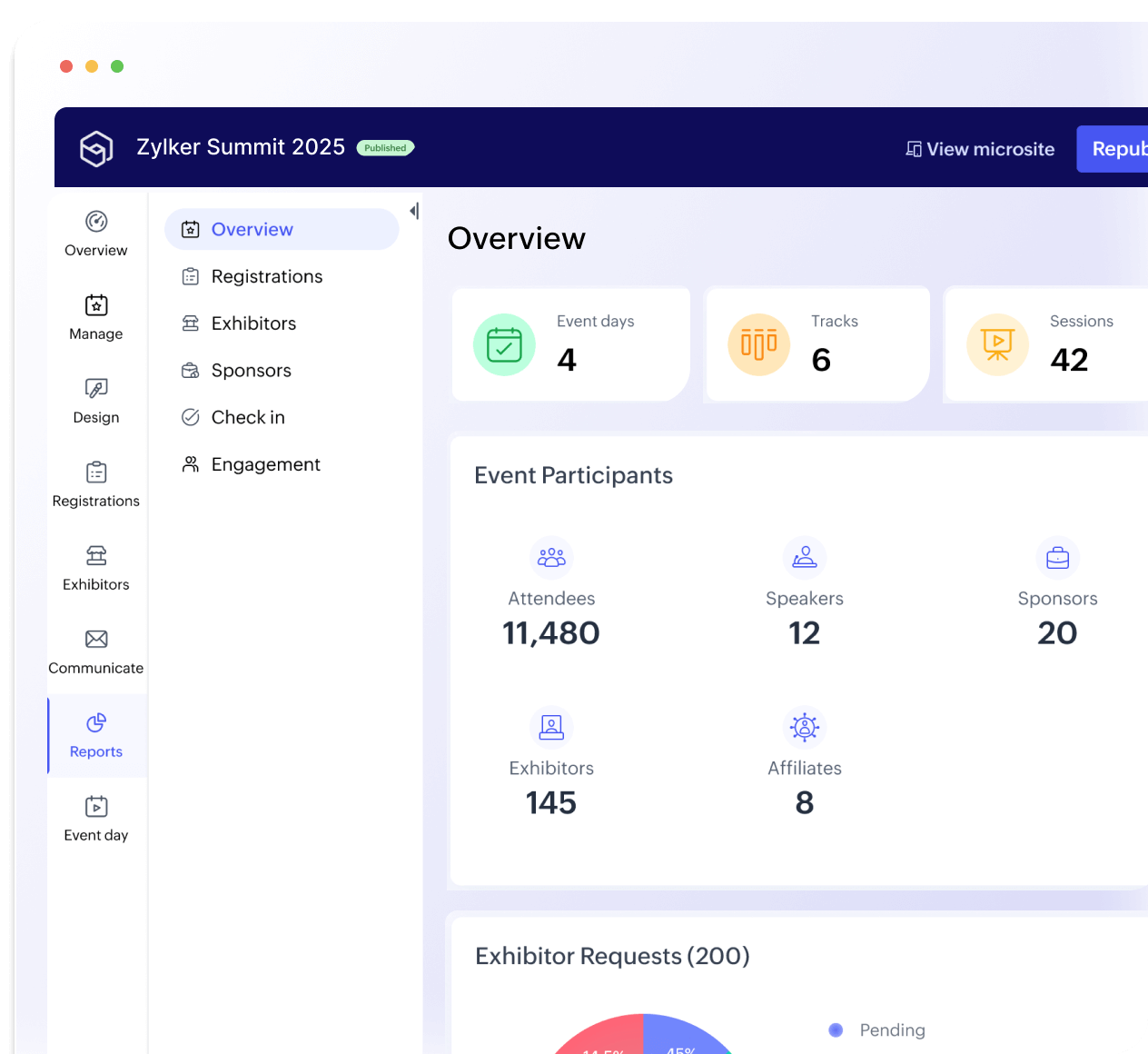
In contrast, here's what the same day, powered by online event management software, looks like. The organizer starts the morning by quickly accessing real-time registration updates on their dashboard, freeing up time for creative planning. Collaboration with team members, scattered across different locations, happens seamlessly through shared digital platforms. As the day winds down, automated reports and instant insights are readily available, leaving the organizer confident and focused on enhancing the attendee experience.
Your event management software should suit your event, not the other way round!

Every event type has unique features and requirements needing a different mix of tools to manage them effectively. In-person events like conferences and workshops require attention to venue layouts, attendee registrations, seating plans, and logistics.

Virtual events need robust digital infrastructure, including live streaming, engagement tools, and real-time analytics. Whereas hybrid events combine physical spaces with digital participation, making coordination and data management more demanding.

As event management evolves, relying only on offline tools is almost impossible. Basic offline options may cover fundamental aspects, but they are less scalable and adaptable for hybrid or large-scale events. Online event management platforms with automation reduce manual tasks and support organizers in delivering better experiences and achieving stronger outcomes.

What is offline event management software?

Offline event management software includes desktop-based, pre-programmed or on-premises tools that operate without a constant internet connection. These solutions were common before cloud computing and typically offered:

  • Basic registration management: Track attendee names, contact details, ticket types, and event schedules.
  • Agenda planning and scheduling: Create timelines and session schedules within the software.
  • Reporting: Generate simple attendance or ticket sales reports.
  • Limited collaboration: Sharing updates and files often required manual exports or emails.

What is online event management software?

Online event management software is cloud-based, enabling organizers to manage events anytime, anywhere through a browser or app. Platforms like Zoho Backstage offer comprehensive tools for planning, execution, and analysis.

Key features include:

  • Cloud-based registration: Manage online attendee registration with automated confirmations and ticketing payment processing.
  • Collaboration tools: Enable team members to manage tasks, track progress, and communicate in real time.
  • Virtual event capabilities: Integrate live streaming, webinars, and virtual networking sessions.
  • Analytics and insights: Use real-time dashboards to provide insights on registrations, engagement, and ROI.
  • Integrations: Sync data seamlessly with marketing tools, CRM systems, analytics platforms, and third-party apps.

Online vs. offline event management software: A features comparison

FeatureOffline Event Management SoftwareOnline Event Management Software
Accessibility Limited to specific computers; access is tied to the device where the software is installed. Accessible from any device with internet, allowing organizers to manage events from anywhere—perfect for distributed teams
Collaboration Manual and slow; sharing updates often requires emailing spreadsheets or files. Real-time team collaboration enables multiple stakeholders to update schedules, attendee info, and tasks simultaneously, streamlining work.
Automation Minimal; organizers must manually handle registrations, reminders, and ticketing. High-automates registrations, notifications, ticketing, and reminders, reducing errors and saving time.
Integration Difficult; connecting with marketing, CRM, or analytics tools often requires manual data exports. Easy integration with CRM, marketing, and analytics platforms, ensuring all your event data flows seamlessly.
Scalability Limited; software struggles to manage large events or multiple components efficiently. Highly scalable, allowing events of any size;from local workshops to international conferences can be managed effortlessly.
Data backup Manual; organizers must remember to back up data regularly to prevent loss. Cloud storage with automatic backup keeps all event information secure and accessible in real time.
Analytics Basic reporting; insights are limited and often delayed. Advanced analytics and real-time insights provide actionable data on attendance, engagement, and ROI, helping organizers optimize events.
Event types supported Primarily in-person; virtual or hybrid events require separate solutions. Supports in-person, virtual, and hybrid events in a single platform, making it ideal for modern event management.

While offline solutions may work for small or local events, online software offers the versatility and efficiency needed for modern and hybrid events.

For example, the BusinessNZ Council used Zoho Backstage to quickly pivot an in-person election conference to a live virtual event during COVID-19, managing ticketing, agendas, and speaker updates seamlessly.

"Our favorite thing about Zoho Backstage is the ability to track ticket sales and watch the money come in! The ease of use in terms of editing the agenda and speaker details is also impressive."

- Matt, Event coordinator, Business New Zealand

Why hybrid events make online software essential

Hybrid events are increasingly popular, combining physical attendance with virtual participation. These events let organizers reach a wider audience, accommodate different comfort levels, and offer more flexible ticketing options.

Event planners using offline software often struggle with hybrid events because:

  • Updates need to be synced manually between digital and physical platforms.
  • Virtual attendees require a separate system for registration and engagement.
  • Data from in-person and online participation is hard to consolidate.

Online platforms like Zoho Backstage eliminate these challenges by providing:

  • Single dashboard management: Monitor both in-person and virtual components simultaneously.
  • Live streaming and virtual engagement tools: Host sessions online without needing separate software.
  • Integrated analytics: Measure engagement across both audiences in real time.

A unified online event management platform for hybrid events gives organizers clearer oversight, instant updates, and fewer errors. Attendees enjoy a seamless experience, while organizers benefit from faster coordination, real-time problem solving, and better data collection for improved future planning.

Key considerations when choosing between online and offline event management software

While online event management software offers clear advantages over offline solutions, it is important to evaluate your event needs before making a decision. Consider the following:

Event type and audience size

Small, local gatherings with few attendees may be managed with offline tools. Large-scale or hybrid events benefit from online platforms.

Team structure and collaboration needs

Teams working remotely or across locations need real-time collaboration, which offline tools cannot provide.

Budget and resources

Offline software may have lower upfront costs, but online platforms save time and reduce errors, often making them a better investment.

Future-proofing

Online solutions like Zoho Backstage support growth, hybrid formats, and integration with emerging technologies, making them a better long-term investment.

How Zoho Backstage powers online event management

Zoho Backstage is a comprehensive event management solution for in-person, virtual, or hybrid events. Key features include:

1. End-to-end event lifecycle management.

From planning to execution and post-event analysis, Backstage covers every stage:

  • Event website creation with custom branding
  • Ticketing and registration management
  • Session scheduling and agenda building
  • Real-time attendee engagement tools

2. Cloud-based collaboration

Backstage's cloud infrastructure allows teams to collaborate seamlessly:

  • Share updates instantly with team members
  • Assign tasks and track progress.
  • Integrate with Zoho apps like CRM, Campaigns, and Analytics for data-driven decision-making.

3. Enhanced attendee experience

Backstage offers features that boost participant engagement:

  • Personalized agendas for attendees
  • AI-powered networking and matchmaking tools
  • Live polls, Q&A, and session feedback collection

4. Scalable and flexible

Backstage adapts to any event scale, from local meetups to international conferences:

  • Handles thousands of registrations effortlessly
  • Supports live streaming and virtual booths for global audiences
  • Provides actionable insights with real-time reporting

Why online event management software is the future

The choice between online and offline event management software comes down to flexibility, scalability, and efficiency. While offline tools may serve niche purposes, modern events, especially hybrid or virtual-first, require the efficiency and versatility of online solutions.

Offline event management tools have clear limitations: collaboration is slow, updates are manual and error-prone, scaling to larger events is difficult, and integrating with other systems is cumbersome.

In contrast, cloud-based platforms like Zoho Backstage let organizers manage registrations, agendas, and communications seamlessly, collaborate in real time, host in-person, virtual, or hybrid events easily, and use analytics to improve engagement and ROI.

FAQs

Online software is cloud-based, allowing real-time updates, remote collaboration, automation, and integrations. Offline tools run locally on a device and are useful without internet, but they lack scalability, collaboration, and hybrid-event capabilities.

Yes, but mostly for small or local events where teams work from a single location and internet connectivity is unpredictable. For larger, hybrid, or multi-team events, offline tools often create delays and data inconsistencies.

Hybrid events combine in-person and virtual participation, which requires unified registration, engagement, live streaming, and analytics. Online tools centralize these functions, while offline tools cannot sync real-time data across formats.

Cloud platforms provide automation, team collaboration, scalable features, live analytics, integrations with marketing/CRM tools, and anytime-anywhere access—making them ideal for modern, complex events.

Zoho Backstage offers end-to-end event management—from agenda planning and ticketing to live streaming, attendee engagement, task tracking, and analytics—all in one cloud-based platform. It's built to support in-person, virtual, and hybrid formats seamlessly.