How to manage event technology and AV equipment: A 7-step guide

From microphones and speakers to projectors and lighting, learn how to manage event technology with ease for a seamless, secure, and memorable attendee experience.

The AV and technical arrangements are the backbone of any experiential event. But, they're also one of the hardest parts of the planning process to crack.

In 2025, AV setups and event technology has evolved to allow organizers to create highly detailed event arrangements in a bid to wow their attendees. The global event equipment rental market size is projected to reach USD 25 billion by 2032, as more event planners add tech-heavy aspects like AR (Augmented Reality) experiences, gamification, live demonstrations and more to their events.

However, many event planners often feel out of their depth while selecting vendors and equipment—they need to account for everything from budget and venue facilities to the overall creative vision of the event itself.

A lot of event planners are also wary of embarrassing technical mishaps and AV failures that may derail their event. Take the September Meta Connect 2025, where Mark Zuckerberg's introduction of Meta's big product update was live in front of thousands, only to be awkwardly interrupted by apparent Wi-Fi issues.

AV setups and technical infrastructure, while operating from the shadows, are critical in shaping how attendees engage with your event. From basic lighting and cameras to detailed gamified setups, all kinds of event planning rely on precise AV management to be successful.

Managing event technology and AV infrastructure: A quick guide

Why is event technology important for event planning?

AV and technology are no longer just "tech support" for events. Audio Visual (AV) infrastructure comprises everything from lighting and audio to end-to-end streaming such as microphones, projectors, speakers and more.

Across corporate event types—virtual (like webinars), hybrid (like town halls), and in-person (like conferences)—proper AV setup is fundamental to event success.

It's nearly impossible to create a sophisticated event today without strong background technical support. From digital banners and international broadcasting to advanced AR/VR capabilities, event experience depends on how well your technical setup runs at ground level.

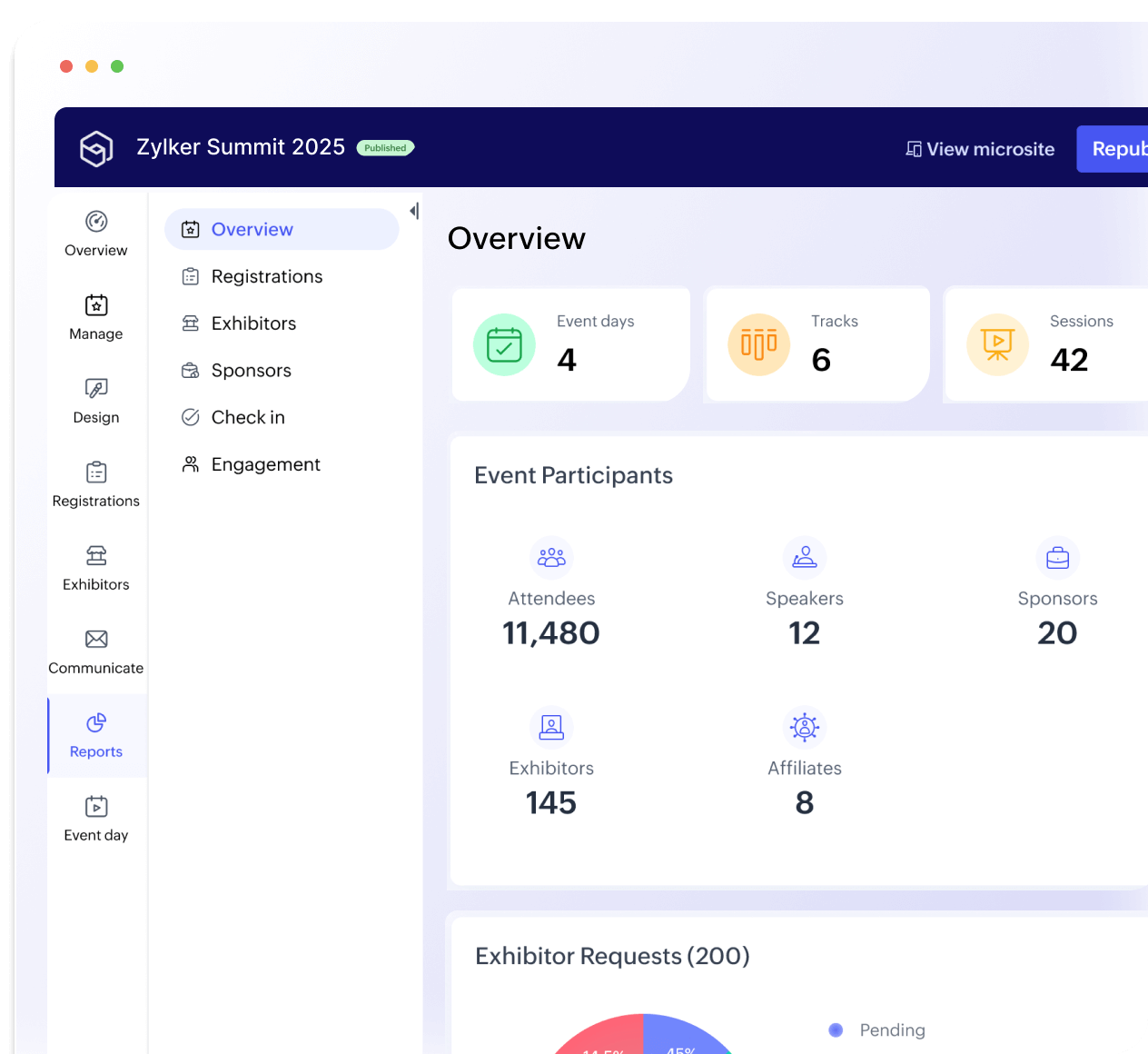
That is why event planners have AV equipment and setups as one of their top budget allocations. It's also why about 85% of event planners around the world prefer using an event management software, like Zoho Backstage, to plan out their events. Features like visualizing the floor plan, tracking vendors and tasks make it an integral part of event technology planning, and ensures everything is managed smoothly from a central command center.

Event technology 101: The must-haves for every event type

Different event types need different technical setups. For example, in virtual events, the "hero" is the speaker and presentation—ensure high-quality streaming and presentation, and you have a great event.

If it's an in-person event, the venue and ambience capture a good chunk of your attendees' attention. So, your team can get much more creative with AV setups—think everything from stage decor to strobe lights and speakers. And with a hybrid event, you need to find the right balance between both worlds.

Let's look at how each event type influences AV planning:

Table Title- Event Technology Requirements Across In-person, Virtual, and Hybrid Events

Attribute / SetupIn-person EventsVirtual EventsHybrid Events
Venue Layout Planning✅ Physical floor plans, booth/stage mapping, seating zones✅ Required for physical segment
Streaming Tools✅ Central to event delivery✅ Unified streaming for both audiences
Audio Setup✅ Handheld/lapel mics, speaker systems✅ High-quality USB or lapel mics✅ Distributed feeds for in-room & online audiences
Video Setup✅ Multi-camera coverage, LED walls, projectors✅ HD webcams or cameras with lighting✅ Multi-camera with switching for both formats
Lighting✅ Stage and ambient lighting✅ Controlled lighting for on-camera clarity✅ Combined lighting for physical and broadcast
Connectivity / Internet✅ High-bandwidth WiFi or wired backhaul✅ Stable, high-speed internet with backup✅ Dual connectivity for venue + streaming
Digital Signage & Branding✅ On-site digital displays, screens, and signage✅ Optional virtual/physical branding assets
Check-in / Access Control✅ RFID, QR, and smart kiosks✅ Virtual entry links or secure login✅ Both on-site and online access management
Engagement Tools✅ On-ground interactions, gamified setups✅ Polls, chat, and Q&A features✅ Synced engagement across both audiences
Equipment Vendors / Operators✅ Required for setup and troubleshooting✅ On-site tech and streaming operators
Backup & Redundancy✅ Backup audio/video systems✅ Backup internet/servers✅ Central control and redundancy across both sides
Budget Allocation✅ 10–15% of event budget (approx. $10K–$100K+)✅ Software subscriptions, streaming costs✅ Combined budget for physical + virtual infrastructure
Event Management Software Integration✅ To manage floor plans, exhibitors, and AV vendors✅ For streaming and attendee flow✅ Centralized agenda, speaker, and feed management
Example Platform✅ Zoho Backstage for floor plans, check-in, gamification✅ Zoho Backstage OnAir for streaming✅ Zoho Backstage for integrated hybrid control

In-person events

For in-person events, technical and AV setups largely depend on factors such as the event objective, venue, attendee volume, and planned activities.

This means that a small event like a corporate roundtable with only 50 attendees has a much simpler tech setup than a global marketing conference that brings together 1000+ attendees.

Here are three aspects to consider for AV in physical events:

  • Venue's physical layout: A single 10x10 booth in a tradeshow is a lot different from a hotel conference hall that can host 100 attendees.
  • Activities: Formal and casual activities—from keynote presentations and live demos to casual pre-event mixers—each have their own setup.
  • Attendee volume: This helps mainly by quantifying the setup—for example, how many speakers you will need for 200 vs 500 attendees.

Generally, technical equipment setup on the day of the event feels quite complex to navigate for the event planning team—especially when the vendors and staff have questions related to the technical setup that the team is unfamiliar with.

To make this process easier, you can create a smart floor plan, keep track of exhibitors, and source the exact AV requirements using your event planning platform.

Some basic tech and AV setups for in-person events:

  • Audio: Full-fledged audio equipment like handheld mics, high-quality speakers and sound-sets across the venue. You might have a separate operator team handling this, located near your stage.
  • Video: Set up your cameras across the stage and venue to meet coverage needs and requirements. You can also include LED walls or projectors, and confidence monitors for speakers.
  • Lighting: Place adjustable stage lighting, spotlights, and dimmers for visual clarity.
  • Connectivity: Dedicated, high-bandwidth event Wi-Fi (at least 10 Mbps per 100 devices) or wired back-haul to support on-site tech operations.
  • Digital collaterals: Extensive setups for billboards, signage, and digital displays for branding and navigation across the venue site—refer to your floor plan and marketing collateral checklist to decide on this.
  • Check-in facilities: RFID devices and smart kiosks with printing facilities for instant badging—these little details make the overall attendee experience much better.
  • Interactions and gaming: Live polling devices, VR headsets, even miniature robots and gaming systems—such experiential, gamified tech is gaining in popularity.

In fact, large-scale events that bring together thousands of attendees generally spend 10–15% of their budgets on AV setups alone. This can range from $10K to even $100K+ in budget allocation.

When you're spending this extensively, however, it is important to have a detailed event budgeting for your technical setups. It is also crucial to choose an end-to-end event management software that makes your job easier.

For example, Zoho Backstage empowers you with check-in technology, gamification capabilities, and live streaming in one place. It lets you use quick scan-based options and QR codes to handle the guests' entry and arrival processes. It's quick, and simplified, so your attendees have an easy time skipping queues and getting seated, while you don't have to over-hire staff for hosting and reception, and helps you avoid scattering budget while still creating best-in-class event arrangements.

Virtual events

When you're hosting virtual events, technical setup is heavily centered on streaming and distribution. Everything from attendee registration to final delivery happens online—so you need the appropriate technical setup across both online and physical touchpoints. Your streaming software, microphone, lighting, cameras and all other equipment need to work in tandem with each other for a smooth virtual event.

For virtual events, these are the key tech and AV requirements:

  • Streaming: Use reliable streaming software that is easy for both speakers and attendees to navigate.
  • Audio: Set up high-quality USB or lapel mics, with noise suppression for clear delivery.
  • Video: If you'd like advanced visual coverage, use external HD webcams or cameras with proper lighting to maintain broadcast quality.
  • Connectivity: High-speed WiFi, along with backup to prevent streaming interruptions.

Individually, a lot of this setup can be expensive to cover—streaming software alone has subscriptions that run into hundreds of dollars a month for even basic options.

To avoid these issues, you can choose an event management platform that comes with built-in streaming services for virtual and hybrid events. For instance, Zoho Backstage OnAir is a live streaming functionality that's part of the event platform.

This helps you centralize your event flow, improve the attendee experience, and increase overall turnout.

Hybrid events

Event tech set up for hybrid events requires that both your virtual and in-person event experience remains on the same level for audiences. Setting up the technology and AV for a hybrid event could be tricky as it requires equal attention to both modes of delivery in real-time.

Let's combine elements from both in-person and virtual setups for this:

  • Audio: Distribute mics and speakers throughout the event venue to seamlessly split audio feeds for in-room and remote audiences.
  • Video: Multi-camera setup for both in-person and remote presenters. Make sure this is orchestrated by a dedicated controller from your staff to switch seamlessly between slots.
  • Streaming: Unified broadcasting tools that manage on-site and remote session delivery. You can also use a streamlining service built into your event management software.
  • Engagement: Synced polls, chat, and Q&A features connecting both audience types.
  • Redundancy & Control: Central switcher and hybrid tech command center to monitor both feeds.

When you're building hybrid events, you generally have participants across time zones and devices, joining both in-person and virtually. If the event has multiple speakers and presenters, you also need to ensure there is seamless hand-off between sessions for a smooth viewer experience.

Planning out your virtual events with an event management software makes this entire process a lot smoother—it allows you to manage your agenda, feature speakers, and update calendars from one centralized platform. This makes sure you don't miss any scheduled slots, and your attendees can navigate the event agenda without any hassle.

These details help you draft your Request for Proposal (RFP) with accurate and up-to-date information, and gives both internal and external stakeholders a complete picture of your technical requirements.

Plan a flawless tech and AV set up in just 7 steps

Let's run through each of the steps required to manage your entire event technology requirements with full precision.

Step 1: Enlist the AV and hardware requirements

Start by identifying the key technical aspects—think audio setups, display screens, streaming platforms, and lighting design.

Match each requirement to your event type (virtual, hybrid, or in-person), expected attendee volume, and budget. The overall creative vision of your team also matters here—are you looking at a tried-and-tested arrangement? Or an experimental setup that's never been done before?

Doing this helps you understand the full extent of your AV setups, how it fits in your overall budget, and how to enlist the right vendors to accomplish your vision. With this, you can build a detailed RFP with all the requirements, to send out to prospective vendors.

Step 2: Map your venue layout

The venue can be the make-or-break of your event! It's important to select the right venue for your event—one that suits your objectives, has all the facilities you need, and helps you build an engaging experience overall.

If you have an external venue you've chosen for the event, you'll need to know the exact layout of the venue to plan AV setup. When selecting locations such as hotel conference rooms, stages, or event halls, consider aspects like the venue's acoustics, power outlets, seating zones, and camera sightlines.

For hybrid events, you should plan your digital layout simultaneously—where your cameras should stream from, and how virtual attendees will view the event. This prevents any mismatches, and helps you orchestrate technology and livecasting without any hitches.This eliminates any confusion on event day and makes your event a lot more seamless for attendees.

Step 3: Evaluate and onboard vendors

Once you begin receiving RFP responses, your event planning team should begin shortlisting AV partners. Do an initial qualified list, with key responses to service-related requirements and security certifications—this is sacrosanct.

Additionally, strong vendor coordination can give your event a significant edge. To finalize the best vendor(s), ask for SLAs covering response times, emergency procedures, and staff availability.

Selection is not just about pricing, here. The best vendors have safety and reliability in mind, and this shows in their responses. That's the kind of team you need onboard for your event.

Step 4: Establish contingency and security protocols

Thinking about technical failures and emergencies can feel a little nervous for event planning teams. Especially in the case of events where you have attendees in-person, you're taking responsibility for their overall safety throughout the event.

First, create a detailed security SOP and protocols for all kinds of security scenarios, from minor technical failures like AV issues to critical emergencies such as electrical malfunctions. Next, have an internal security officer from your team, a member of the venue's host team, and SPOCs from the technical vendor(s) run through detailed safety, permissions, and certificate verifications.

Finally, create a contingency plan that includes spare hardware,backup routers, mirrored slides, and generators. Implement access control for AV booths, encrypted Wi-Fi for streaming, and clear escalation chains for troubleshooting.

Step 5: Conduct technical rehearsals

A technical rehearsal is a comprehensive check of the entire technical and AV setup, including all key stakeholders—speakers, operators, and the organizing team—throughout the event's agenda. This is an important activity across event formats!

For an in-person event, you can conduct technical rehearsals directly at the event venue a couple of hours before the event starts. In case your event is done in a virtual/hybrid format, you can assemble all your speakers and presenters for practice sessions to check if your streaming set-ups are up to the mark.

Do a complete tech run multiple times, including all the contingency scenarios, to build confidence and ensure all checks are in place. This is not only for basic checks and safety.

It's also a great way for your presenters and performers to get familiar with the stage, lighting, and how to operate their mics. This ensures there's no last-minute fumbling and nerves, boosting their confidence and preparing for a great event.

Step 6: Monitor performance in real time

Keep a close eye on the small and large details during your event. You should, ideally, track connectivity, audio levels, and attendee engagement through a central dashboard. When it's a virtual event, you'll be able to measure every detail from joining time, to poll responses and exit time. Similarly, for hybrid or in-person events, smart check-ins help you instantly track and manage check-ins, badging, and more.

Platforms like Zoho Backstage let you view analytics live, helping you spot drop-offs in virtual/hybrid events and live check-ins for in-person events.

Step 7: Review and optimize post-event

After tear-down, analyze equipment performance, downtime, and attendee feedback. Use these insights to refine your future event tech and AV planning, refer to vendors' performances, and improve the overall event experience in the future.

Smart management of AV and technology with Zoho Backstage

Event technology has a critical role in shaping the success of an event. Well-rigged AV systems, secure connectivity, and smooth execution are the basics of good tech setups—but they hold the key to delivering better engagement, stronger ROI, and lasting audience impact.

As event technology becomes more advanced, a reliable system to plan and execute your plans takes you a long way ahead. By centralizing your overall event planning with an event management software like Zoho Backstage, you can create more secure workflows, manage vendors efficiently, and streamline most of your workflows. With better technology comes better execution—and better execution comes the best of experiences.

FAQs

Technical setups for corporate events can include audio setups (microphones, speakers, mixers), video and display systems, lighting, connectivity infrastructure, and power backup. Depending on the format (virtual, hybrid, or in-person) and attendee size, you may also need streaming software and interactive virtual tools. The goal is to ensure clear communication, strong visibility, and a seamless attendee experience across every stage of the event.

To select a vendor to handle technical setup, evaluate them on five key criteria:- service offerings, compliance verification, prior experience, pricing, and staffing availability.

In order to select the best AV equipment for your events, start by matching equipment needs to your event's size, venue acoustics, and format. You can then create a checklist of all equipment to purchase, whether you're renting them (from the venue/vendors), or purchasing them for repeated use. You can then research on quality, reviews and pricing, to ensure you buy the best AV equipment needed.

To create an AV plan for an in-person event, you should use the floor plan of your event venue to understand the overall arrangement of venue components, attendee spaces and activity setups. Based on this structure, you should plan to position your AV equipment such that they all perform the required activities while being unobtrusive for attendees.

While conducting tradeshows, some of the most common issues you will encounter include power fluctuations, audio/lighting mismatches and streaming interruptions. These can delay sessions, disrupt audience focus, and affect brand perception. In corporate events, even brief failures can cause speakers to lose momentum or sponsors to miss visibility moments. Testing, redundancy, and real-time monitoring help prevent these problems before they affect the experience.