Advanced Analytics for Zoho Spend
Zoho Spend is a cloud based spend management platform that helps businesses control and optimize company expenses from purchase requests and approvals to vendor payments and expense tracking.
The Advanced Analytics Connector for Zoho Spend helps you analyze spend data to understand expense patterns, budget utilization, vendor performance, and financial efficiency. With this connector, you can track key metrics, gain deeper insights into spending behavior, and make data driven decisions to improve cost control and financial planning.
- How to set up the Zoho Spend integration with Zoho Analytics?
- Handling Data Synchronization Failure
- Managing Data Sources
- Data Modeling & Preparation
- How can you visualize and analyze Zoho Spend data?
- Sharing & Collaboration
- Technical Support
How to set up the Zoho Spend integration with Zoho Analytics?
A user with administrator privileges (Account Admin and Organization Admin) can configure the integration.
Follow the below steps to import your Zoho Spend data into Zoho Analytics seamlessly:
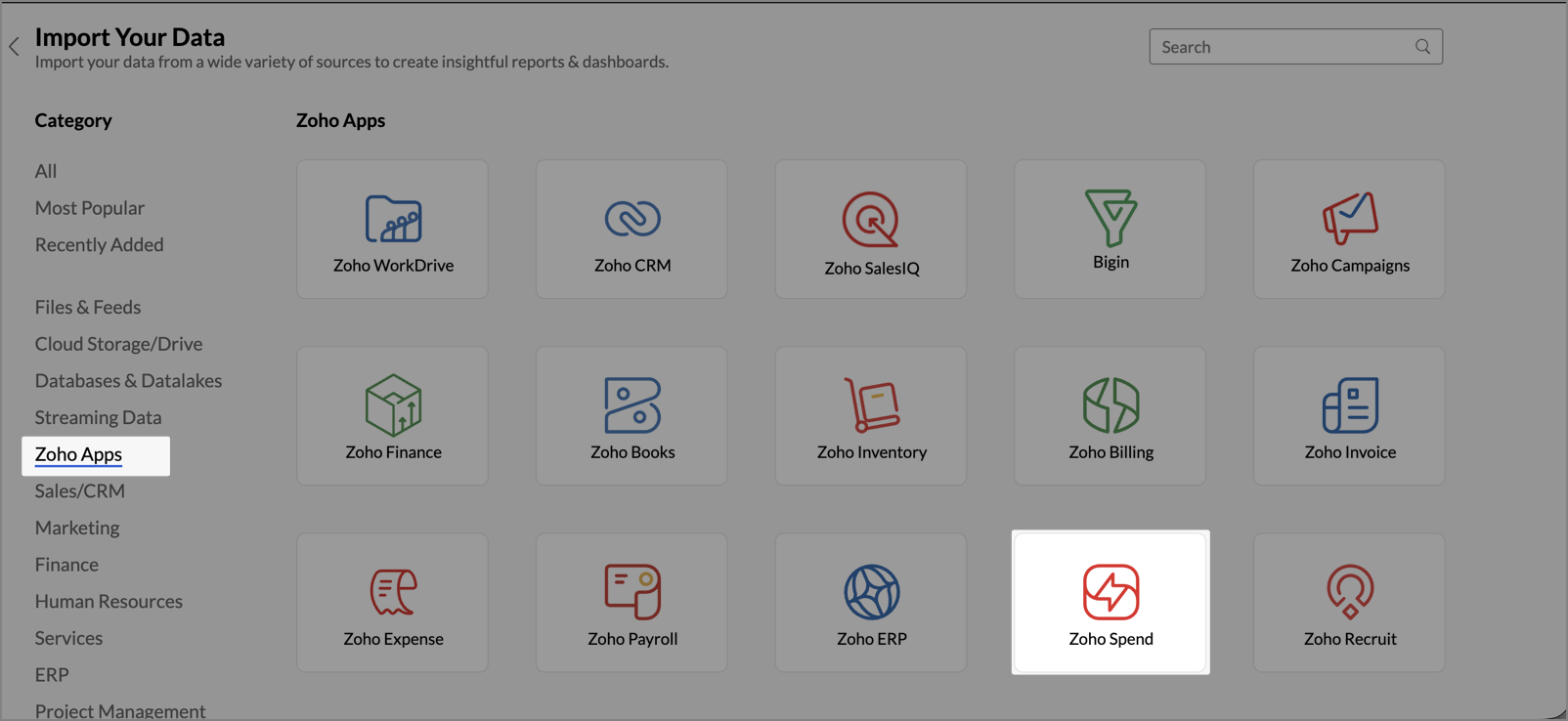
- On the Zoho Analytics home page, click Import Your Data.
- Navigate to the Zoho Apps tab, and select Zoho Spend from the available applications.
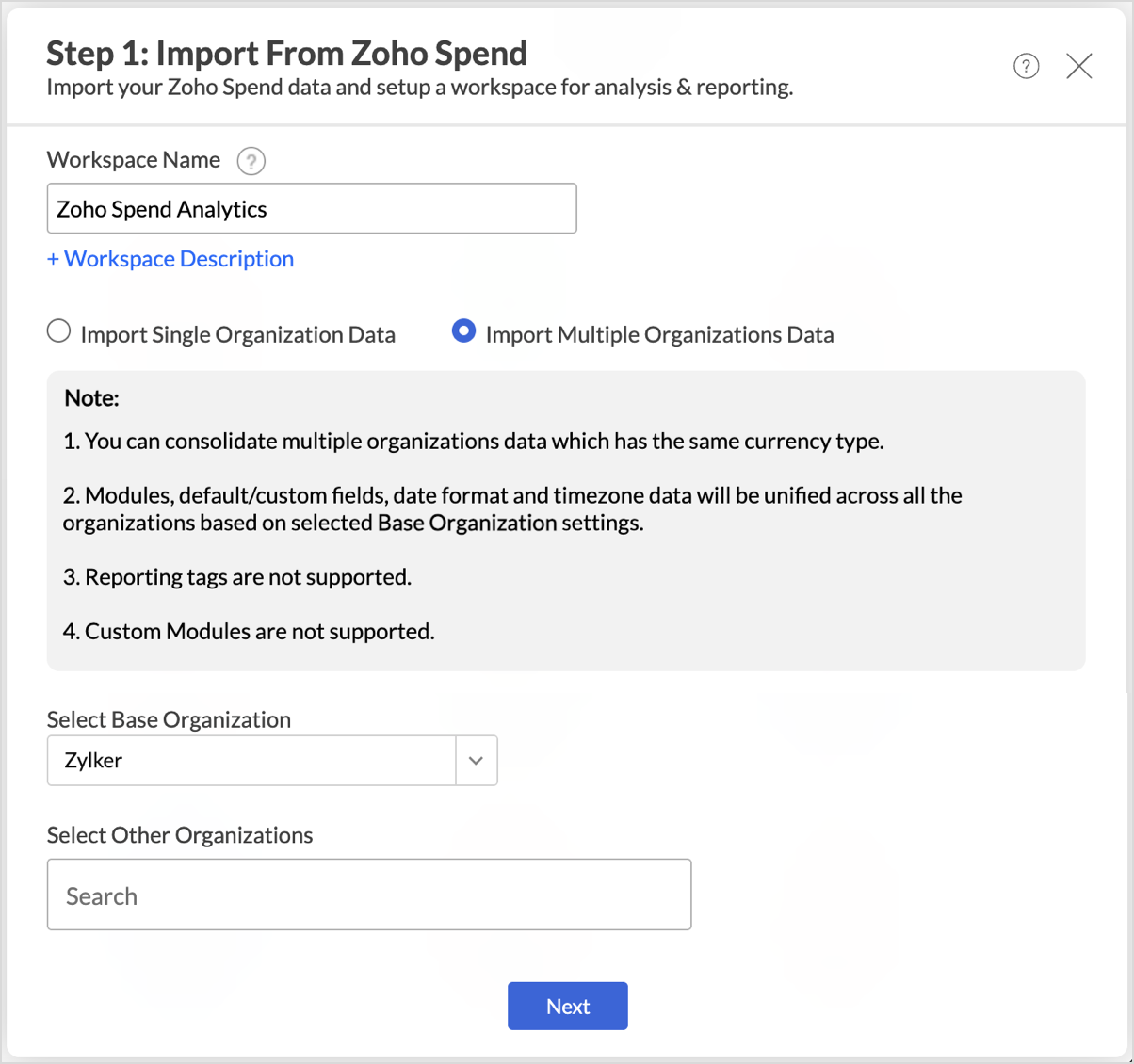
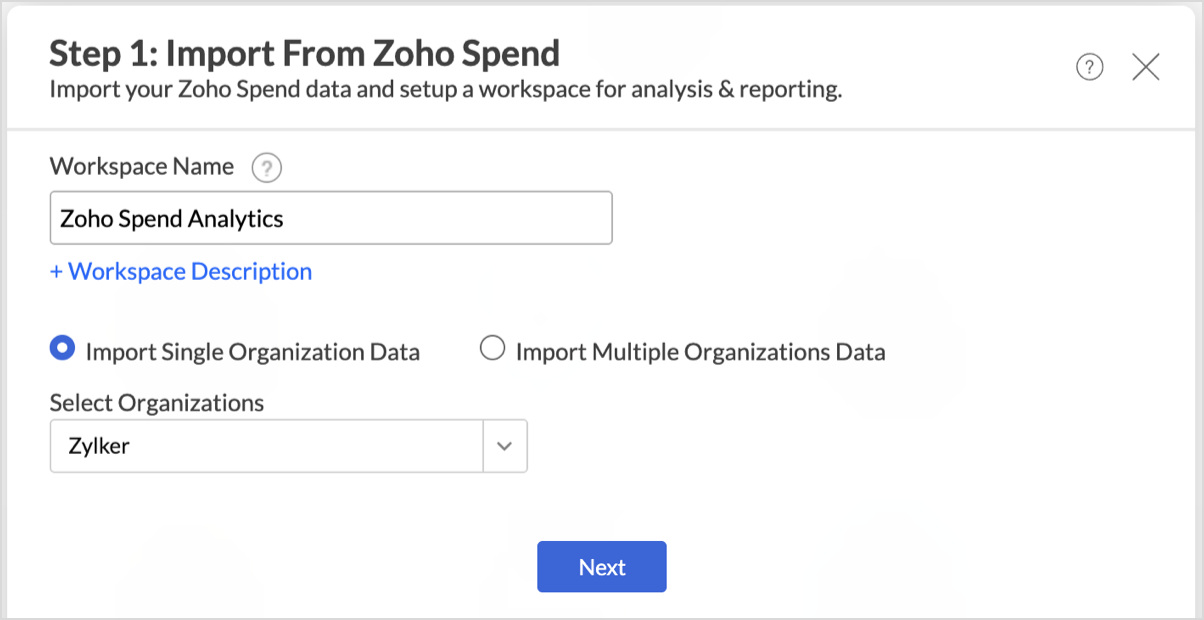
- Enter Workspace Name and Workspace Description (Optional).
- Choose whether to import Single Organization Data or Multiple Organizations Data.
If you choose Import Multiple Organizations Data, do the following:- Select the Base Organization.
Search and select the Other Organizations to include.
Note:
- You can consolidate data only from organizations that use the same currency.
- Modules, default and custom fields, date format, and timezone are unified based on the Base Organization settings.
- Reporting tags are not supported.
- Custom modules are not supported.
- Select the available Organization from the drop-down and click Next.
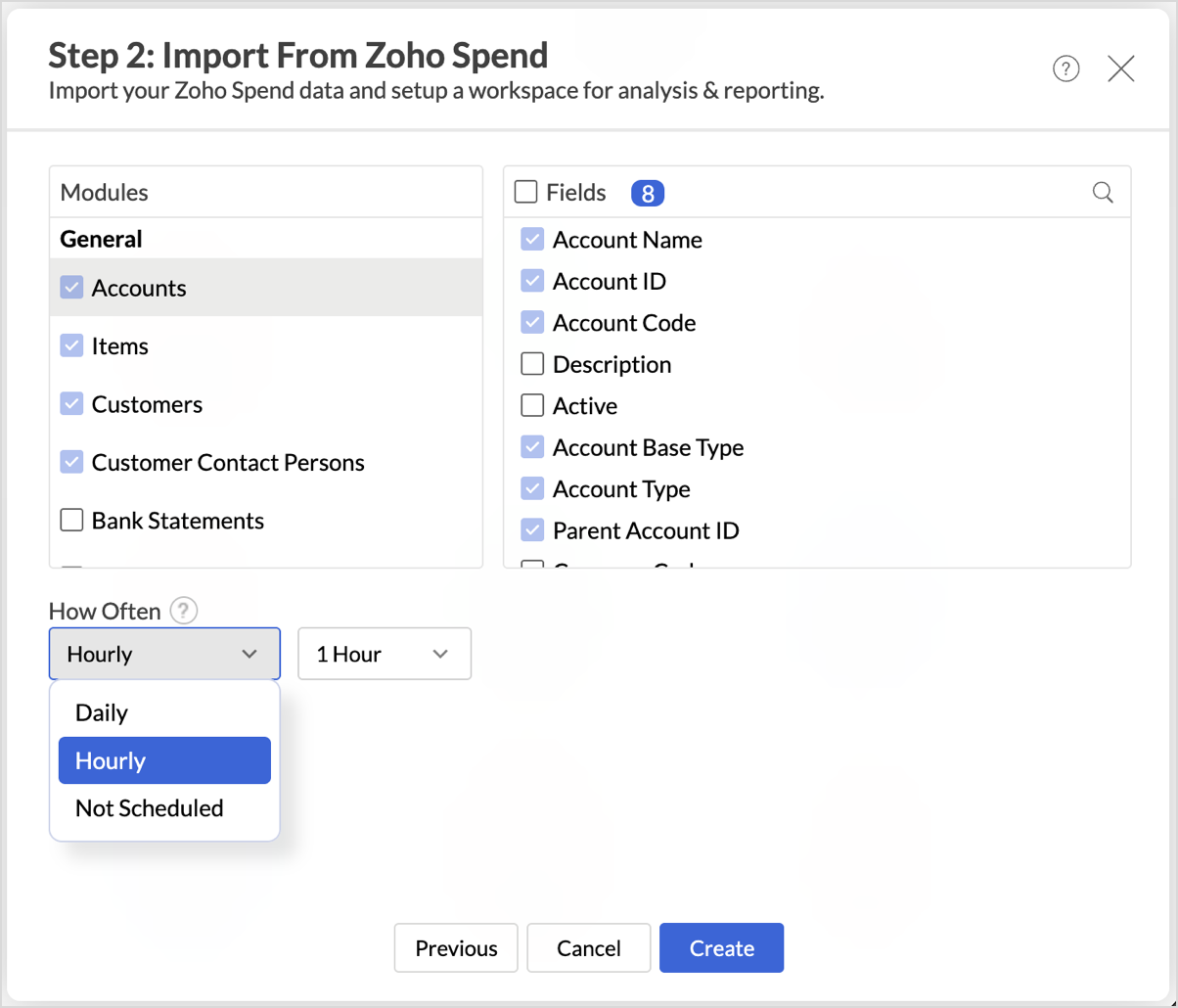
- Select the Modules and Fields.
- From the How Often section, choose the interval in which the data should be synced. Refer to the Data Sync Frequency section to learn more.
- Click Create. Import will be initiated.
Note:
- The initial fetch might take a few minutes depending on the volume of the data to be imported. An email and an in-app notification will be sent, once the initial fetch is complete.
- The setup process can sometimes fail for a variety of reasons. In this case, we request you to access the Data Sources tab and click the Retry link to import again. If the issue persists, write to us at support@zohoanalytics.com.
Modules & Fields
The below table lists the modules and fields that will be synced to Zoho Analytics.
Some fields may vary depending on the selected organization’s country and currency.
| Modules | Fields |
| Accounts | Account Name, Account ID, Account Code, Description, Active, Account Base Type, Account Type, Parent Account ID, Currency Code, Owner ID, Sub Type, Last Modified Time, Created Time |
| Items | Item ID, Item Name, SKU, Type, Sales Description, Purchase Description, Sales Price, Product Category, HSN/SAC, Tax Exemption ID, Tax ID, Status, Product Type, Source, Usage unit, Last Modified Time, Created Time, Created By, Modified By |
| Customers | Last Modified Time, Customer ID, Customer Name, Display Name, Company Name, Salutation, First Name, Last Name, Email, Phone, Mobile Phone, Credit Limit, Payments Due, Payment Terms Label, Currency Code, Notes, Website, Status, Customer Sub Type, Default Address ID, Customer Owner ID, Place Of Supply, Tax Exemption ID, GST Treatment, GSTIN, Source, Created Time, Created By, Modified By, Accounts Receivable, Bank Account Payment, Portal Enabled, PAN Number |
| Customer Contact Persons | Customer ID, Contact Person ID, Salutation, First Name, Last Name, Email, Phone, Mobile Phone, Last Modified Time, Created Time, Created By, Modified By |
| Bank Statements | Statement ID, Statement Line ID, Date, Debit or Credit, Amount, Account ID, Payee, Description, Reference Number, Status, Exclude Description, Last Modified Time, Created Time, Created By, Modified By |
| Timesheet | Project ID, User ID, TimeSheet ID, Task ID, Invoice ID, Invoice Item ID, Notes, Time Spent, Date, Cost Rate Per Hour, Billable Status, Billed Status, Last Modified Time, Created Time, Created By, Modified By |
| Projects | Project Name, Project Code, Project ID, Project Head ID, Description, Billing Type, Project Cost, Customer ID, Budget Type, Budget Amount, Budgeted Cost, Project Budget Hours, Status, Last Modified Time, Created Time, Created By, Modified By |
| Tasks | Id, Task ID, Task Name, Description, Project ID, Task Rate Per Hour, Budget Hours, Is Billable, Last Modified Time, Created Time, Created By, Modified By, Task Status |
| Taxes | Id, Tax ID, Tax Name, Tax Percentage, Tax Type, Tax category, Start Date, End Date, Deleted, Created Time, Last Modified Time, Created By, Modified By |
| Reporting Tags | Id, Tag ID, Tag Name, Option ID, Option Name |
| Customer Addresses | Id, Customer ID, Address ID, Shipping Address Attention, Shipping Street, Shipping Street 2, Shipping City, Shipping State, Shipping Country, Shipping Code, Shipping Phone, Shipping Fax, Billing Address Attention, Billing Street, Billing Street 2, Billing City, Billing State, Billing Country, Billing Code, Billing Phone, Billing Fax, Created Time, Last Modified Time, Created By, Modified By |
| Users | Id, User ID, UserName, Email, Status, Created By, Modified By |
| User Details | Id, User ID, Status, App Name, Role, Created By, Modified By, Created Time, Last Modified Time |
| Departments | Id, Department ID, Department Name, Department Code, Department Head ID, Description, Created By, Last Modified By, Created Time, Last Modified Time |
| Project User | Id, Project ID, User ID, Staff Rate Per Hour, Cost Rate, Budget Hours, Orders, Created By, Modified By |
| System Mails | Id, Mail History ID, From Address, To Address, CC Address, BCC Address, Subject, Date, Mail Type |
| Budgets | Id, Budget ID, Budget Name, Budget Period, Start Date, End Date, Option ID, Tag ID, Project ID, Last Modified Time, Created Time, Created By, Modified By |
Data Sync Frequency
Zoho Analytics offers flexible sync schedules to ensure that your data is always up-to-date for effective analysis. These schedules allow you to automate the process of updating your data, ensuring that your analyses are based on the latest information.
- 1 Hour (Enterprise plan)
- 3 Hours (Standard plan and above)
- 6 Hours (Standard plan and above)
- 12 Hours (Standard plan and above)
- Daily (Basic plan and above)
Handling Data Synchronization Failure
Data synchronization can fail if,
- Authentication to the Zoho Spend account has expired or was revoked.
- The data type of a field is changed in the Zoho Spend Application.
- The Modules and Fields selected for analysis are deleted in the source application.
- The user who configured the integration no longer has permission to access the modules.
In any of the above mentioned cases, the data sync will be paused. You will be notified via email and in-app notification with the exact reason for failure along with the solution.
To resolve the sync failure, delete or restructure the views, or restore the specific modules and fields from the source application. Refer to Data Sync failure and solutions article for more details.
Once you have made the changes, click the Sync now option to resume the data sync. If the issue persists, mail us at support@zohoanalytics.com.
Managing Data Sources
The Data Sources tab provides essential information to monitor and manage the integration setup. It also allows you to edit the settings as needed. Users with administrator privileges will be able to view and modify the connection settings.
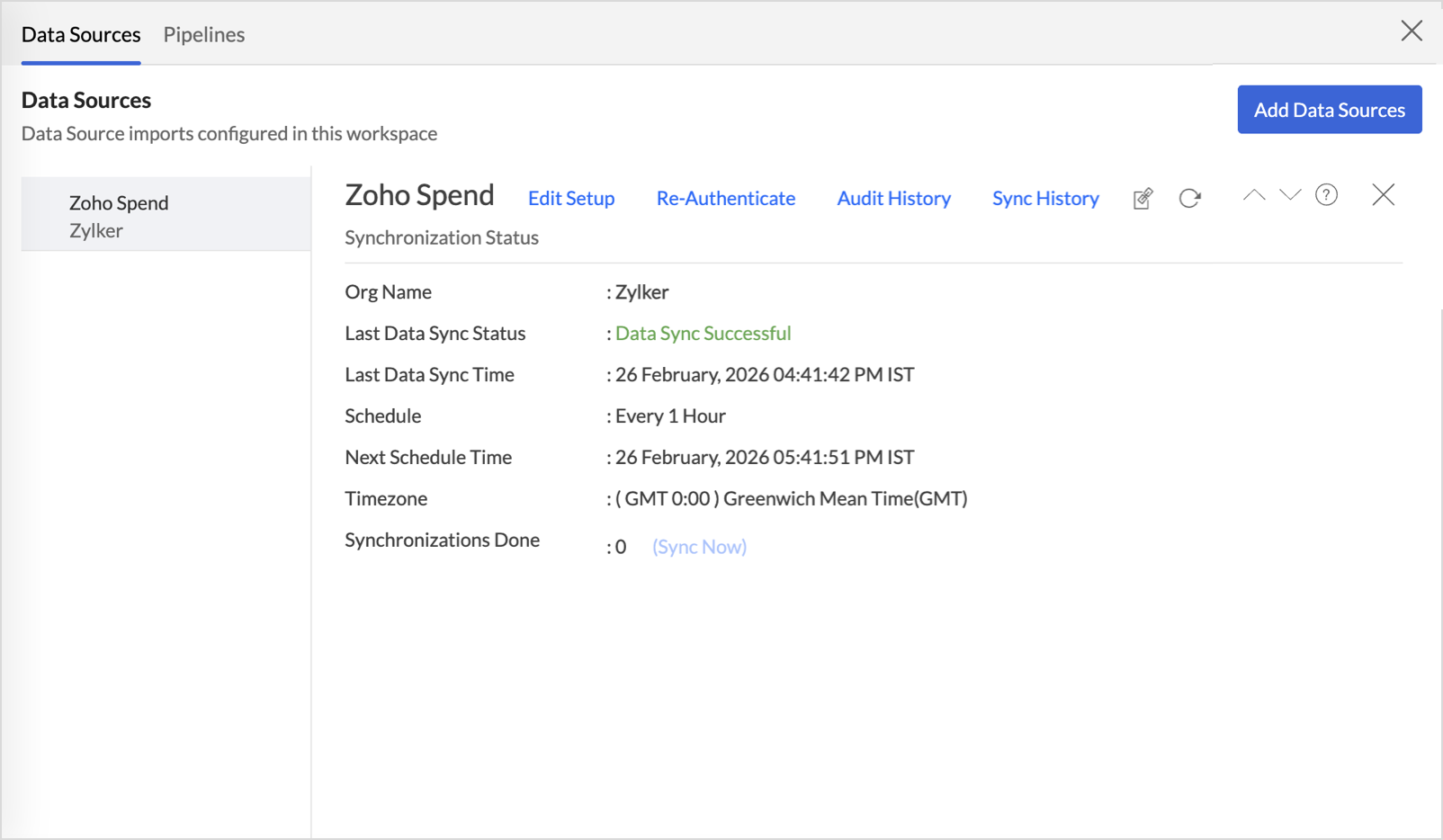
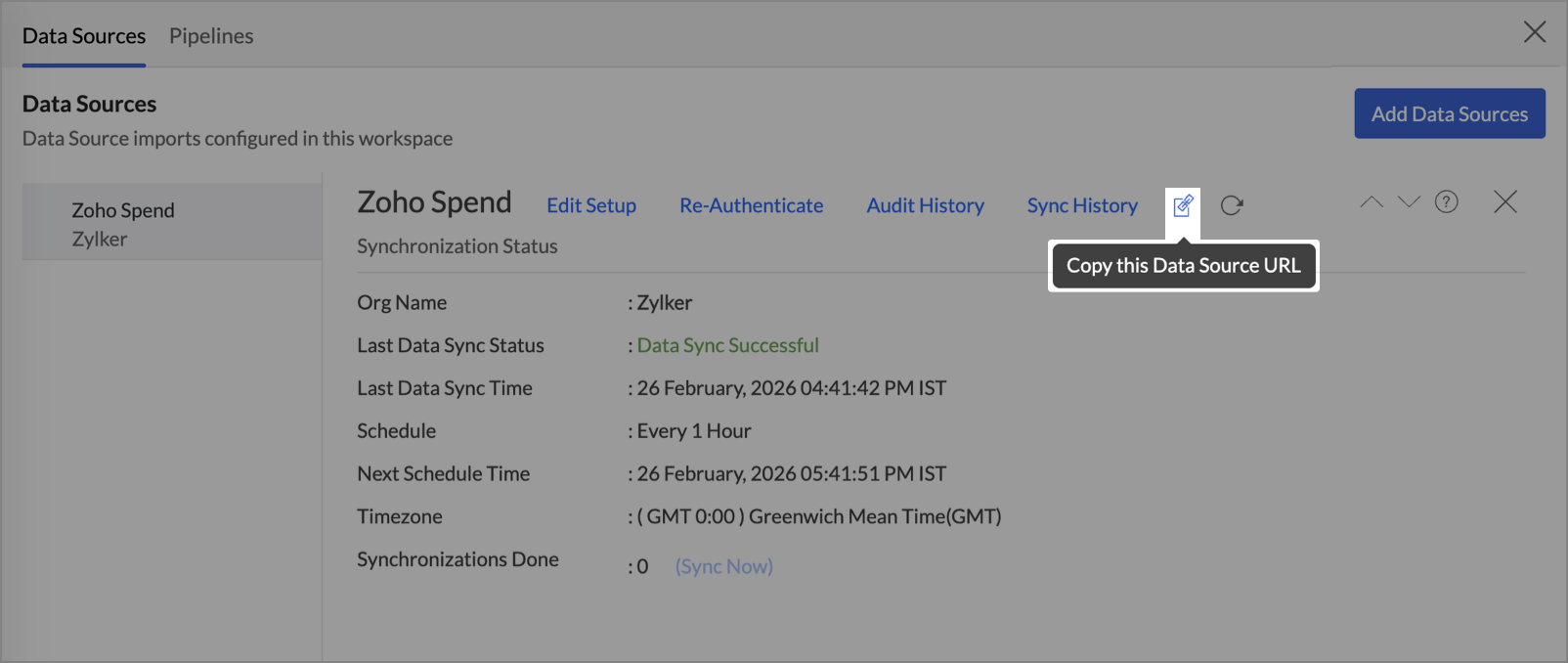
Data Source URL
The Data Source URL helps you easily access the data source tab. Only the Organization Admin and Account Admin can make changes in the Data sources page. Other users can know the synchronization details like whether the last data sync was successful or not, when the last data sync happened, when the next sync is scheduled to happen, etc.
This link can also be pasted in dashboards so that everyone accessing the dashboard can know about the sync status.
Note: Additionally, users with Organization Admin and above privileges can do the following actions :
- Edit Setup
- Re-Authenticate
- Audit History
- Sync History
Edit Setup
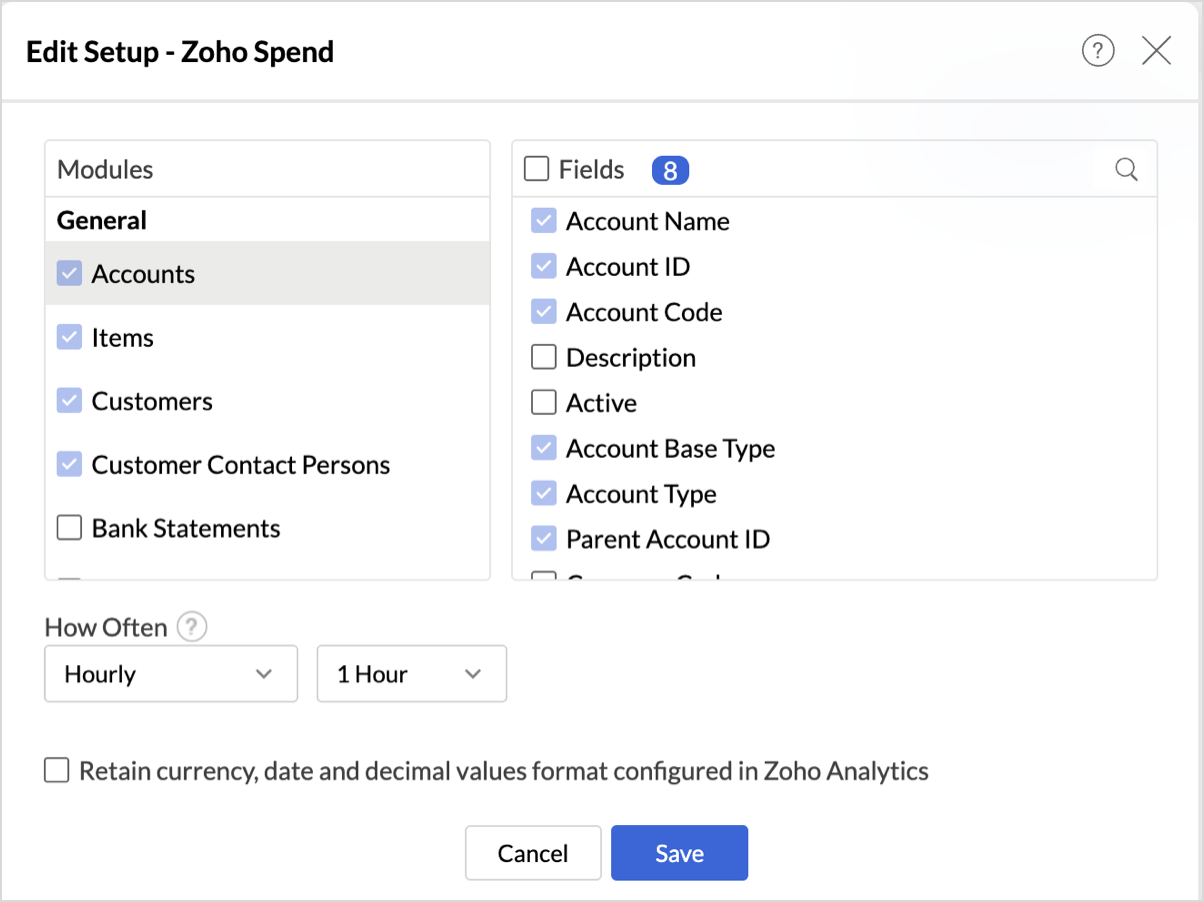
The Edit Setup tab allows you to add or delete modules or fields, change the schedule interval, and modify other settings specific to the business application.
To modify the settings,
- Click Data Sources > Edit Setup.
- The Edit Setup - Zoho Spend dialog will open. Modify the settings as needed and click Save.
Re-Authenticate
Re-authentication will be helpful when the API key or password is changed. In this case, the data sync will be paused, and the administrators must re-authenticate to resume the data sync.
To re-authenticate,
Click Data Sources > Re-Authenticate. The Re-Authenticate Zoho Spend dialog will open. Click Authenticate Zoho Spend and enter the Zoho Spend credentials to re-authenticate.
Sync History
The Sync History tab provides details about the data sync for the last 45 days. A successful data sync is marked in green, and a sync failure is marked in red.
To view the sync history,
- Click Data Sources > Sync History.
- A calendar with the Sync History of the last 45 days will open. The date when the data sync has happened will be highlighted. Hover to view the number of times the data had got synced on a specific date.
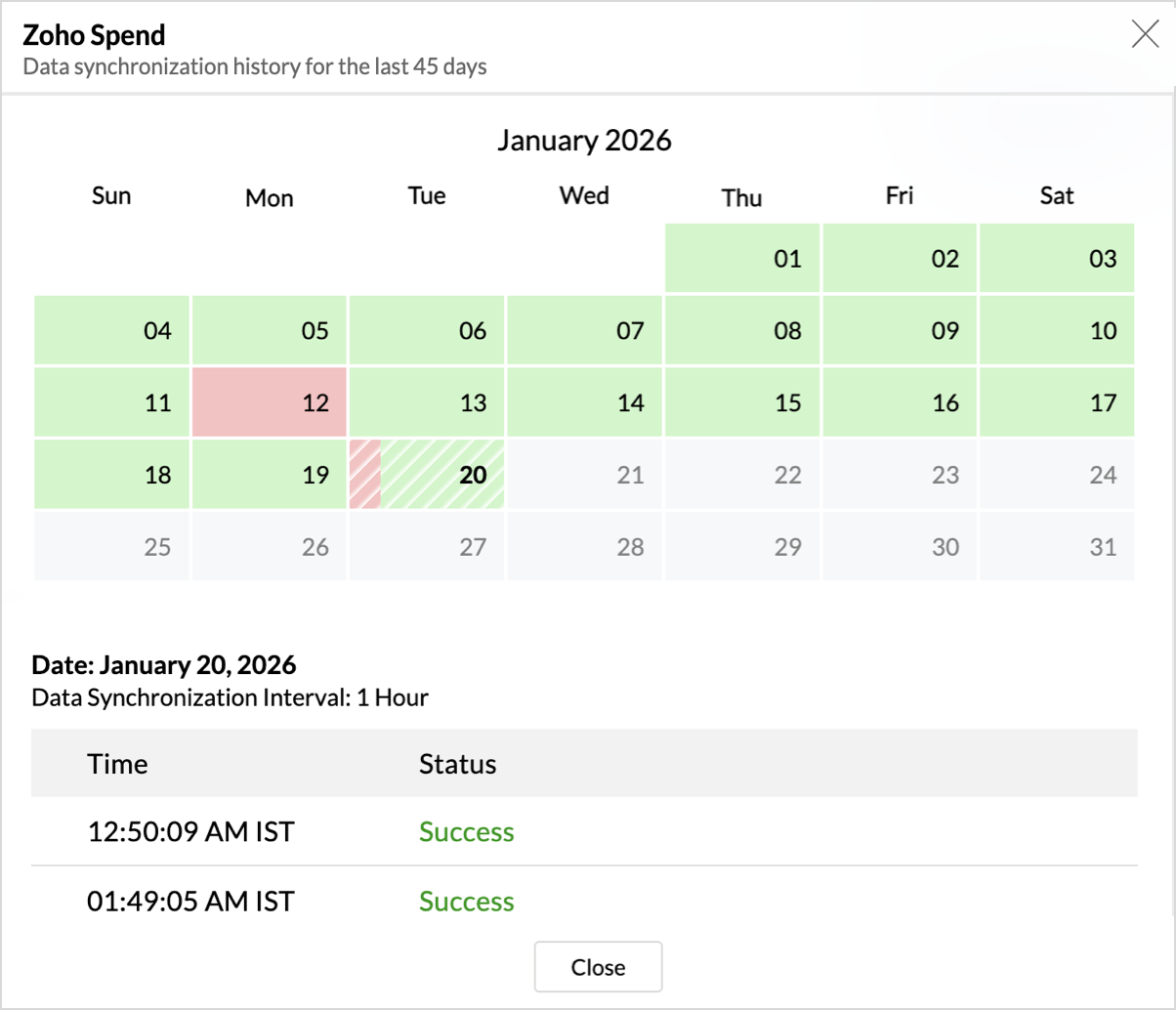
- Click the date to view more details.
- Time - Displays the time when the data is synced.
- Status - Shows whether the sync was a success or a failure. In case of failure, the reason will be displayed. Refer to resolving sync failures article to learn how to resolve the issue and avoid further failure.
Audit History
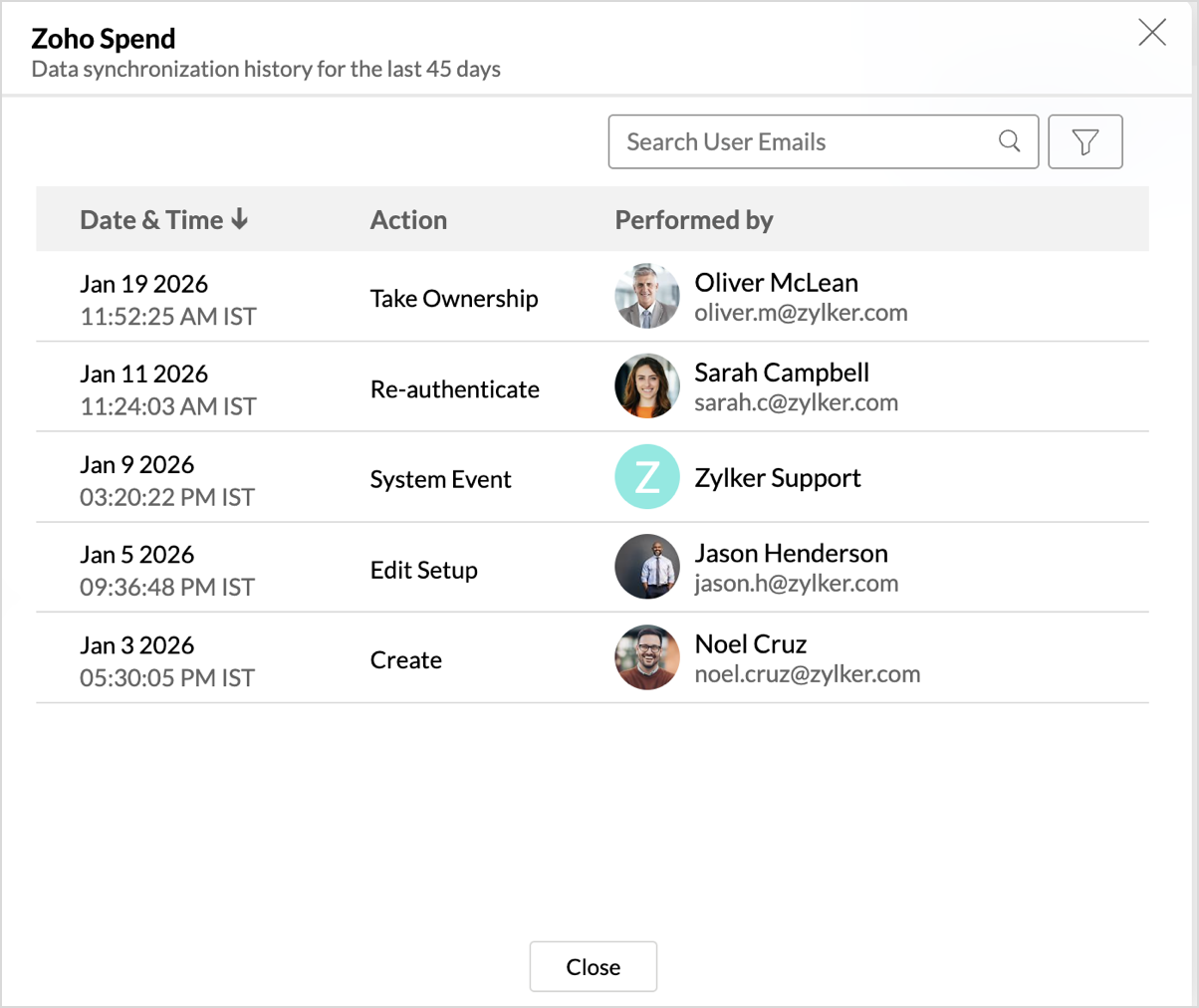
Zoho Analytics logs all the user activities and system events within the Zoho Spend workspace. The following actions are logged in Zoho Analytics,
- User Action: Create, Modules Added, Modules Removed, Fields Added, Fields Removed, Schedule Change, Entities Modified, Delete, Take Ownership, Re-authenticate, Sync Now, and Retry.
- System Action: Plan upgrade or downgrade.
Remove Data Source
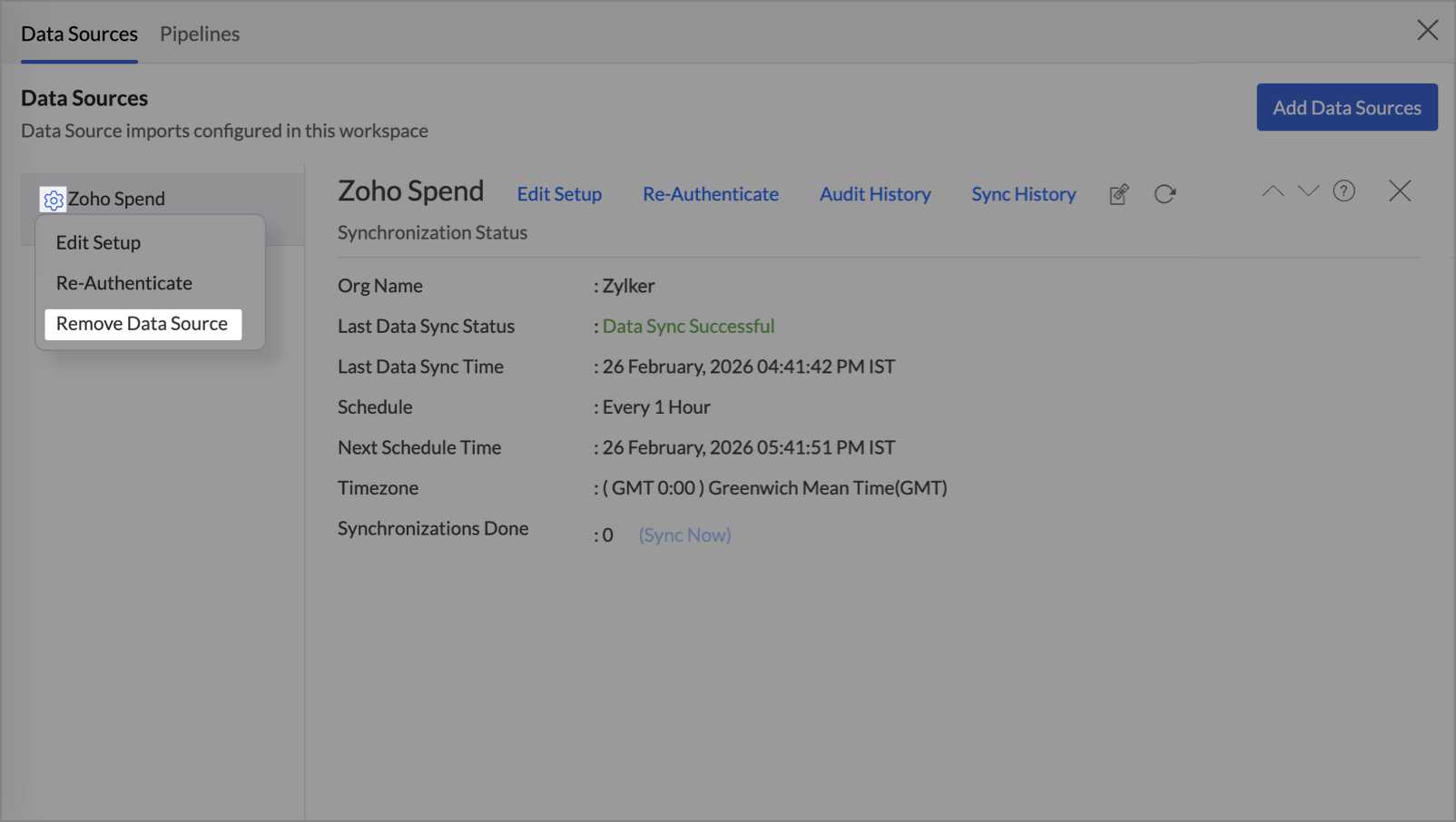
Zoho Analytics allows you to remove the integration when it is no longer required. Removing the integration deletes the data source along with all synced data tables, related reports, and dashboards. Further data synchronization will also stop.
Click the Settings icon in the Data Sources tab, and select Remove Data Source from the drop-down menu.
Data Modeling & Preparation
Zoho Analytics allows you to combine data from various sources such as Files, Feeds, Databases and business applications for in-depth analysis. Query Tables allow you to combine data from different tables to create reports. The SQL Query Suggester helps to build complex queries.
Zoho Analytics auto identifies similar columns and provides suggestions for lookup while importing. Click here to learn more about joining tables.
How can you visualize and analyze Zoho Spend data?
Zoho Analytics allows you to create a wide range of visualizations to analyze Zoho Spend data and gain actionable insights into company expenses and financial performance. You can build reports and dashboards to track spending trends, monitor budget utilization, analyze vendor payments, evaluate expense categories, identify cost overruns, and improve overall spend control.
- Zoho Analytics offers a wide range of visualization types to conduct your analysis. Refer to the Creating Reports section to learn more. The chart type primer lists all the viz types available in Zoho Analytics.
- With Predictive analytics, forecast future trends, detect anomalies, and segment data using Cluster analysis.
- Find the What, Why and How behind any outcome with Zia Insights.
Sharing and Collaboration
- Use fine-grained permission control over your shared data and reports while collaborating with your colleagues & friends.
- Efficiently collaborate with your users by setting up real-time commenting on a shared view.
- Publish reports for wider consumption. Embed reports/dashboards within your websites, web applications, and blogs.
- Export, email, and print reports in a variety of formats.
- Get the mobile apps (optimized for both IOS and Android platforms), and access data, reports and dashboards on the go.
Technical Support
We offer 24x5 technical support (Monday to Friday). In case if you need our assistance, kindly do mail us your questions to support@zohoanalytics.com.
You can also reach out to us on our toll-free numbers.
United States: +1 (888) 900 9646
United Kingdom: +44 (20) 35647890
Australia: +61-2-80662898
India: +91 44 6965 6060