How franchises can manage Google reviews at scale
- Last Updated : May 18, 2026
- 11 Views
- 5 Min Read

You built a franchise to grow. But every new location you open adds another pile of reviews to manage, another voice speaking on behalf of your brand, and another way things can quietly go wrong.
Running a franchise is one of the great experiments in controlled chaos. You have a brand, a playbook, standards. Then you hand a piece of it to someone else to run. And then another someone. And another. Each location is supposed to feel like you. Most of the time, it does. But your Google reviews? That's where the cracks start to show.
This isn't a piece about why reviews matter. You already know they do. This is about the part nobody talks about enough: The operational nightmare of managing Google reviews when you have 20, 50, or 500 locations all generating feedback at the same time, with no guarantee that any of it is handled consistently.
The visibility gap
Most franchisors can't tell you, right now, which of their locations hasn't responded to a review in the last 30 days. That blind spot is where reputation quietly takes a hit.
The brand dilution risk
One location with a three-star average and zero responses doesn't just hurt that location. It introduces doubt about every other location carrying the same name.
The "everyone does their own thing" problem
Franchises give each location the freedom to run their own show. Great for operations. But when every location handles reviews on their own, you don't have one reputation strategy. You have 50 different ones, and most of them aren't working.
These aren't hypothetical problems. Look at your own locations on Google Maps right now. Unless you've already solved this, you'll find at least one location that's behind on responses, one with a rating that doesn't reflect the brand you've built, and one that's collecting reviews with no system behind it at all.
The real problems franchises face
Before any solution, here's an honest look at what's actually breaking down across franchise networks right now.
The inconsistency problem
Some franchisees are on it. They respond fast, they sound human, and they handle negative Google reviews effectively. Others haven't logged into their Google Business Profile in four months. That inconsistency isn't invisible. Customers see it. Google sees it.
The brand voice problem
When you leave review responses to individual location managers, you get 50 different versions of your brand. One replies with all caps. Another copies and pastes the same three sentences to every review. Another gets into arguments with customers. None of that is what you signed up for.
The visibility problem
Most franchisors have no real-time view into what's happening at the review level across locations. By the time a pattern of negative feedback surfaces, the damage is already done. There's no early warning system. There's just damage control.
The volume problem
Manual review management doesn't survive past three locations. It simply doesn't. At 10 locations, someone is always behind. At 50, you're drowning. The math is merciless: More locations means more reviews means more chances for something to fall through the cracks.
One bad location, left unmanaged, can become the most Googled story about your brand.
💡Something worth sitting with :
Your worst-reviewed location gets Googled the most.
There's a pattern that shows up consistently across multi-location brands: The locations with the lowest ratings tend to attract the most review page visits. Curious customers dig in. They read the bad ones. They scroll to see how the brand responded.
That means your lowest-rated locations are actually under the brightest spotlight. And if responses are slow, generic, or missing entirely, that's what people are seeing at exactly the moment they're already on the fence.
The locations that need the most attention are usually getting the least. Fixing that order of priority is often the single highest-leverage thing a franchise can do for its reputation.
What a scalable review system actually looks like
The franchises that win at reviews have a system—something repeatable that doesn't rely on any single manager remembering to do anything.
Centralize without suffocating
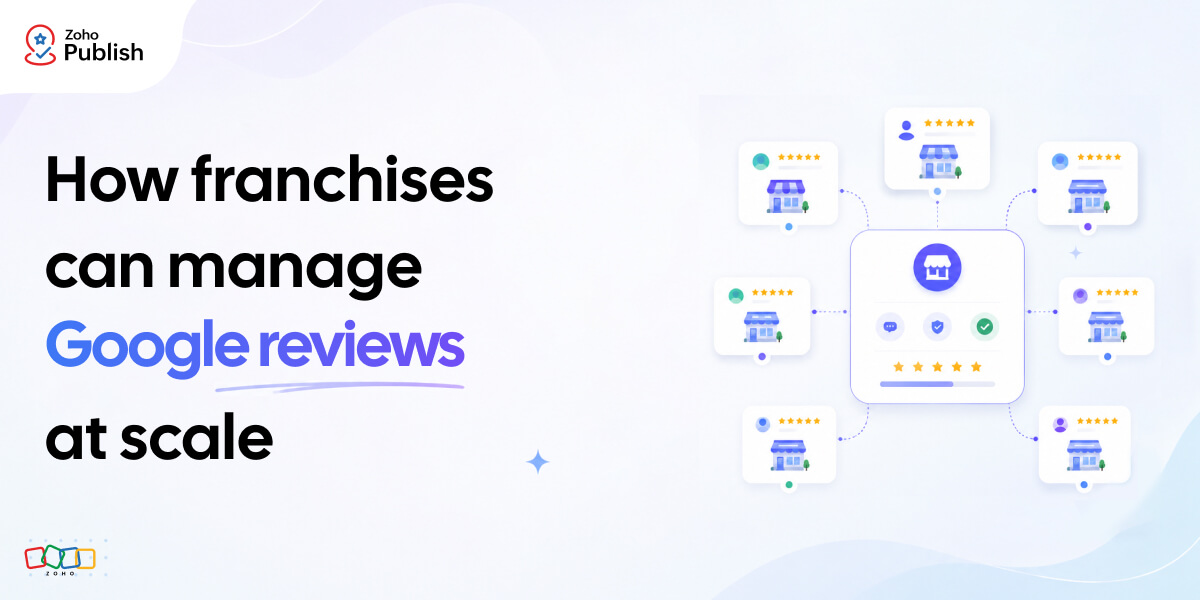
Give your head office a clear view of reviews across all locations. In a single dashboard, you can see every incoming review, every response (or lack of one), and every location's rating trend. You don't need to control everything. You need to see everything.
Build response templates with room to breathe
Create brand-approved response frameworks for common review types: positive, neutral, negative, and no-star-just-text. Templates keep your voice consistent. The local manager personalizes the middle. It's the best of both worlds.
Automate review requests at the point of transaction
Set up post-visit or post-purchase review request flows that trigger automatically. SMS works better than email for most franchise categories. Timing matters, too. Send the request within two hours of the visit, not two days later when the experience has gone cold.
Set response time standards and track them
More than half of consumers expect a review response within two to three days. Make that a standard across all of your locations. Flag locations that fall behind. Treat slow response times the same way you'd treat any other operational lapse.
Use review data as a management tool
Patterns in reviews are operational intelligence. If three locations are consistently getting complaints about wait times, that's not a review problem. That's a staffing or process problem. Reviews tell you what your mystery shoppers aren't.
Getting the brand voice right across locations
This is where most franchises under-invest. They create a review response policy and send it to location managers as a PDF. Two weeks later, it's forgotten.
The difference between a great response and a damaging one often comes down to five or six words. Here's what that actually looks like in practice:
Scenario | What not to say | What would work |
1 star, no comment | "Sorry you feel that way." | "We'd love to make this right. Please reach us at [contact]." |
Negative about a specific staff member | "That employee no longer works here." | "This isn't the experience we want for you. We're looking into it." |
Glowing 5-star review | "Thanks! 😊" | "This genuinely made our team's day. See you next time, [Name]." |
Complaint about wait times | No response. | "You're right, and we're actively working on it. Thank you for telling us." |
A personalized response to a negative review can bring back customers who were ready to walk. Responding isn't just reputation management. It's customer retention at scale.
The metric most franchises ignore
Star ratings get all of the attention. But review velocity, the rate at which new reviews come in, is quietly one of the most important signals both for Google's ranking algorithm and for consumer trust. A location with 400 reviews but the last one is from eight months ago looks stagnant. A location with 80 reviews and three from this week looks alive.
Build review generation into the customer experience itself, not as an afterthought. Train staff. Use QR codes at the point of sale. Include a gentle ask in post-visit messages. Make it easy, make it timely, and make it consistent across every location.
The franchises pulling ahead in local search aren't doing anything exotic. They've just made reviews a system, not a task. That's the whole game.