- HOME
- Reputation
- AI-powered reputation management: The future of customer engagement
AI-powered reputation management: The future of customer engagement
- Last Updated : September 7, 2026
- 20 Views
- 4 Min Read

Imagine owning a business where every customer conversation happens in one room. Customers share compliments, complaints, questions, and suggestions, and you learn from every interaction. Now imagine that room filled with 10,000 people talking at once. That is what managing your online reputation feels like today.
Every review, rating, and response shapes how customers perceive your business. The challenge is no longer collecting reviews; it's understanding them quickly enough to act on it. That's where AI is transforming reputation management, helping businesses listen, understand, and respond at a scale that was never possible before.
Why traditional reputation management is no longer enough
For years, reputation management followed a simple process. A customer left a review, someone from the business replied, and the conversation ended.
That approach worked when businesses managed a single location and received only a handful of reviews each week, but customer expectations have changed. Businesses today often manage dozens of locations, receive reviews across multiple platforms, and interact with hundreds or even thousands of customers every month.
As businesses grow, reputation becomes more difficult to manage manually. Reading every review, identifying recurring complaints, comparing performance across locations, and ensuring consistent responses quickly becomes overwhelming.
The volume of customer conversations has grown faster than most businesses' ability to manage them. AI is helping close that gap. Understanding the fundamentals of reputation management and why it matters to your business is a good starting point before deciding where AI can add value.
AI understands patterns, not just individual reviews
One of AI's biggest strengths is recognizing patterns that humans would take much longer to discover.
Imagine receiving 2,000 customer reviews over the course of a month. Reading every review is possible, but identifying the common themes across all of them takes significant time and effort.
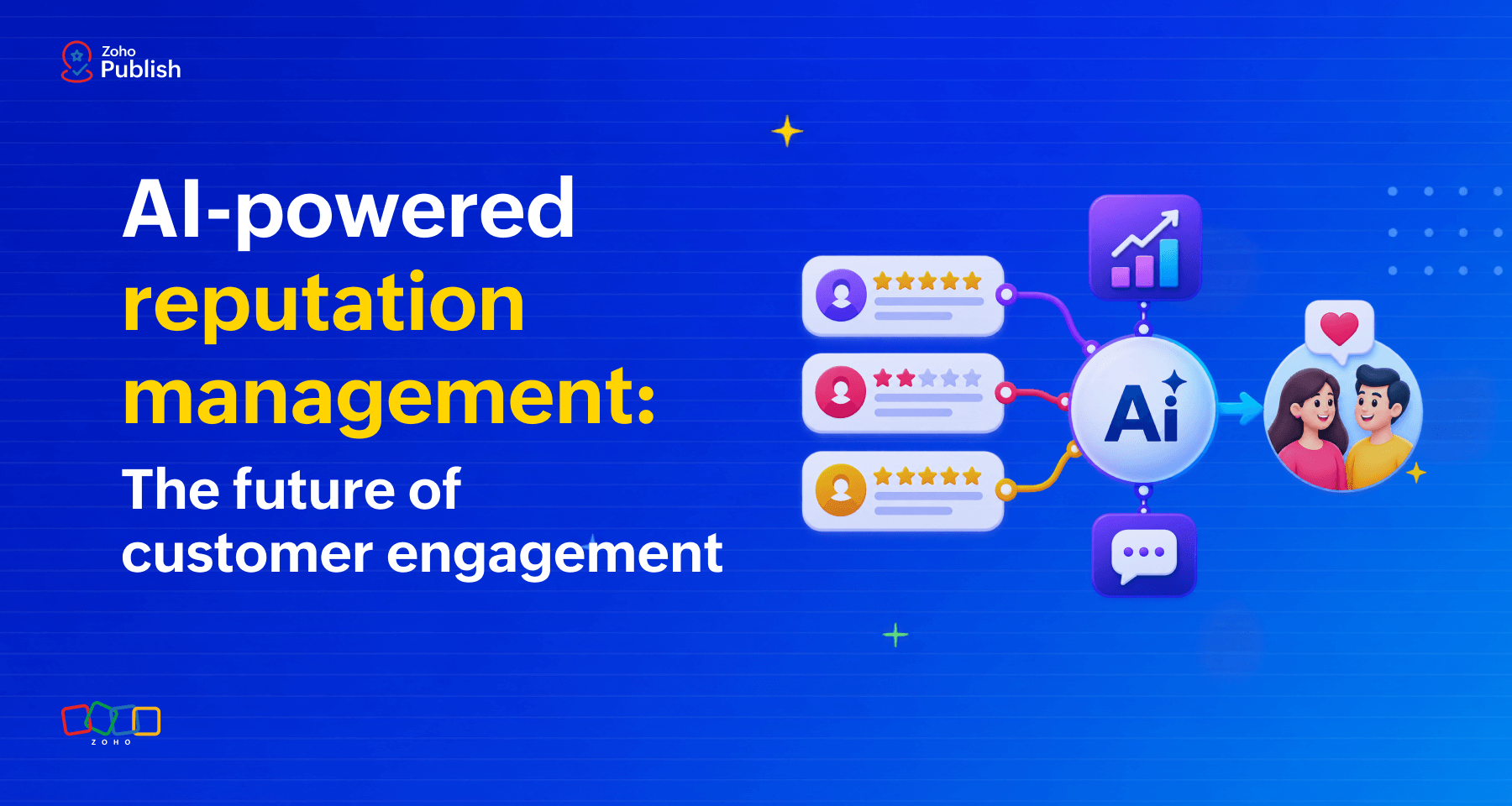
AI can analyze those reviews collectively. Instead of treating every review as an isolated conversation, it groups similar experiences together, identifies recurring praise and complaints, detects sentiment, and highlights emerging trends.
This changes how businesses use customer reviews.
If dozens of customers mention long waiting times, AI identifies that as an operational issue rather than a collection of unrelated complaints. If customers consistently praise your staff or service quality, AI recognizes those strengths as opportunities to reinforce your brand.
Businesses no longer have to rely on intuition alone. They can make decisions based on patterns supported by customer reviews.
AI helps businesses focus on what matters most
Not every customer review deserves the same level of attention.
A positive review thanking your team may only require a personalized acknowledgement. A review describing poor service, incorrect business information, or a serious complaint may require immediate action from the right department. The challenge is knowing where your attention is needed first.
AI helps businesses prioritize customer conversations by identifying urgency, classifying topics, recognizing sentiment, and surfacing reviews that need immediate action. Instead of spending hours sorting through reviews manually, teams can focus on solving problems that have the greatest impact on customer experience.
Deloitte's 2026 State of AI in the Enterprise report found that organizations are rapidly scaling AI adoption, with the greatest business value coming from combining AI with human judgment, effective governance, and well-designed workflows.
Reputation management follows the same principle. AI accelerates the analysis, while people build the relationships.
The businesses succeeding with AI are using it differently
The businesses seeing the greatest value from AI are not trying to automate every customer interaction. They use AI where it performs best: reading large volumes of reviews, identifying recurring themes, suggesting personalized review responses, and highlighting issues that deserve human attention.
Human judgment remains essential. Employees understand context, emotions, and customer relationships in ways AI cannot. A thoughtful response to a frustrated customer still requires empathy, accountability, and sound business judgment.
The best customer engagement strategies combine AI's speed with human understanding.
Reputation management is becoming proactive
Traditionally, businesses reacted to customer words after problems became visible. Ratings declined, and complaints accumulated, and only then did teams investigate what had gone wrong.
AI is gradually changing this reactive approach.
By continuously analyzing customer reviews, businesses can identify recurring concerns much earlier. They can monitor changes in sentiment, compare locations, recognize operational issues, and detect opportunities for improvement before those issues begin affecting customer trust or local visibility.
This shift is especially valuable for multi-location businesses. When customer reviews from every location are analyzed together, businesses gain a clearer understanding of which branches consistently perform well, which locations need operational support, and which successful practices should be adopted across the organization. This visibility also helps address some of the biggest reputation challenges for multi-location brands, from maintaining consistency to managing a growing volume of reviews.
What leading businesses are doing today
Businesses using AI effectively tend to follow similar practices. They review customer reviews regularly instead of reacting only to negative ones. They monitor trends across locations instead of focusing on individual comments. They use AI to identify recurring themes but involve people when responding to sensitive customer conversations. Most importantly, they treat customer reviews as a source of business intelligence rather than simply another task to complete. This approach creates benefits that extend far beyond reputation.
Customer reviews help businesses improve operations, strengthen customer experience, train employees, identify new opportunities, and build greater trust with future customers.
The businesses that grow fastest are often the ones that learn fastest.
The future of customer engagement starts with better listening
Customer expectations continue to evolve. People expect faster responses, personalized interactions, and businesses that genuinely understand their experiences. At the same time, the number of customer reviews continues to grow across every platform where businesses maintain a presence.
AI gives businesses the ability to understand those conversations at a scale that was never possible before. It transforms thousands of individual reviews into meaningful insights, helping teams identify patterns, prioritize improvements, and make better decisions without losing the human element that customers value.
The future of reputation management will not be defined by businesses that automate the most; it will be defined by businesses that understand their customers the best.