- HOME
- Reputation
- The biggest reputation challenges for multi-location brands (and how to fix them)
The biggest reputation challenges for multi-location brands (and how to fix them)
- Last Updated : May 21, 2026
- 147 Views
- 8 Min Read

A regional manager at a 40-location home services franchise gets a call from the VP of Marketing. A customer in Austin left a 1-star Google review with photos. It's been sitting unanswered for 11 days. Three other people have left similar complaints at that same location in the past month.
Nobody responded. Nobody even noticed.
This is not an isolated story. It plays out every week across multi-location businesses in retail, healthcare, restaurants, financial services, and beyond. The brand runs national campaigns, maintains brand gui
delines, and invests in customer experience. But the reputation breaks quietly at the ground level, one unanswered review at a time.
Managing reputation at scale is a fundamentally different problem than managing it for a single location. And most businesses don't have systems built for it.
Why reputation breaks at the location level
Brand reputation is not one thing. It is the sum of thousands of micro-experiences happening simultaneously across every location you operate. At its core, this comes down to how well your review management and listing practices hold up at scale.
A glowing review in Dallas. A 2-star complaint in Denver. An outdated phone number on a Google Business Profile in Atlanta. A manager in Phoenix who responds to every review within 24 hours. A location in Chicago where nobody has touched the GBP in eight months.
None of these feel catastrophic individually. Together, they create a fractured brand presence that confuses customers, weakens local search rankings, and quietly erodes trust at scale.
The challenge is not that businesses don't care about reviews. The challenge is that the systems they use to manage them were not built for scale.
Challenge 1: Inconsistent listings across locations
Before a single customer reads your reviews, they need to find you. Finding you depends almost entirely on whether your business listings are accurate, consistent, and complete.
For a business with 20, 50, or 200 locations, this is harder than it sounds. Business details change. Hours shift for holidays. Phone numbers get updated. A location moves half a mile down the road. On the back end of that change is an avalanche of listing updates that need to happen simultaneously across Google, Apple Maps, Bing, Facebook, and more.
When those updates don't happen, you get what local SEO practitioners call NAP inconsistency, which is mismatched name, address, and phone information across platforms.
Google's own ranking systems treat listing completeness and accuracy as direct signals for local search. An incomplete or inconsistent listing is not just a customer experience problem. It is a rankings problem.
What this looks like at scale
A franchise with 80 locations might discover through an audit that:
14 locations have outdated holiday hours still live from last year
23 locations are missing a business description
6 locations have conflicting addresses between Google and their website
11 locations have not added a single photo in over 12 months
Each one of those is a quiet drag on local search visibility and customer confidence.
What to do next
Run a full NAP audit across all locations on listing sites where your business has a presence.
Prioritize your Google Business Profile first, since it drives the most local search traffic.
Standardize your listing update process. When any location detail changes, it should trigger an automatic update across all platforms, not a manual ticket.

Challenge 2: Review volume that's uneven across locations
Star ratings are not created equal. A brand average of 4.2 stars means very little when five of your top locations are pulling a 4.8 and three underperforming locations are dragging at 3.1.
Prospective customers do not search for your brand. They search for the nearest location. What they find at that location level, the rating, the review count, the recency of reviews, is what determines whether they call you or your competitor.
According to the Whitespark 2026 Local Search Ranking Factors report, review signals account for 20% of local ranking weight, making them the second most influential category after Google Business Profile signals. Review recency, quality, and count all factor into that weight.
The bigger issue for multi-location businesses is the gap. Your best-performing locations have hundreds of recent reviews. Your worst-performing locations have 12 reviews from 2021. That gap does not just hurt those weaker locations. It creates an inconsistent brand experience that erodes customer confidence at the brand level.
What this looks like at scale
A casual dining chain with 60 locations runs an audit and finds:
Top 10 locations average 310 reviews each
Bottom 10 locations average 28 reviews each
8 locations have not received a new review in over 90 days
The problem is not that customers are unhappy at the underperforming locations. It's that no one is asking for reviews, and there is no system to change that.
What to do next
Check your review volume by location. Which locations have the most reviews, and which are the furthest behind?
Build a post-visit review request workflow for low-volume locations. SMS and email follow-ups after a service appointment or purchase consistently outperform in-store signage.
Set minimum review volume benchmarks per location per quarter. Treat them like operational KPIs, not marketing nice-to-haves.
Investigate low-rated locations for operational patterns, not just marketing fixes. A 3.1-star location often has an underlying service or staffing issue that no amount of review requests will solve.
Challenge 3: Reviews going unanswered
Responding to reviews is one of the most underutilized reputation levers in local SEO, especially on Google Business Profile. Google reviews matter because they are often the first signals customers see. Responding shows that you value your customers and their feedback.
But for a brand with 50 locations averaging 20 new reviews per month, that's 1,000 reviews requiring individual, thoughtful, non-templated responses every single month. Most marketing teams are not resourced for that.
The result is predictable. Reviews pile up unanswered. Negative reviews sit visible for weeks with no brand response. Customers who left positive feedback feel ignored. Google reviews affect local ranking, and the signal Google receives is that this business does not actively engage with its customers.

Common mistakes to avoid
Templated copy-paste responses
Using the exact same "Thank you for your feedback!" response across hundreds of reviews is worse than it looks. Google's systems recognize repetitive patterns, and customers reading through your reviews will notice immediately.
Responding only to negative reviews
A response strategy that ignores positive reviews sends the message that you only show up when there's a problem.
Delegating responses without guidelines
Local managers responding without a framework will produce a wildly inconsistent tone, and sometimes make the situation worse.
What to do next
Set a 48-hour response SLA for all reviews, positive and negative.
Build a response framework with approved language for common scenarios, not copy-paste templates, but tone and structure guidelines.
Using AI to respond to Google reviews can support more consistent and well-structured replies.
Personalize every response with at least one specific detail from the reviewer's comment.
For negative reviews specifically, acknowledge, apologize where appropriate, and move the conversation offline. Include a direct contact method.
Assign ownership by location. Whether it's a local manager, a regional marketing lead, or a centralized team, someone needs to be accountable.
Challenge 4: No visibility into location-level performance
One of the most common conversations in multi-location review management sounds like this: "We know we have a reviews problem, but we don't know where it's worst."
Without a consolidated view across all locations, you find out about a reputation crisis from a complaint that reaches the VP level, not from a system that notified the right team member the moment a sensitive review came in. By the time it surfaces, the damage is already done.
This is the difference between managing your reputation reactively and managing it proactively. Brands that can see review trends, response rates, and rating movement across every location simultaneously can intervene early. Those that can't are always one step behind.
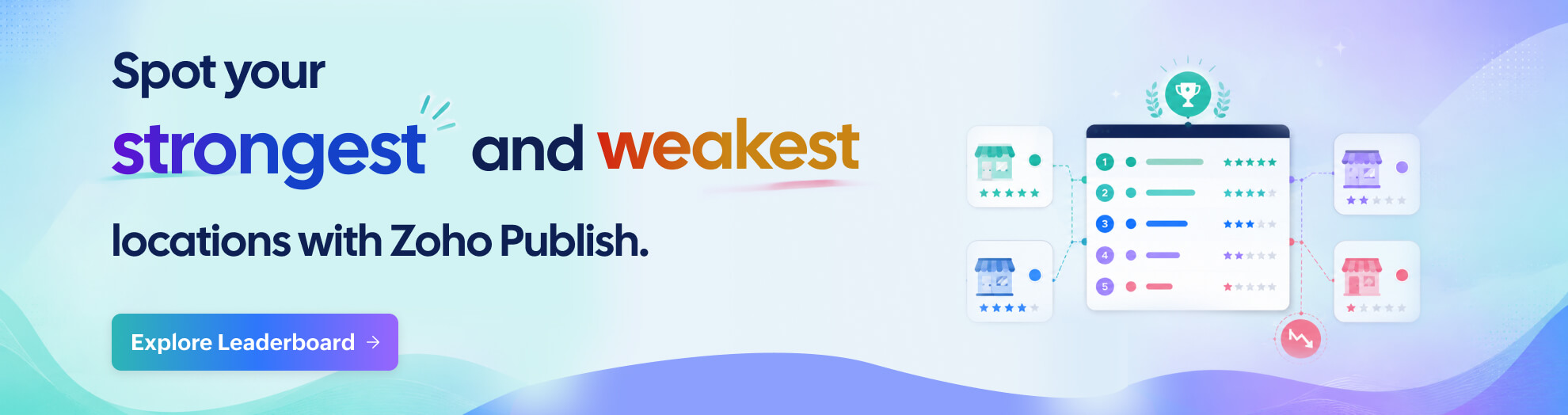
This is exactly where auto-review response and alerts change the game. In Zoho Publish, sensitive or negative reviews can be automatically assigned to a specific team member or escalated to a regional manager. Instead of a review sitting unattended, the right person is notified immediately and owns the response.
What this looks like in practice
A marketing agency managing reputation for a 120-location healthcare group needs to answer questions like:
Which 10 locations have the lowest response rates?
Which locations saw a rating drop of 0.3 stars or more in the last 60 days?
Which regions have the highest review velocity, and can we replicate that?
Are there recurring themes in negative reviews across specific location groups?
Without centralized tooling, answering each of these questions requires manually pulling data from platform to platform. With the right system, it takes seconds.
What to do next
Set your KPIs at both the brand and location level—minimum acceptable rating, response rate target, and review volume per quarter.
Build a monthly reputation report per region, not just overall brand averages.
Flag outliers automatically. Locations that drop below the set threshold should trigger alerts, not manual discovery.
Use review sentiment analysis to surface recurring themes at scale. Reading 1,000 reviews manually is not a strategy.
Challenge 5: Balancing brand consistency with local authenticity
This is the tension that every multi-location brand eventually faces.
Brand consistency protects your reputation at the macro level. It ensures that what customers experience in one market reflects the same values, quality, and promise as every other market. But overly rigid brand control kills the local authenticity that actually drives community trust.
The most effective multi-location brands have figured out how to hold both. They standardize the structure, the response framework, the listing format, and the review request process, while leaving room for local voice and community engagement.
A franchise location in a tight-knit neighborhood that responds to reviews by name, references local events, and engages with community comments will consistently outperform a location where every response sounds like it came from corporate legal review.
What to do next
Create a brand voice guide with permissible local customization zones. Define what stays consistent, such as tone and prohibited phrases and escalation process, and what can flex, such as local references, manager sign-offs, and community-specific language.
Give local managers or regional leads meaningful ownership over review responses, with training and oversight, not just approval chains.
Celebrate location-level wins internally. When a location improves its rating by 0.5 stars or hits a response rate milestone, recognize it. Behavior you reward gets repeated.

Conclusion
Reputation for a multi-location brand does not fall apart in one big moment. It erodes over time—one unanswered review, one outdated listing, one location with no recent photos, one manager who responds to complaints with corporate boilerplate.
The good news is that these are all fixable. The challenge is having the systems to catch them before they compound.
The brands that win at the local reputation level are not the ones with the most marketing budget. They are the ones that treat listing accuracy, review response rates, and location-level visibility as operational standards: measurable, accountable, and actively managed.
Start with an honest audit. Find your weakest locations. Fix the fundamentals. Then build the systems to keep them fixed.