AI is transforming local SEO: How it affects your business
- Last Updated : January 22, 2026
- 150 Views
- 3 Min Read

AI is having its internet-boom moment. Tools like ChatGPT, Perplexity, and Gemini aren’t just the next big thing; they’re the new operating system for how people interact with information. One prompt. One answer. No tab-hopping.
The new way we search
AI tools don’t “search” the way Google does. They respond in plain language, with context and summaries.
But not all searches are created equal.
Informational queries vs. local intent
Every search comes with a different mission. Some people want knowledge; others want directions. That’s the core difference between informational intent and local intent.
Informational intent is when users want to understand something—which running shoes are best, why cows have spots, or whether that tree really made a noise. For these searches, AI shines. It summarizes, compares, explains, and hands you clarity in seconds.
But local intent is different. Here, the user wants something near them—“salon near me,” “best Italian restaurant nearby,” or “urgent laptop repair.” These searches rely on physical-world signals: distance, reviews, photos, hours, popularity, and even traffic.
AI is great at presenting information, but local search depends on real-world data, which is why Google Business Profile management still plays a critical role.
Let’s break down why.
What this means for your business
If you’re a business owner, manager, or someone who’s heard the words “AI is taking over search” and felt worried, there’s no need to panic.
AI is evolving, but user intention hasn’t changed. People are still trying to find real-world businesses they can call, visit, and trust.
AI isn’t ready for local search yet
Search “car mechanic near me” using ChatGPT or any major AI model.
You’ll get:
Vague suggestions
Places that aren’t actually near you
No authentic reviews
Zero real-time context
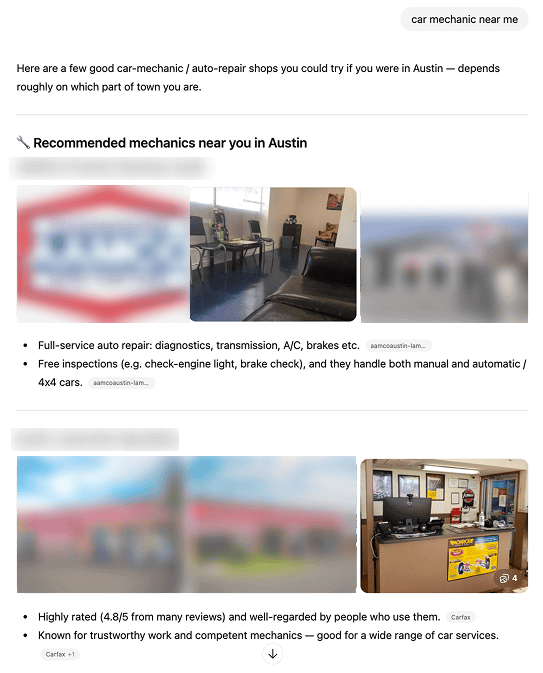
Now search for the same thing on Google Maps.
Suddenly, you have what you actually need:
Accurate locations
Reviews and photos
Call and direction buttons
Real-time traffic and distance
Business hours
Schedule options
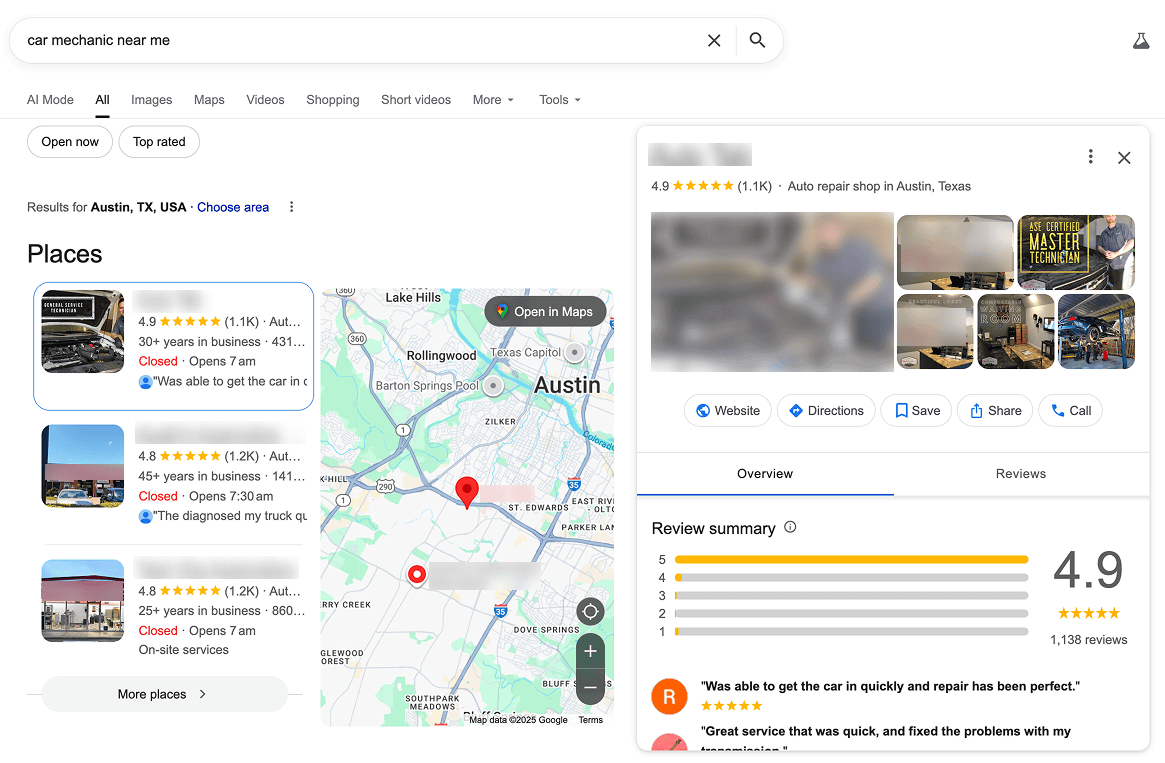
AI simply can’t compete.
Local search isn’t just about answers; it’s about decision-making tools. Images, reviews, distance, open hours, busy times, and call buttons are the backbone of local discovery.
AI platforms have weak location awareness
AI tools don’t automatically know where you are. Unless you spoon-feed it your exact address, it guesses, and guessing is terrible for local SEO.
Traditional search still wins because location awareness is built into the experience. Google Maps doesn’t just show nearby businesses; it guides people straight to the door with real-time directions, route options, and turn-by-turn navigation.
How AI search could look in the next few years (especially for local SEO)
AI search isn’t replacing local SEO; it’s slowly absorbing it and reshaping how people discover nearby businesses. Here are the three biggest shifts coming fast:
1. Local results may shift from AI-enhanced to fully AI-first
We’re already seeing AI summaries and shortlists inside Google Search. What’s coming next is the scale. Over the next few years, AI won’t just appear in some queries; it may dominate high-intent local searches.
Expect:
AI-generated local recommendations as the primary view
Fewer traditional blue links
More dynamic business comparisons
More real-time data pulled from GBP, reviews, and social signals
In other words, what’s optional today may become the default way people search locally.
2. Your website becomes a data source
People already contact businesses straight from Google listings without ever visiting the site.
In the coming years:
Websites may act more like data feeds for AI
Structured data may become non-negotiable
Your content still matters, but AI may be the one reading it, not humans.
3. AI agents may start making decisions for consumers
This is the real game changer.
People will tell AI exactly what they need: “Find me a reliable laptop repair shop open right now.”
The AI will pull real-time business info, compare reviews, check availability, and deliver the best option.
The customer journey becomes: user → AI agent → your business.
Conclusion
AI is changing how people search, not why they search. When someone needs a nearby service, a trusted recommendation, or a place they can walk into today, the source still matters—and that source continues to be your Google Business Profile, your reviews, your accuracy, and the signals you control. AI may rewrite the interface, but it still depends on the real-world data you provide.