

- HOME
- Accounts payables
- Accounts Payable: The complete guide for business owners and finance teams
Accounts Payable: The complete guide for business owners and finance teams
Every business that buys goods or services on credit has an accounts payable function that sits quietly in the background, but touches every vendor relationship, every outgoing payment, and every line of your balance sheet.
If you get it right, your business runs with financial discipline and vendor trust. Let it slip, and the consequences show up in your cash flow, your audits, and your supplier relationships before you realize something has gone wrong.
This guide covers everything you need to know about accounts payable. What it is, how it works, who owns it, and what separates businesses that manage it well from those that don't.
What is accounts payable?
Accounts payable, commonly abbreviated as AP, is the amount a business owes to its vendors, suppliers, and service providers for goods or services it has received but not yet paid for.
It is recorded as a liability on the balance sheet because it represents money the business is obligated to pay.
When your business receives an invoice from a vendor, that invoice creates an accounts payable entry. Once the invoice is paid, the entry is cleared. Everything that happens between those two moments, like validation, approval, scheduling, and the recording, is the accounts payable process.
It may help to distinguish AP from its counterpart - Accounts receivable.
Accounts receivable is money owed to your business by customers. Accounts payable is money your business owes to others. One tracks incoming value, the other tracks outgoing obligations.
In most organizations, accounts payable sits within the finance or accounting team and reports into a controller, CFO, or finance manager depending on the size of the business.
Why AP matters more than most businesses realize
AP is often treated as a back-office function. Necessary, but not strategic. That is a costly misconception. Your accounts payable directly influences how much cash you have on hand at any given time.
Paying invoices too early ties up cash that could be deployed elsewhere. Paying too late damages vendor relationships and can attract late payment penalties. The ability to time payments intelligently, based on due dates and cash flow forecasts, is one of the most practical levers a finance team has.
Beyond cash flow, AP is a frontline defense against financial errors and fraud. Invoices get duplicated. Vendors bill incorrect amounts. In the absence of a structured AP process, these errors go undetected and payments go out the door incorrectly. The cost of catching a payment error after the fact is almost always higher than preventing it in the first place.
There is also the matter of vendor trust. Suppliers who are paid accurately and on time are suppliers who prioritize your orders, extend better terms, and show up when you need them. AP is, in a practical sense, how your business maintains its reputation with the people it depends on.
Finally, a well-run AP function makes audits straightforward. Every invoice, approval, and payment is documented, traceable, and defensible. Without that paper trail, audits become expensive, time-consuming exercises in reconstruction.
The accounts payable process - Step by step
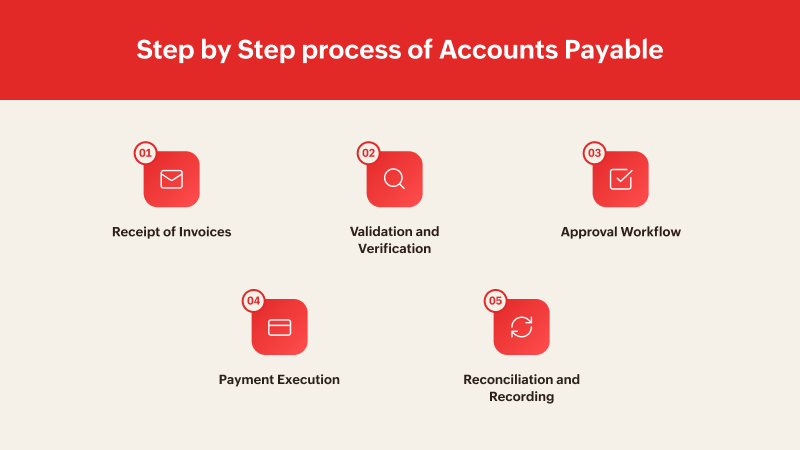
The AP process follows a defined lifecycle that begins the moment an invoice arrives and ends when the payment is recorded in your books.
Receipt
Every AP process begins when you receive an invoice. Invoices reach through email, postal mail, vendor portals, or directly from procurement systems. The first job of any AP process is to capture these invoices reliably and in one place, regardless of how they arrive or what format they are in.
Validation
Before an invoice moves forward, it needs to be checked and validated. Does the vendor exist in your system? Does the amount match what was ordered? Is this a duplicate of something already submitted? Validation is the checkpoint that prevents bad data from moving downstream.
Approval
Once validated the invoice goes through approval. Depending on the size of the payment or the type of expense, this may require sign-off from a department head, a finance manager, or a member of the executive team. Approval workflows define who needs to review what and in what order, ensuring no payment leaves the business without the right authorization.
Payment
After approval, the invoice is scheduled for payment. This is where AP teams make decisions about payment timing and method. Some vendors require bank transfers, others accept ACH payments or checks. Payment scheduling balances vendor terms with the business's own cash flow needs.
Reconciliation
Once payment is made, the final step is reconciliation. The payment is recorded against the invoice in the accounting system, the liability is cleared from the balance sheet, and the transaction becomes part of the business's financial record. This step closes the loop and keeps the books accurate.
The AP team and what they are responsible for
In a small business, accounts payable may be handled by a single person wearing multiple finance hats. In larger organizations, there are dedicated AP clerks, AP managers, and sometimes entire departments structured around vendor payment operations.
Regardless of size, the AP function carries a consistent set of responsibilities. AP professionals receive and process invoices, maintain vendor records, manage approval workflows, execute payments, handle vendor queries, and ensure that every transaction is correctly recorded. They are also the first line of response when a vendor reports a missing payment or disputes an invoice.
AP managers take on an additional layer of oversight. Monitoring aging reports to flag overdue invoices, identifying bottlenecks in the approval process, enforcing payment policies, and producing reports that give leadership visibility into outstanding liabilities.

Though accuracy is non-negotiable, it is not what makes a strong AP team. The key to an efficient AP machine is the ability to manage high volumes of transactions without letting anything fall through the cracks, while maintaining the vendor relationships that keep the business running.
Common accounts payable challenges
Even well-intentioned AP processes run into problems. Most of them are predictable.
Duplicate payments
Duplicate payments are among the most common and costly AP errors. They happen when the same invoice is submitted more than once, processed by different team members, or entered through multiple channels without a centralized system to catch the overlap. The money goes out, the vendor may or may not flag it, and recovery takes time and goodwill.
Delayed approvals
Approval bottlenecks slow the entire process down. When approvals depend on a single person who is traveling, unavailable, or managing too many other priorities, invoices pile up. Vendors follow up. Late payment fees accumulate. The business's credibility takes a quiet but real hit.
Manual entries
Manual data entry introduces errors at scale. An invoice processed by hand is an invoice subject to human error be it a transposed digit, a wrong vendor code, or an incorrect amount. In low volumes, these are manageable. As the business grows, they compound.
Fraud risk
Fraud is a genuine risk in AP. Vendors can submit inflated invoices. Internal employees can create fictitious vendor accounts. Without controls and visibility, these schemes can run undetected for months.
Lack of visibility
Finally, poor visibility into what is outstanding makes cash flow planning difficult. If the finance team does not have a clear picture of what invoices are pending, approved, or overdue at any given moment, cash flow forecasts are guesswork.
Accounts payable best practices
The businesses that manage AP well share a set of habits that are worth building into your own process, regardless of where you are starting from.
Centralize data
Centralizing vendor information is the first and most foundational step. Every vendor your business works with should have a verified record — bank details, payment terms, contact information, and tax documentation — stored in a single system. This eliminates the ambiguity that leads to payment errors and makes onboarding new vendors consistent.
Segregate roles
Separating duties within the AP process is a critical internal control. The person who approves an invoice should not be the same person who processes the payment. This segregation reduces the risk of fraud and creates a natural audit trail.
Streamline approvals
Establishing clear approval thresholds saves time and prevents bottlenecks. Not every invoice needs executive sign-off. Defining approval levels by payment amount or expense category means routine invoices move quickly while large or unusual payments get the scrutiny they deserve.
Standardise reconciliation
Reconciling AP regularly, weekly at minimum, keeps the books clean and prevents surprises at month-end or during audits. Aging reports should be reviewed consistently to catch overdue items before they become disputes.
Honor payment terms
Documenting payment terms for every vendor and honoring them consistently builds the kind of vendor trust that translates into real business advantages over time.
How automation is changing accounts payable
For a long time, accounts payable was almost entirely a manual function. Invoices arrived by mail or email, were keyed into spreadsheets or accounting systems by hand, routed for approval through email chains, and filed in physical or digital folders. It worked, but it required significant time and attention, and it scaled poorly.
AP automation replaces the repetitive, rule-based parts of that process with software that captures invoices automatically, routes them through predefined approval workflows, matches them against purchase orders and receipts, and executes payments without manual intervention at every step.
The result is not just speed. It is accuracy, visibility, and control at a scale that manual processes cannot match. Finance teams spend less time processing and more time analyzing. Errors drop because human data entry is removed from the equation. Approvals happen faster because they are routed to the right person automatically, not chased down by email.
For growing businesses, automation is what allows the AP function to scale without a proportional increase in headcount. The volume of invoices can double without doubling the work.
How Zoho Procurement brings it all together
Understanding accounts payable is one thing. Having the right system to manage it is another.
Zoho Procurement is built around the full AP lifecycle described in this guide. It captures invoices from multiple sources and formats using AI, automatically extracting header and line-item data with high accuracy. Every vendor gets a centralized record and a dedicated portal to submit invoices and track payment status, which eliminates the back-and-forth that slows most AP teams down.
Approval workflows in Zoho Procurement are hierarchical and criteria-based, so the right invoices reach the right people without manual routing. Before any bill moves to payment, automated 2-way and 3-way matching checks it against purchase orders and receipts to catch discrepancies early. Payments go out via ACH, and every transaction syncs automatically to your accounting records.
The outcome is an AP process that is accurate, auditable, and built to scale with your business. If you are ready to bring that kind of structure to your accounts payable, explore Zoho Procurement now!
Conclusion
Accounts payable is not just an accounting obligation. It is a reflection of how well your business manages its financial commitments. The businesses that treat AP with the seriousness it deserves tend to have cleaner books, stronger vendor relationships, and a clearer picture of where their money is going. That clarity, more than any single tool or tactic, is what gives finance teams the confidence to make better decisions.