
- HOME
- Procurement
- What is procurement? process, key stages, and smart strategies to optimize
What is procurement? process, key stages, and smart strategies to optimize
For most organizations, the procurement process takes center stage only when a critical supplier misses their deadline, an invoice or payment gets stuck in email threads, when an audit flags non-compliant spending, or when margins start to erode quietly. Procurement doesn't need to be like that. This guide will break down how to understand and optimize procurement with practical steps to make procurement smoother, cheaper, and smarter.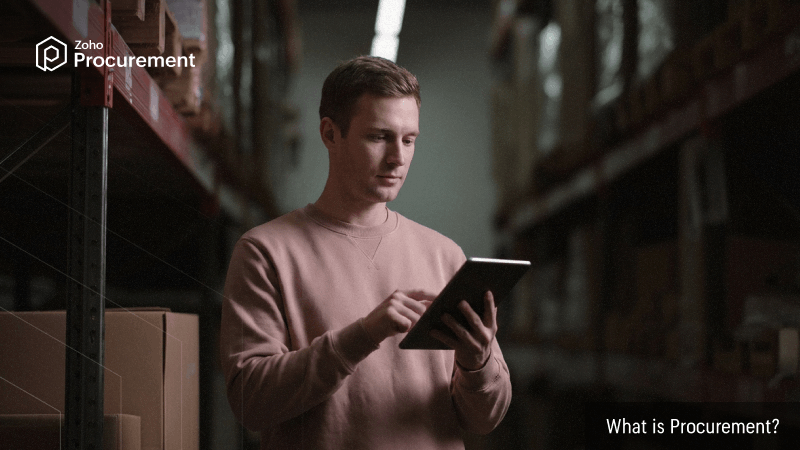
What is procurement?
Procurement is a structured process that an organization follows to source suppliers, negotiate terms, purchase goods or services, and ensure timely payments by maintaining control, visibility, and accountability at every step. By ensuring timely payments, organizations not only maintain strong supplier relationships but also free up working capital, enhancing cash-flow resilience and supporting sustainable business growth.
What is the difference between purchasing and procurement?
More often, procurement is confused with purchasing. Purchasing is transactional; it precisely involves placing orders and paying invoices. Procurement is a strategic process that balances cost efficiency, operational excellence, governance, and risk control. Procurement begins well in advance of a purchase order and continues long after the supplier is paid.
Evolution of procurement: From cost control to value creation
In today's AI era, procurement extends beyond serving as a cost-saving mechanism; it is also a source of value creation that shapes how organizations plan, spend, and grow. Factors such as supply chain disruptions, heightened regulatory scrutiny, pressures on working capital, and cash flow constraints have significantly transformed the procurement function.
In response to these challenges, procurement teams now need to adopt proactive strategies, integrate cross-functional collaboration, and engage in continuous improvement to enhance organizational resilience and competitiveness.
Anticipate supply chain risks and have a proactive backup plan of action.
Building stronger supplier relationships for innovation and sustainability, and to mitigate supply chain risks.
Collaborate closely with finance, production, operations, and legal teams.
Negotiating contracts and enabling faster decision-making without losing control.
Procurement, as a process, has moved from a reactive process to a more structured process, adding value to your bottom line.
Key stages of the procurement process
Although procurement processes may vary depending on industry, organizational size, and the specific goods or services involved, their fundamental purpose remains consistent. All procurement processes aim to identify suitable suppliers, ensure cost efficiency, maintain compliance, and support operational continuity. This shared foundation provides a framework for understanding the key stages of procurement across diverse organizational contexts.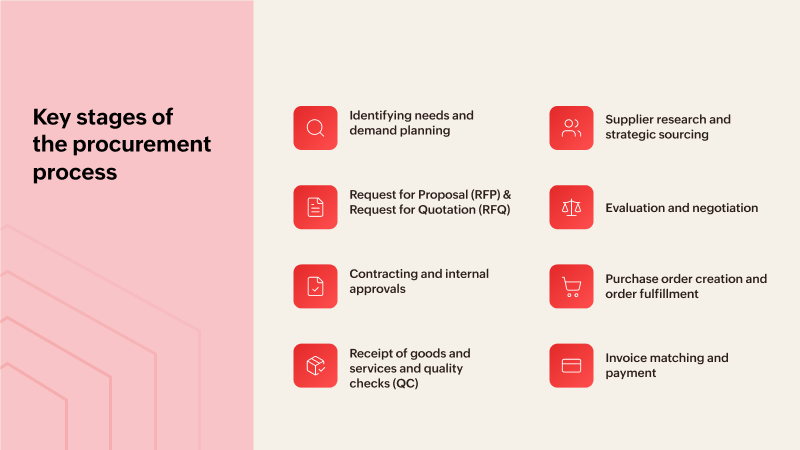
Identifying needs and demand planning
The first step in the procurement journey is to understand the 3Ws of the requirement: What is required? Why is it required? By when is it required?
What: Clearly states the product, what is needed, its technical specifications, and the required quality standard.
Why: Justifies the purchase, helping procurement teams understand the complexity and cost constraints to keep in mind for better supplier negotiations.
When: Sets the delivery timeline and date, allowing the team to plan resources appropriately.
Having the 3Ws answered helps procurement teams enable bulk negotiations, predict spend, and improve supplier engagement, fueling effective demand planning for the organization.
Supplier research and strategic sourcing
Once the requirements are set and given, the focus shifts to the market. This stage is critical and involves identifying potential suppliers who can meet the organization’s needs in terms of quality, cost, reliability, and risk profile.
Keeping pricing aside, other factors that determine supplier scores are:
-->Supplier financial stability
-->Past performances and references
-->Compliance with regulatory and ethical standards
Request for Proposal (RFP) & Request for Quotation (RFQ)
Once the vendors are narrowed down and shortlisted, RFPs or RFQs are sent out to different vendors. The RFP includes all details and requirements in clear terms. It clearly defines scope, timelines, evaluation criteria, and expectations without overlooking any aspects. Transparency is key at this stage, as it builds trust and encourages suppliers to submit their best proposals.
Evaluation and negotiation
In the evaluation stage, procurement moves beyond price comparison. Proposals are assessed based on total cost of ownership, risk exposure levels, and alignment with business needs. Once evaluations are complete, teams begin negotiations and draft agreements that work for both parties.
In most organizations, finance, legal, and operational stakeholders are involved during the negotiation stage. This ensures decisions are commercially and operationally viable.
Contracting and internal approvals
Once terms are agreed upon by both parties, contracts are drafted, and approvals are obtained. This stage often exposes gaps in governance.
Key steps for contracts include:
SOW -Scope of work mainly comprises the deliverables in detail, deadlines, and performance standards.
Legal viability and consistency -This constitutes the NDAs (Non-Disclosure Agreement), SLA (Service Level Agreement), and IPs (Intellectual Property Rights).
Timing & payment -Clearly specify the delivery time for goods and services. Payment terms, from the percentage to the mode of payment, should be specified too.
Consequences -This establishes how parties can settle any disagreements that arise if they do not fulfill their terms of the contract.
Approval hierarchies are followed internally with an auditable trail, which reduces exposure to legal and financial risk.
Purchase order creation and order fulfillment
A purchase order is the backbone of procurement; it transforms the contractual terms into actionable instructions for suppliers and internal teams.
Purchase orders help procurement teams:
Align expectations on pricing and delivery.
Track commitments versus budgets.
Perform two-way and three-way matching.
During fulfillment, procurement teams monitor delivery timelines and proactively act based on the details furnished on the PO.
Receipt of goods and services and quality checks
Apart from a logistical checkpoint, this stage involves multiple teams, including the operations team to receive goods, quality assurance teams to conduct quality checks and quality assessments, and teams to confirm service completion.
Invoice matching and payment
This is the final stage, where the finance teams come into play. Invoices are matched against purchase orders and receipt records to ensure accuracy. This process is referred to as three-way matching. When this stage is automated and well-integrated, it becomes one of the strongest enablers of financial control.
Challenges businesses face with procurement
Despite having processes, frameworks, and rule books in place, organizations struggle with procurement execution for a number of reasons.
Maverick spending
Employees bypass the buying process tend to buy necessities for themselves and then claim reimbursements, which in turn wastes money, as companies might miss out on corporate bulk deals.
Lack of visibility
Siloed decision-making across departments can lead to duplicate purchases.
Manual approvals
Endless email chains slow everything down, causing delays and supply chain disruptions.
Supplier dependency risks
Dependence on a single supplier can lead to financial instability and reduced bargaining power.
Weak compliance
Lack of policy enforcement, fragmented systems, absence of a vendor onboarding framework, and inconsistent documentation lead to compliance and governance issues.
Optimizing procurement: Strategies that actually work
The primary step towards creating a strategy is to initiate a process that drives clarity, consistency, and confidence to the top management.
Standardize processes and policies
Enforcing policies and setting clear guidelines reduces ambiguity and speeds up decision-making without compromising governance.
Improve spend visibility
Centralized data allows teams to identify patterns, consolidate suppliers, and negotiate from a position of insight.
Strengthen supplier relationships
Strategic suppliers should be treated as partners, with regular performance reviews and open communication.
Leverage technology
Digital procurement tools automate routine tasks, enforce controls, and provide real-time insights, freeing teams to focus on strategic work
With Zoho Procurement, organizations can automate purchasing and accounts payable with policy-driven workflows, approvals, and invoice processing so teams can focus on core business priorities.
Role of supplier performance for successful procurement processes
An important factor in having a standout procurement process is strong supplier relationships. Monitoring their performance helps organizations create a sustainable environment in the long run.
On-time delivery rates (OTD), responsiveness, defect-free order completion rates, cost competitiveness, and invoice accuracy are some of the key metrics for the supplier scoring process. Conducting quarterly reviews for key suppliers and discussing their performance helps build a stronger supply chain for your organization.
Conclusion
Procurement goes beyond simply buying efficiently; it enables smarter decisions, protects the organization from risk, and supports sustainable growth. Modern procurement is no longer a back-office function. It is a strategic process that determines how efficiently an organization operates and how resilient it becomes over time. A procurement process that is clearly defined and thoughtfully optimized becomes a competitive advantage, quietly shaping how resilient, agile, and financially disciplined a business can be.
With Zoho Procurement, an AI-powered system, you can transform your procurement process into a strategic advantage and uncover cost-saving insights for smarter spending decisions.