- HOME
- HR insights
- 5 challenges associated with AI adoption in HR
5 challenges associated with AI adoption in HR
- Last Updated : May 14, 2026
- 337 Views
- 4 Min Read
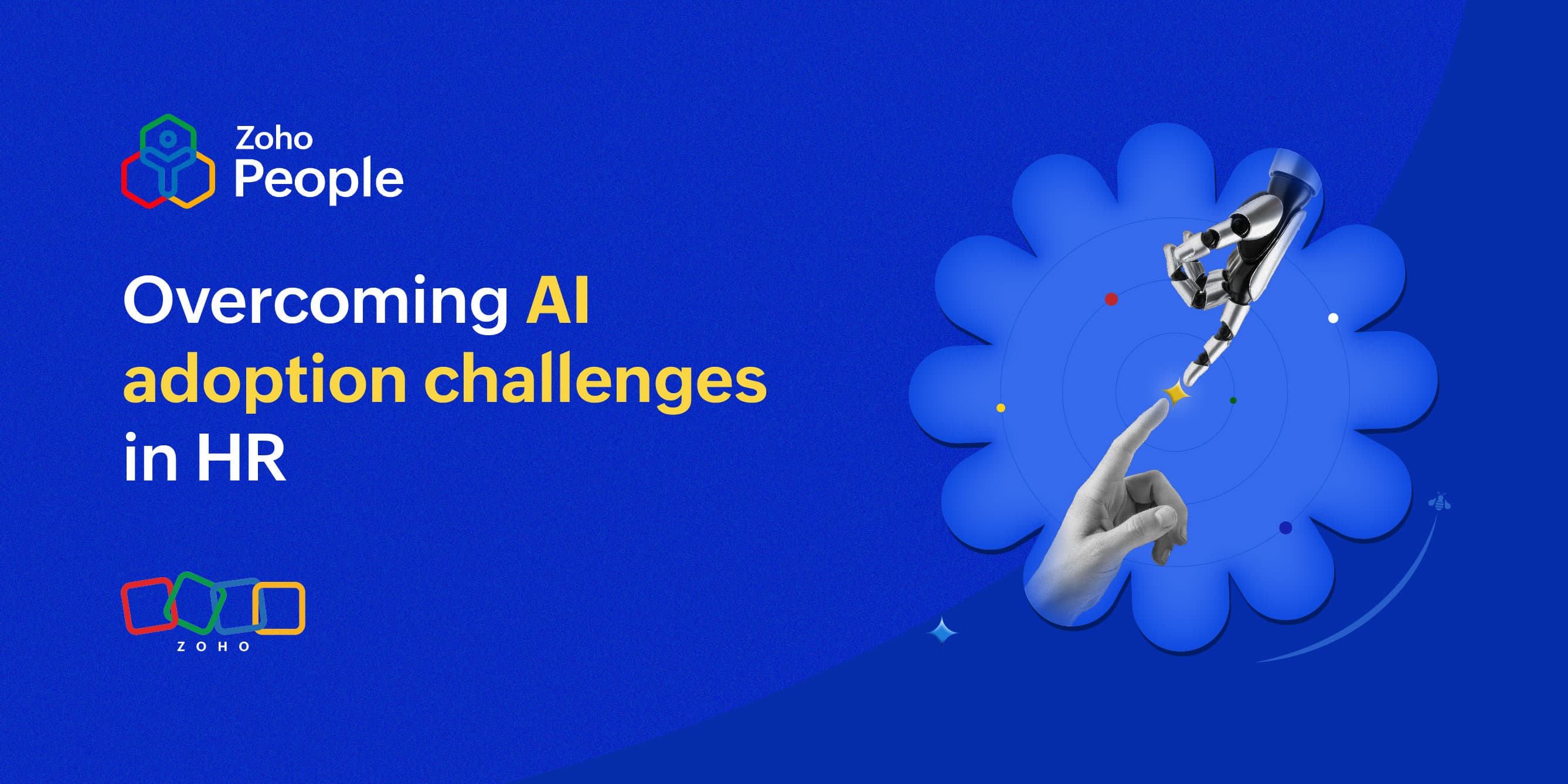
AI is already handling basic problem-solving in HR. It automates repetitive hiring tasks, responds to employees instantly, and brings more data into decision-making. Many teams use it in their day-to-day workflows, and it's slowly becoming part of how employees get their work done.
But the complexity rises when teams aim to apply it consistently across all functions.
This is because HR isn’t always predictable. It deals with changing contexts, and what works in one scenario may not work in another. AI performs best when processes are structured, so the challenge becomes less about adoption, and more about what it actually takes to address the tougher problems.
Here are five key challenges that often hold back AI adoption in HR and what can be done to overcome them:
Challenge #1: Lack of consolidated, structured data
HR data is often scattered across systems, like hiring, attendance, payroll, leave, and core HR. There may be multiple formats, with duplicates, missing fields, and outdated information. These inconsistencies make it difficult for AI models to generate meaningful and reliable output. For instance, AI may misidentify promotion candidates because skills or performance data was mapped incorrectly in the first place.
Tip: Start out by centralizing your HR data, and then standardize formats and create structure so your AI model can learn from consistent information. Establish clear data ownership and role-based access controls to ensure quality holds up over time.
Challenge #2: Automating too much or too little
While AI can automate everything from candidate communication to performance feedback, some tasks call for empathy, intent, and context that only a human can provide. For instance, during performance reviews, employees are most likely share their concerns and take feedback when they feel heard by their managers, not by a system. Relying on AI to take on that role only causes more issues.
On the other hand, some organizations only adopt AI automation for obvious use cases (like HR chatbots or basic resume screening) and then they stop. As a result, many repetitive tasks stay manual, and HR doesn't function as efficiently as it could.
Tip: As a first step, identify touchpoints in your employee journey that require personal context, like candidate communication, hiring decisions, and career discussions. Those are the moments where HR should stay human. Everything else, like screening, scheduling, and report generation, can be handled by AI. This way, it acts as a support layer to your everyday HR operations, while you handle other strategic processes.
Challenge #3: Filling AI literacy gaps
Many employees use AI tools in some capacity, and while this can increase output and quality, it also requires a certain level of training and understanding. Some employees may rely too heavily on AI and trust every recommendation that it provides without proper vetting, whereas others may hesitate to use it due to lack of trust. For instance, one manager may rely on AI-generated performance feedback without actually reviewing underlying data, which can cause inaccurate ratings; another manager may avoid these insights altogether and miss important AI-flagged data that could have been addressed sooner.
Tip: Identify the AI tools your employees already use or may use in the future, and start organizing simple training sessions to help them understand proper use, where to use their own judgment, and how to interpret output. Help them understand where AI fits into their everyday work by covering specific use cases.
Challenge #4: Employee resistance to AI adoption
Some employees worry about AI replacing them. Others don't want it to change their everyday routine. Many are uncertain about how AI can actually complement and support their role. When you don't address this challenge, even after adoption, employees may not fully use the new features and go back to familiar ways of working.
Tip: The core focus here is on building trust. Instead of rolling AI out all at once, go one team at a time. Have managers show employees how it fits into their workflows and improves results. Identify early adopters and let them show others how it has really helped them. Make sure your leadership team is clear that AI is here to support employees, not to replace them.
Challenge #5: Measuring the ROI of AI adoption
HR teams may find it challenging to measure how AI has actually improved efficiency, speed, decision-making, or employee experience, since these are outcomes take time to show up and are often hard to quantify. Combining this with uneven adopting across teams makes it even more difficult to understand overall outcomes. For instance, leadership may judge AI's value based on easy metrics, like chatbot response times, while more meaningful results go under the radar.
Tip: Before you start out, define what success actually looks like. Set up measurable metrics like time saved, cost per hire, productivity rate, and employee satisfaction, and establish a baseline to measure against.
Wrapping up
As organizations move from experimenting with AI to actually embedding it into everyday processes, gaps in data and adoption start to surface more clearly. The key is to address these challenges early on. Organizations that build a strong data foundation, find the right balance between automation and human interaction, enable employees to use AI effectively, and create clarity around its impact will get the most out of these tools.
 Tarika
Content Specialist at Zoho People