- HOME
- How to optimize landing pages for AI-referred visitors
How to optimize landing pages for AI-referred visitors
- Last Updated : August 24, 2026
- 24 Views
- 6 Min Read

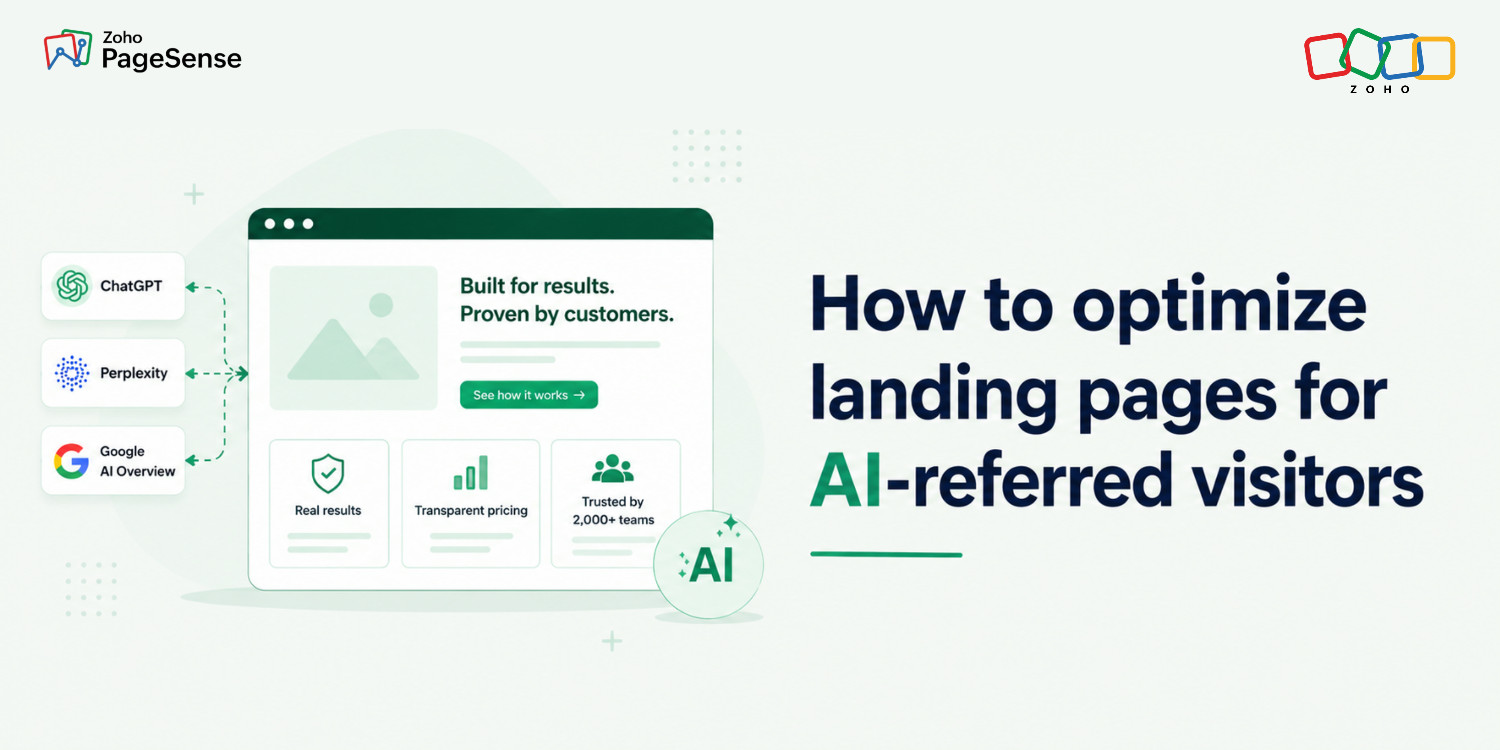
Most landing pages were built for a visitor who no longer exists. That visitor came in cold. Found you on Google, had zero context, needed the page to walk them through the problem before it could even think about pitching a solution. That made sense a few years ago. But, that's not the case anymore.
A growing chunk of your traffic today is coming from AI — Google AI Overviews, Perplexity, ChatGPT. These people read a synthesized answer before they click through to you. They already know about the category. They're not here to be educated. They're here to figure out if your product specifically is worth their time. And most landing pages have absolutely nothing for a visitor at that stage.
Who is the AI-referred visitor?
The useful way to think about this visitor is that they're not discovering, they're verifying.
The AI gave them a summary. It explained the category, named some options, maybe even addressed the obvious objections. They read it, found it plausible, and clicked through to check whether it holds up. By the time they land on your page, the educational part of the journey is already done. What's left is confirmation — does this page give them something more specific, more credible, more useful than what the AI already covered?
A visitor in verification mode isn't looking for an introduction, they're looking for evidence, pricing, real case studies, integration lists. Something that either confirms the AI's framing or corrects it. If the page can't deliver that within the first scroll, they leave, and not because they weren't interested, but because the page didn't meet them where they actually were.
Where most landing pages go wrong for this audience
The core problem is that most landing pages are built around a one-way information transfer. We tell you what we are, we establish that the problem matters, we present the solution, we ask for the conversion. That structure makes sense when the visitor has no prior context. It completely breaks down when they already have context and came specifically to go deeper.
The AI-referred visitor already received the introductory information transfer from the AI. What they need from your page now is a two-way signal: can this page confirm what I already believe, and give me something more specific than a summary?
The problem is most pages can't. They're still running the education playbook for a visitor who is past it.
The hero section is explaining what the product category does. The social proof is a logo strip with no outcomes attached. The first CTA is "learn more" or "download the guide", offers designed for someone who needs warming up, not someone who arrived ready to evaluate. And the body copy could describe any company in the category, which is exactly the signal this visitor is screening for. When a page feels interchangeable with five other competitors, a verification-mode visitor concludes the AI's summary was the best they were going to get and leaves.
What to actually change
The most reliable way to find the specific gaps on your own pages is to watch session recordings of AI-referred visitors. Ten of those who converted and ten who bounced quickly. The converters found something specific and stayed, whereas, the bouncers hit generic content and left. That pattern shows up consistently. Those recordings will tell you, concretely, what your page is and isn't delivering.
Lead with differentiation, not description.
The hero section needs to answer "why this one over everything else" and not "here's what this is." Your headline should reference a specific outcome, a specific audience, or a constraint you uniquely address. "The only CRM built for B2B companies with sales cycles longer than 90 days" lands differently for a verification-mode visitor than "Everything you need to manage your customer relationships" The first gives them something to confirm or challenge. The second gives them nothing they didn't already know.
This is genuinely hard to write because it requires having a real, defensible differentiator. But if you don't, the AI-referred visitor will figure that out quickly anyway. Better to confront it in your messaging than discover it in your bounce rate.
Pull your specific proof toward the top.
Most pages put logos and trust badges near the top and save detailed case studies for deep below the fold. For high-intent traffic, flip this. A real case study with a real number — "Company X cut form abandonment by 34% in six weeks" — does more conversion work in the first two scrolls than any amount of logo rows.
Filter your heatmap data for visitors who spend more than 90 seconds on the page. They're almost always engaging with the specific, concrete content, maybe real numbers, screenshots, named customers, detailed comparisons. Not the brand statements. That engagement pattern tells you where the page's actual conversion weight sits, and where to move it.
Give this visitor a CTA path that matches where they are.
You don't have to make your lowest-commitment offer the first thing everyone sees. Add a secondary path for verification-mode visitors — "See how we compare," "View full pricing," "See the feature breakdown."
Test leading with one of these specifically for organic and AI-referred traffic. For cold paid traffic this is likely the wrong fit, but for high-intent arrivals, pointing them toward evaluative content rather than awareness content often moves conversion meaningfully.
Signal depth early.
The AI-referred visitor decides quickly whether this page has anything the summary didn't. An original data point in the subheadline, a specific benchmark in the opening paragraph, a reference to a methodology that's specific to you, That single shift in intentthese signal within seconds that there's something here worth reading. It's not about front-loading the page with data. It's about showing fast that you have something the AI couldn't give them.
Give them something to comeback to.
Some visitors won't convert on the first visit. They're building a shortlist and they'll be back. When they don't convert, make sure they take something with them — a comparison guide, a resource genuinely worth bookmarking. Visitors who leave with something useful come back at much higher rates than visitors who left because the page gave them nothing to hold onto.
How to measure this audience separately
You can't optimize for AI-referred visitors if they're buried inside your organic or direct traffic numbers.
In most analytics setups you can pull them out by referral source — perplexity.ai, chat.openai.com, specific Google parameters tied to AI Overviews. It's not a perfect segmentation. Some AI-referred visitors arrive via direct if they manually type your URL after seeing it in an answer. But you capture enough to work with.
Set up a separate funnel for this segment in Zoho PageSense. Track where they drop off versus your overall population. If they're converting at higher rates but abandoning at the same pages, those pages have room to improve. If they're converting at similar rates to everyone else, your current experience accidentally works for them, but you probably have more to gain by actually designing for their behavior.
The session recordings are where this gets genuinely useful. Watch ten sessions from AI-referred visitors who converted. Then watch ten who bounced quickly. The behavioral difference between those two groups, what they clicked on, how far they got, where they stopped engaging, tells you directly what the page is and isn't delivering for this audience.
AI-referred visitors are some of the most valuable traffic hitting your website right now. They arrive informed, and they have specific intent. They're closer to a decision than almost any other segment.
Specific proof up front, a CTA path that respects where they are in the journey, content that goes beyond what the AI already covered — close those gaps and the conversion numbers will follow.