How to set up an out of office email or auto reply
What is an out-of-office message?
An out-of-office email (also known as an OOO message) is an automatic reply that can be sent as a response to people who email you when you’re away from work. It lets your contacts (colleagues, clients, and business contacts) know that you’re not available and that the response will be delayed.
When you add a proper out-of-office message, you can also let them know who to contact in your absence if there’s an emergency. It’s particularly important to have a proper out-of-office message if you’re away for a long period due to an annual vacation, sick leave, or other long absences from work.

What is an auto-reply message?
An auto-reply message is a system-triggered email sent based on the conditions set to trigger the message. These emails can be customized based on the needs of the hour. You can configure them using templates and filters to send emails with preset conditions.
An out-of-office email is an auto-reply message sent to email addresses sending you emails in your absence or unavailability. There are also other auto-reply messages, set both at the system level and the organization level.
These messages alerts recipients that their email has been received or rejected, or any custom reply based on the preset configuration.
The difference between an out-of-office message and a general auto-reply message
An out-of-office message can be customized to be sent at a set time-interval, and to send different responses for internal (organization) and external (outside-organization) email addresses. However:
- You can’t use different templates for different email addresses.
- You can’t send the responses only to a set of email addresses.
- You can’t exclude some email addresses from receiving the responses.
On the other hand, an auto-reply message can be customized based on different needs. These messages can be configured using different email templates for different purposes.
Emails sent to a particular email alias or group email address can be answered with a specific auto-reply. You can use filters to define when an auto-reply should be sent based on the sender’s email address or the subject of the email. You can also define a specific period during which the auto-reply will be active.
When should you set up a professional out-of-office message?
There are times when you’ll have to spend your days outside of the office. It can be going on vacation with limited or no access to the internet, or flying off to a different country to attend a business meeting and working in a different time zone.
Before you leave, ensure that you’ve informed your team of your plans. Because your inbox is still receiving emails from co-workers, customers, and other important people, it’s professional to set up an out-of-office message with details about your out-of-office dates and duration. You can also define who will be your backup while you’re gone.
Every time you receive an email, an automatic reply will be sent to the sender informing them about your absence based on your out-of-office settings. If the same sender repeatedly sends you emails, you can control the interval in which the out-of-office auto-response is sent to the users.
Professional scenarios can include, but aren’t limited to:
- Business trips.
- Business summits or conferences.
- Lead-gen conferences.
- Marketing conferences.
- Customer visits or trainings.
- End of your shift time.
- Weekends.
Personal scenarios can include, but aren’t limited to:
- Personal trips.
- Family vacations.
- Un-official team trips.
- Lunch or coffee breaks.
- Family functions or celebrations.
Absence due to medical reasons include:
- Sick leave.
- Maternity leave.
- Paternity leave.
Why should you set up an out-office message?
Setting up an out-of-office message will prevent your contacts from being in limbo when they don’t receive a response in your absence or unavailability. It will help them to prepare themselves to reach out to you at your available time.
It bridges the communication gap that occurs when people sending you emails aren’t informed about your absence. It ensures they know what needs to be done in case of an emergency.
You can also enjoy your period of absence from work without worrying about the emails received during that time.
What do you need to keep in mind when you configure your out-of-office message?
- Be polite and thank the sender.
- Specify the dates you’ll be away.
- If needed, specify the reason for your absence.
- Include the details of the contact person to reach out in case of emergency.
- Close with a greeting.
Best practices for drafting an out-of-office message
- Tell your readers when your trip will be over and give them the date you’ll be back in the office. Be sure to mention the starting date of your absence.
- Mention the person they can contact in your absence if they’re in need of urgent assistance. Sometimes, it’s better to ask the sender to write to common email addresses or group emails (support@, sales@, info@), instead of an individual.
- Make sure that your content suits all kinds of audiences, from a work superior to a friend. Following email etiquette rules helps you draft proper emails that will suit all kinds of audiences.
- Avoid including any personal information, like where you’re spending your holidays or your personal contact information unless you want all of your readers to know it.
- Be cautious when you provide details in out-of-office messages because anyone who sends you an email may get hold of the information.
Examples of out-of-office messages
Out of office message: When you go an a business trip
When you go on a business trip, you’ll still be attending to the priorities that require your attention. You’ll also be sure of the dates of your travel. So it’s ideal to have the out-of-office message written in a way that includes the dates you won’t be available and the expected time for your reply to the emails. You can also add other information, such as the alternate contact in your absence.
Subject: On a business trip from <Start Date> to <End Date>.
Hello!
Thanks for your email. I’ll be out of the office from <> to <> for a business trip. I’ll have limited access to emails and will try to respond to emails tagged important.
If you’re reaching out regarding something important, please resend this email tagging the subject as Important.
In the meantime, feel free to reach out to us at <group email address>.
Regards,
<Your name, designation, company name>
Subject: On a business trip from <Start Date> to <End Date>.
Hello!
Thank you for your email. I’m currently out of the office until <> on a business trip. I won’t be able to check and reply to my emails on a regular basis. I’ll read and respond to your email as soon as I return.
In case of an emergency, please contact <colleague’s name, role> at <email/ phone>.
Thanks,
<Your name, designation, company name>
Out of office message: When you’re traveling to a business summit or conference
Conferences are the ideal places for networking. You might meet your clients, customers, vendors, and other relevant contacts. When you’re out-of-office to attend a conference, add your contact details to the message. It could create an opportunity to network if they’re also at the conference.
Subject: Out of office to attend a business conference
Hello!
Thanks for your email. I’ll be out of the office from <> to <> to attend a business conference on <Conference name>. I won’t be able to answer your email until I return.
If you’re also attending the conference, feel free to reach out to me at: <Official contact number>. We can connect in person and discuss further.
Regards,
<Your name, designation, company name>
Out of office message: When your work shift ends
If you work in a customer or client-facing role in an international company, it’s a good idea to have an out-of-office message set up during your off-shift hours. It will let others know the expected time of reply and the alternate contact.
Subject: Out of office: Will respond during the shift hours from <Start time> to <End time> <Time zone>
Hello!
Thanks for your email. I’m out of the office now and will respond to your emails during my shift hours <Start time> to <End time> <Time zone>.
In the meantime, feel free to reach out to us at <group email address>/<email address of the available contact person>.
Regards,
<Your name, designation, company name>
Out-of-office message: When you go on vacation
Subject: On a vacation from <Start date> to <End date>.
Hello there!
Thanks for reaching out. I’m currently on vacation until <date>. I have limited access to the internet and won’t be able to check my emails. I will check and reply to your email when I return to work.
If you need any assistance in the meantime, please contact <colleague’s name, role> at <email/ phone>.
Thanks,
<Your name, designation, company name>
Out of office message - Sick leave
When you’re taking a sick leave, you may not have a concrete date of return. It’s better to inform people that you’re away and provide an alternate contact.
Subject: Out of office on sick leave.
Hello!
Thank you for your email. I’m currently out of the office on sick leave and don’t know when I’ll be back to work. I won’t be able to check and reply to my emails for some time.
In case of any emergency, please contact <colleague’s name, role> at <email/ phone>. I will respond to your emails when I return to work.
Thanks,
<Your name, designation, company name>
Out-of-office message - Maternity leave
Having a proper out-of-office message when you’re taking maternity leave is essential so the sender will know that you’ll be away from work for a long time and they should reach out to the relevant people. It’s better to leave two alternate contacts since you won’t be back for an extended period of time.
Subject: Out of office on maternity leave.
Hello!
Thank you for your email. I’m currently out of the office on maternity leave and I plan on returning to work on <date/ month>. I will not be working and will have no access to emails during this time.
<Contact name> can help you in my absence. Contact him/her at <email/phone number>.
You can also write to <group email address> for any other assistance.
Thanks,
<Your name, designation, company name>
Out of office message in Zoho Mail
The out-office-message feature in Zoho Mail will help you craft your message with ease. The granular options will help you customize the message using the formatting tools, include or exclude days on which the reply should be sent, and the date and time the message should begin and end.
You can also configure two distinct messages for your contacts and external senders. You can also choose to auto-decline any event invitation that gets added to your calendar in your absence.
How to Set up an out-of-office auto-reply in Zoho Mail
- In your Zoho Mail account, click the Settings icon in the top-right corner and navigate to the Out of Office section.
- Select the Start date and End date you want the reply to be sent.
- You can also select the specific days of the week you want the reply to be sent.
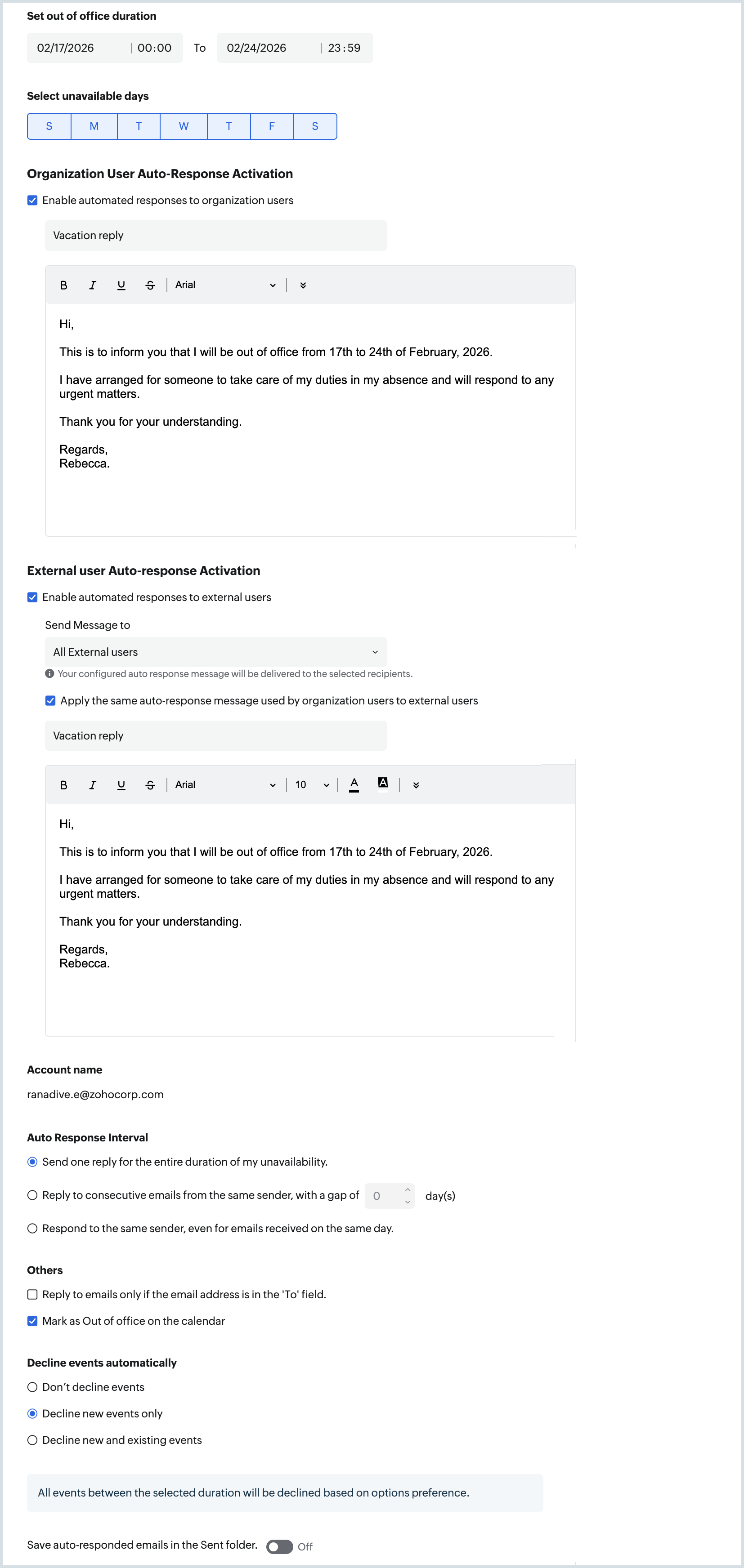
- Choose your audience.
- Send distinct auto-replies to organization users and external users.
- When you enable the auto-reply for external users, you can choose to send the auto-reply to Everyone, to Your contacts, or to Non-contacts.
- Select the Auto-response interval if you want the replies to be sent for emails received during a specific time range.
- Recurrence interval: To create a gap between two consecutive out-of-office replies to the same person, provide the number of days in the Auto respond every _ days.
- Choose Mark as Out of office in your calendar to let know your colleagues you’re on vacation when they try to add you to an event they create.
- You can also choose to automatically decline any events that you’re being added to or have already been added to.
- Enter the Subject and Content of the message.
- Click Save.
The out-of-office message will be saved and sent to people who email you during the specified period. This will be based on the recurrence pattern you selected and the time interval you provided.
Try out this feature and share your feedback with us at support@zohomail.com.
Top Articles