

- HOME
- Accounting Principles
- Understanding the accounting cycle in India
Understanding the accounting cycle in India
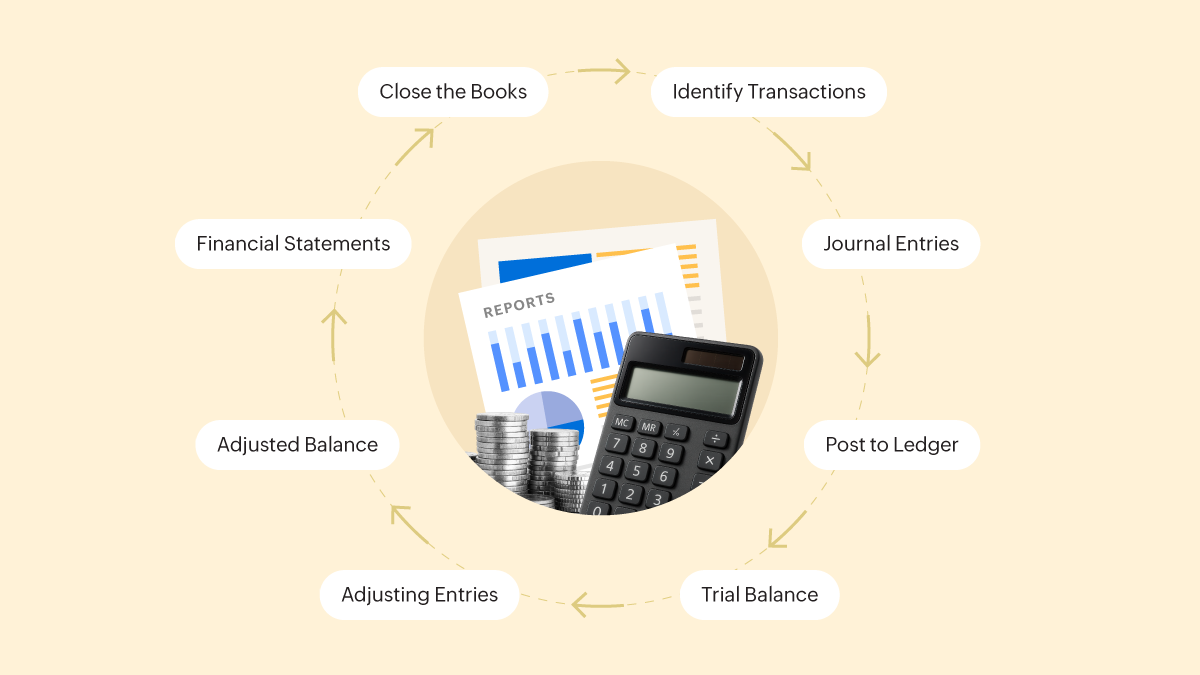
Have you ever wondered what actually happens between when a sale is made and the books are closed?
Every business transaction tells a story. A sale, a payment, a purchase order, a GST invoice, or a salary payout—all of these financial activities need to be recorded accurately to keep a business financially healthy.
That’s where the accounting cycle comes in.
The accounting cycle is the step-by-step process businesses follow to record, organize, verify, and report financial transactions during an accounting period. Whether you're a small business owner, accountant, finance student, or growing startup in India, understanding this cycle is essential for maintaining accurate books and staying compliant.
This guide breaks down the accounting cycle in India in a simple, practical, and easy-to-understand way to help you understand how it all comes together for your business.
What is the accounting cycle?
The accounting cycle is a fixed set of steps that every business follows to record, classify, summarise, and report its financial transactions over an accounting period. The cycle repeats every month, quarter, or financial year.
In India, the standard accounting period is April 1 to March 31 of the following year, aligned with the financial year as defined by the Income Tax Act, 1961. So, the cycle resets every year on April 1.
In India, the accounting cycle also supports compliance requirements such as:
GST filing
TDS accounting
Financial reporting
Audit preparation
Income tax compliance
MCA reporting for companies
Think of it as a loop. Every year, you go through the same steps in the same order, and the output is a clean, accurate set of financial statements that tell you (and the government) how your business performed.
Why is the accounting cycle important?
A well-managed accounting cycle helps businesses:
Maintain accurate financial records.
Reduce accounting errors.
Track profitability and cash flow.
Prepare financial statements easily.
Stay GST and tax compliant.
Simplify audits and reconciliations.
Make better business decisions.
Without a proper accounting process, businesses may face reporting errors, tax issues, delayed filings, and cash flow problems.
The 8 main steps of the accounting cycle
Here’s a simplified view of the accounting cycle followed by most businesses in India:
Identify transactions.
Record journal entries.
Post entries to the ledger.
Prepare trial balance.
Pass adjusting entries.
Prepare adjusted trial balance.
Create financial statements.
Close the books.
These steps are widely accepted in accounting practices globally.
Here is a detailed breakdown of each step.
Step 1: Identify and analyse transactions
Every accounting cycle starts with a transaction—any financial event that affects your business.
This includes:
A customer paying you for a service
You purchasing raw materials from a supplier
Paying employee salaries
Receiving a bank loan
Paying GST to the government
What you do at this step
Look at source documents like invoices, receipts, bank statements, purchase orders, credit/debit notes and identify what happened, how much money moved, and which accounts are affected.
Under the GST regime, every B2B transaction must be backed by a valid tax invoice. Under Section 128 of the Companies Act, 2013, companies are required to maintain adequate books of account. Source documents are your legal proof.
If money moved in or out, or if a financial obligation was created or settled, it's a transaction.
Step 2: Record transactions in the journal (journal entry)
Once a transaction is identified, you record it in the journal, also called the book of original entry. This is where double-entry bookkeeping comes in.
Every transaction affects at least two accounts: one is debited, and one is credited. The total debits must always equal the total credits. This is the foundation of the double-entry system, which India follows as per Generally Accepted Accounting Principles (GAAP) and the requirements of the Companies Act.
Example:
A business in Chennai sells goods worth ₹50,000 to a customer and receives immediate payment.
Account | Debit (₹) | Credit (₹) |
Cash/Bank account | 50,000 | — |
Sales account | — | 50,000 |
The business then pays ₹10,000 rent for its office.
Account | Debit (₹) | Credit (₹) |
Rent expense account | 10,000 | — |
Cash/Bank account | — | 10,000 |
If your business is registered under GST, your journal entries must also capture the GST component separately—CGST, SGST (for intra-state), or IGST (for inter-state), as these are separate liabilities to be filed and paid.
GST-inclusive example (intra-state sale in Tamil Nadu, 18% GST):
Account | Debit (₹) | Credit (₹) |
Cash/Bank account | 59,000 | — |
Sales account | — | 50,000 |
Output CGST payable (9%) | — | 4,500 |
Output SGST payable (9%) | — | 4,500 |
Step 3: Post entries to the ledger
After journalising, you post each entry to the respective ledger account. The ledger is a collection of all accounts. Think of it as a folder for each account where all its transactions are compiled in one place.
Each account in the ledger shows:
All debits on one side
All credits on the other side
A running balance
The ledger gives you the complete history of every account. Want to see all transactions in your Sales account for the full year? That's in the ledger. Want to know the total amount owed to a specific vendor? Check your ledger.
Step 4: Prepare the unadjusted trial balance
At the end of the accounting period, you pull all ledger account balances into one list. This is the trial balance.
The purpose of the unadjusted trial balance is simple: verify that total debits equal total credits. If they don't match, there's an error somewhere that needs to be found and corrected before you move forward.
What the trial balance looks like:
Account | Debit (₹) | Credit (₹) |
Cash | 1,20,000 | — |
Accounts receivable | 80,000 | — |
Inventory | 60,000 | — |
Equipment | 2,00,000 | — |
Accounts payable | — | 40,000 |
Capital | — | 3,20,000 |
Sales revenue | — | 1,80,000 |
Salaries expense | 60,000 | — |
Rent expense | 20,000 | — |
Total | 5,40,000 | 5,40,000 |
Note: A matching trial balance doesn't guarantee your books are error-free. It only means your debits equal your credits. Errors of principle (like classifying revenue as capital) or compensating errors won't be caught here.
Step 5: Make adjusting entries
This is where many small businesses fall short and it's one of the most important steps.
Adjusting entries are journal entries made at the end of the period to record items that have been earned or incurred but not yet recorded in the regular journal. These entries follow the accrual basis of accounting, which is mandatory for companies in India under Schedule III of the Companies Act, 2013 and under Accounting Standards (AS) issued by ICAI.
There are four main types of adjusting entries.
Accrued revenues: Revenue earned but not yet received or recorded.
For example, you provided IT services worth ₹30,000 in March, but the client will pay in April. You still record the revenue in March.Accrued expenses: Expenses incurred but not yet paid or recorded.
For example, employee salaries for March worth ₹1,20,000 will be paid on April 5. Record them as a liability in March.Deferred revenues (unearned income): Cash received in advance for services not yet delivered.
For example, a client pays ₹60,000 in February for a six-month subscription starting in March. You recognise only the applicable portion each month.Prepaid expenses: Expenses paid in advance that apply to future periods.
For example, you paid ₹24,000 as your annual insurance premium in April. Each month, ₹2,000 is recognised as an expense.
Depreciation is also recorded as an adjusting entry at the year's end. Indian businesses must follow the depreciation rates prescribed in Schedule II of the Companies Act, 2013 for financial reporting purposes, while the Income Tax Act, 1961 prescribes rates under the Written Down Value (WDV) method for tax purposes.
Step 6: Prepare the adjusted trial balance
After posting all adjusting entries, you prepare a second trial balance—this time with the adjusted balances. This is called the adjusted trial balance.
This version is more accurate than the first because it captures all earned revenues and incurred expenses for the period, regardless of when cash changed hands.
The adjusted trial balance is the basis on which your financial statements are prepared.
Step 7: Prepare your financial statements
This is the payoff. Using the adjusted trial balance, you now prepare the three core financial statements.
1. Profit & loss statement (Income statement)
This shows revenues earned and expenses incurred during the period, resulting in either a net profit or a net loss.
For Indian companies, this is prepared as per Schedule III of the Companies Act, 2013, which specifies the format. Companies following Ind AS (Indian Accounting Standards) must additionally follow the relevant Ind AS standards.
Key line items:
Revenue from operations
Other income
Cost of materials consumed/Purchases
Employee benefit expenses
Finance costs
Depreciation & amortisation
Other expenses
Profit before tax (PBT)
Tax expense (Current + Deferred)
Profit after tax (PAT)
2. Balance sheet
A snapshot of what your business owns (assets), what it owes (liabilities), and the owner's stake (equity) on the last day of the accounting period—i.e., March 31.
For Indian companies, the format is also prescribed under Schedule III.
Equity and liabilities side: Share capital, reserves & surplus, long-term borrowings, current liabilities
Assets side: Fixed assets (Tangible + Intangible), investments, current assets
3. Cash flow statement
For all companies other than One Person Companies (OPCs) and small companies (as defined under the Companies Act), a cash flow statement is mandatory, prepared as per AS 3 or Ind AS 7.
It shows cash flow under three heads:
Operating activities
Investing activities
Financing activities
This statement answers the question: "The P&L says we made a profit; so where did the cash go?"
Other required disclosures
Companies are also required to prepare Notes to Accounts, which form an integral part of the financial statements and include disclosures on accounting policies, contingent liabilities, related party transactions, and more.
Step 8: Close the books (Closing entries)
The final step occurs at the end of the accounting period (March 31). Here, you close all temporary accounts—revenue, expense, and dividend accounts—by transferring their balances to the Retained Earnings (or Profit & Loss Appropriation) account.
The idea is that temporary accounts track activity for just one period. Permanent accounts (assets, liabilities, equity) carry balances forward indefinitely.
After closing your entries:
All revenue and expense accounts have a zero balance.
The net profit or loss has been transferred to your retained earnings.
The books are ready for the new financial year starting April 1.
In Zoho Books, this process is called "locking" the accounting period; it prevents further changes to a closed period and keeps your historical records clean and tamper-proof.
Special considerations for the accounting cycle in India
GST compliance
GST is woven into every transaction. Your accounting cycle must account for:
Input Tax Credit (ITC) – Track GST paid on purchases separately (CGST, SGST, IGST input accounts).
Output tax – Track GST collected on sales.
GST reconciliation – Your books must reconcile with GSTR-1, GSTR-3B, and GSTR-2B every month.
Annual return – GSTR-9 requires annual reconciliation of all GST transactions.
TDS (Tax deducted at source)
When you make certain payments like salaries, professional fees, rent above threshold, and contractor payments, you must deduct TDS at the rates prescribed under the Income Tax Act, 1961 and deposit it with the government. These are recorded as separate liability entries in your books.
Books of account requirements
Section 128 of the Companies Act, 2013 mandates that companies maintain books of account on an accrual basis and according to the double-entry system. For businesses with turnover above ₹1 crore (business) or ₹50 lakh (professionals), Section 44AA of the Income Tax Act also requires mandatory maintenance of books.
Statutory audit
Companies (other than OPCs and small companies in certain cases) are required to get their books audited by a chartered accountant under the Companies Act. The accounting cycle feeds directly into the audit process.
Common mistakes to avoid
Skipping adjusting entries: Many businesses record only cash transactions. This leads to understated liabilities, overstated profits, and mismatched ITR/GST filings.
Not reconciling GST accounts: Your books should match GSTR-2B every month. Mismatches lead to ITC denial and notices from the GST department.
Confusing the financial year: India's financial year is April to March—not January to December. Closing entries and financial statements must be prepared for this period.
Treating capital and revenue incorrectly: Buying a laptop is a capital expenditure (goes to the Balance Sheet as an asset). Paying for a software subscription is a revenue expenditure (goes to the P&L). Mixing these up distorts both statements.
Not locking accounting periods: If prior periods are left open, accidental or unauthorised entries can change historical figures. Always lock closed periods in your accounting software.
How Zoho Books automates the accounting cycle
Zoho Books is built around the accounting cycle, so you don't have to manage each step manually.
Transactions are recorded automatically when you raise invoices, record bills, or reconcile bank feeds.
Journal entries are created in real time. Every transaction generates the correct debit/credit automatically.
Ledger accounts are updated instantly—no manual posting required.
The trial balance is always available. You can view it at any point during the year.
Adjusting entries can be created as journal entries directly in Zoho Books.
Financial statements are auto-generated so your P&L, balance sheet, and cash flow statement are always up to date.
GST returns are pre-populated from your transactions; GSTR-1, GSTR-3B, GSTR-9 are ready to review and file.
Period locking ensures historical data stays clean.
The result is that your accounting cycle runs continuously in the background, giving you accurate, real-time financials without the year-end scramble.
Frequently asked questions
What is the accounting cycle in simple terms?
The accounting cycle is the step-by-step process a business follows to record all its financial transactions and produce accurate financial statements at the end of each accounting period.
How many steps are in the accounting cycle?
The accounting cycle has eight steps: identifying transactions, journal entries, posting to the ledger, unadjusted trial balance, adjusting entries, adjusted trial balance, preparing financial statements, and closing the books.
What is India's accounting period?
In India, the standard accounting period (financial year) runs from April 1 to March 31, as defined under the Income Tax Act, 1961.
Is the accounting cycle different for GST-registered businesses in India?
The core steps remain the same, but GST-registered businesses must separately track input GST (on purchases) and output GST (on sales) as distinct ledger accounts, and reconcile them with monthly GST returns (GSTR-1, GSTR-3B) and annual returns (GSTR-9).
What is the difference between the journal and the ledger?
The journal is the book of original entry—transactions are recorded here first, in chronological order. The ledger is a collection of individual accounts—each journal entry is posted (transferred) to the relevant accounts in the ledger.
What are adjusting entries, and why are they important?
Adjusting entries record revenues earned or expenses incurred that haven't been captured in regular journal entries, typically because cash hasn't changed hands yet. They're essential for presenting accurate financials on the accrual basis, which is required under the Companies Act for Indian companies.
What happens after the books are closed?
Once closing entries are posted and the books are closed (locked), the new accounting period begins. Permanent account balances (assets, liabilities, equity) carry forward as the opening balances for the next year.
Do I need a CA to complete the accounting cycle?
You don't necessarily need one for maintaining day-to-day books. However, for statutory audits (required for certain companies under the Companies Act) and for complex tax matters, a chartered accountant is required. Using accounting software like Zoho Books makes it significantly easier to manage the cycle yourself with your CA reviewing and signing off at year's end.
Conclusion
The accounting cycle isn't complicated when you break it down into steps. It's a process—a repeatable, reliable loop that starts with identifying every transaction and ends with clean, auditable financial statements.
For Indian businesses, getting this cycle right means more than just good bookkeeping. It means accurate GST filings, clean TDS records, a trial balance that your auditor can actually work with, and financial statements that reflect the true picture of your business.
Start with the basics, record every transaction, reconcile regularly, make those adjusting entries, and let Zoho Books handle the heavy lifting in between. Looking for Zoho Books pricing in India? Compare our plans, features, and pricing to find the right fit for your business.