- HOME
- Digital Health
- AI and automation in healthcare workflows: Transforming care delivery
AI and automation in healthcare workflows: Transforming care delivery
- Last Updated : March 27, 2026
- 315 Views
- 6 Min Read

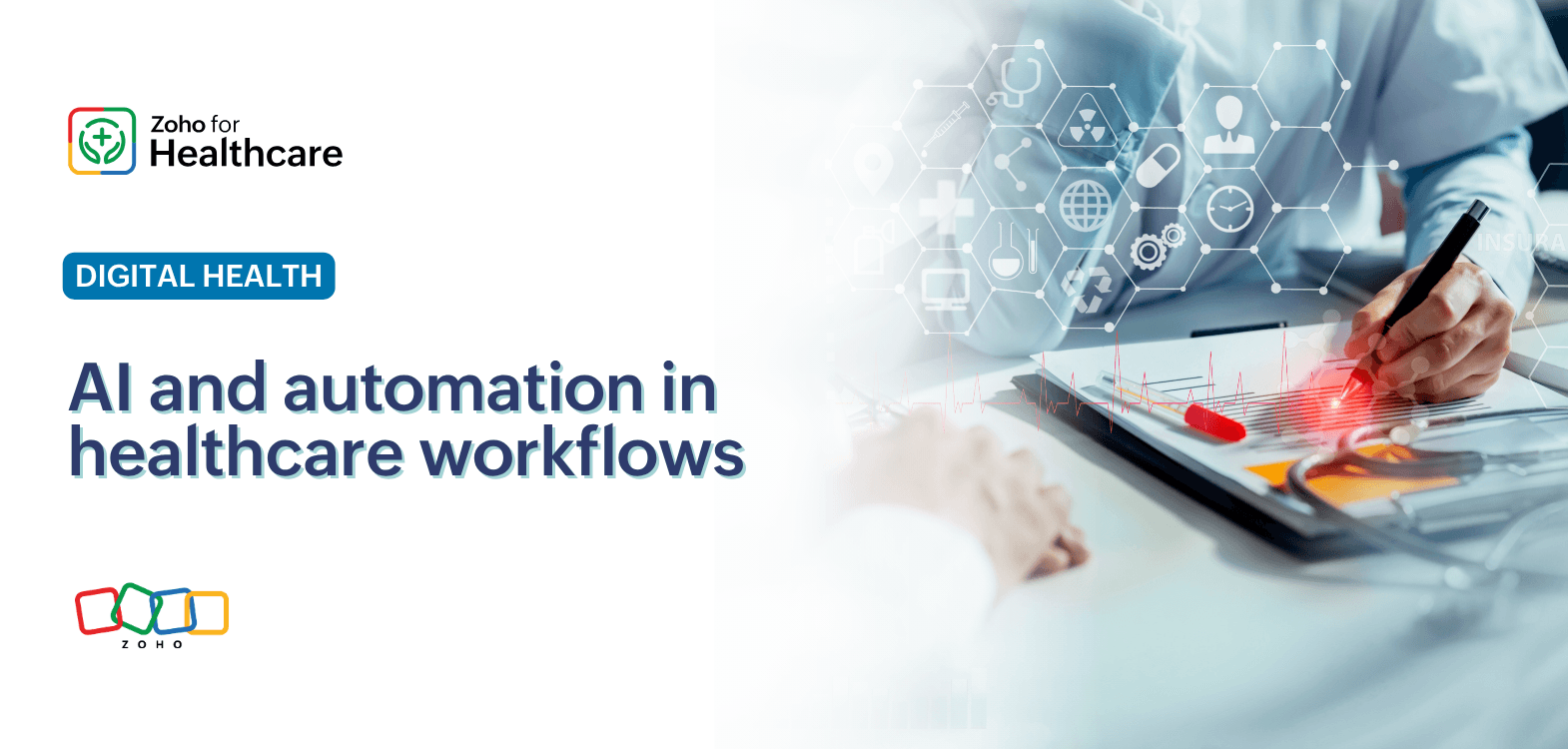
Healthcare workflows today are more complex than ever. From patient intake and scheduling to billing and follow-ups, many processes still rely on manual effort or disconnected systems—leading to delays, data entry errors, and overburdened staff.
AI and automation in healthcare workflows are changing that. By streamlining routine processes and introducing intelligence into decision-making, healthcare organizations can improve efficiency, reduce burden on staff, and deliver better patient care.
The growing complexity of healthcare workflows
Administrative overload in healthcare
Healthcare professionals spend a significant amount of time on administrative work instead of patient care. Tasks like scheduling, maintaining records, insurance processing, and follow-ups slow down operations and increase workload.
Operational bottlenecks affecting care delivery
Manual processes and fragmented systems create inefficiencies. Common issues include double bookings, missed appointments, incomplete records, and communication delays—impacting both providers and patients.
The need for smarter workflow management
With patient volumes rising and operational demands increasing, healthcare organizations need systems that can handle routine tasks automatically and route work more intelligently. Without that, care teams spend their time managing process failures instead of managing patients.
What are AI and automated healthcare workflows?
Exploring workflow automation in healthcare
Healthcare workflow automation uses technology to execute repetitive tasks with minimal human involvement. This includes automating processes such as appointment reminders, billing workflows, patient data entry, and internal task routing. The goal is to remove predictable, rule-based work from care teams.
How AI enhances automation
AI adds a layer of intelligence on top of basic automation. Using machine learning and natural language processing, AI-powered systems can handle less structured tasks: converting spoken conversations into clinical notes, flagging abnormal patterns in patient data, and routing messages based on context instead of fixed rules.
Traditional automation vs. AI-powered workflows
Traditional automation follows a fixed set of instructions. AI-powered workflows, on the other hand, can adapt, learn, and improve over time. This makes them more effective in handling complex and dynamic healthcare processes.
Key areas where AI and automation are transforming healthcare workflows
Patient intake and registration automation
Digital forms and AI-assisted workflows simplify patient onboarding. Patients can fill in their details online, while systems automatically validate and store information, reducing manual entry and errors.
Appointment scheduling and resource optimization
Automated scheduling systems help manage appointments more efficiently. They can match patient needs with provider availability, reduce scheduling gaps, and send reminders to minimize no-shows.
Clinical documentation and medical transcription
AI-powered documentation tools convert conversations into structured medical notes. Clinicians using these tools report spending less time on documentation as well as improved accuracy.
Billing, coding, and revenue cycle automation
Automation simplifies billing workflows by generating invoices, verifying insurance details, and assisting with medical coding—reducing errors and accelerating revenue cycles.
Care coordination and patient follow-ups
Automated workflows ensure timely communication with patients. This improves continuity of care and helps providers stay connected with patients beyond consultations.
Smarter demand forecasting and inventory optimization
AI helps manage the supply of medicines and medical equipment through demand forecasting, inventory optimization, and automated procurement. This reduces stockouts, minimizes waste, and ensures that critical supplies are always available.
Real-world use cases of AI in healthcare workflows
AI-powered clinical documentation assistants
Automated messaging handles appointment reminders, follow-up prompts, and routine health updates at scale. It ensures consistent communication without requiring staff to manage every interaction manually.
Predictive patient management
AI analyzes patient history and current data to flag elevated risk before a patient deteriorates. This enables earlier intervention and improves patient outcomes.
Intelligent workflow routing for healthcare teams
AI prioritizes and routes tasks based on urgency and context. For example, urgent messages are directed to the on-call provider instead of sitting in general queues, improving coordination and response time.
AI for early diagnosis and symptom detection
AI analyzes patient history and symptoms to detect early signs of disease. By identifying patterns and predicting risks, it enables faster diagnosis and timely intervention.
AI in healthcare supply chain and logistics
AI forecasts demand, automates inventory tracking, and triggers replenishment. It also monitors storage conditions for sensitive supplies and optimizes delivery routes, ensuring consistent availability and reducing delays.
Benefits of AI and automation in healthcare operations
Reduced administrative burden
Automating repetitive tasks allows healthcare professionals to focus more on patient care instead of documentation, scheduling, and billing.
Improved operational efficiency
Automation minimizes delays, reduces errors, and ensures smoother workflows across departments.
Real-time insights
AI gives healthcare leaders visibility into operations, patient trends, and resource utilization, enabling faster, data-driven decisions around staffing, capacity planning, and resource allocation.
Better patient experience
Faster scheduling, timely communication, and shorter wait times create a more seamless patient experience.
Improved compliance
Automated systems maintain accurate records, reduce manual errors, and support regulatory compliance.
Challenges in implementing AI in healthcare workflows
Data privacy and regulatory compliance
Healthcare data is highly sensitive and includes personal health information (PHI) such as patient records, medical histories, diagnoses, prescriptions, lab results, and billing details. Implementing AI requires strict adherence to data protection laws and regulatory standards to ensure that this information is securely stored, processed, and accessed.
Integration with existing healthcare systems
Many healthcare organizations rely on legacy systems that don’t easily integrate with modern AI solutions, making implementation more complex. For example, an AI documentation tool may struggle to sync with an existing EHR, or a scheduling system may not connect seamlessly with billing software. These gaps can lead to data silos, duplicated work, and limited workflow efficiency unless proper integrations are established.
Change management and staff adoption
Adopting AI requires training and changes to existing workflows, which can be challenging for healthcare teams. In some cases, clinicians may take time to adapt to AI-generated clinical notes, or administrative staff may resist shifting from manual scheduling to automated systems. Without proper training, clear communication, and gradual onboarding, adoption can slow down and limit the impact of AI initiatives.
The future of AI-driven healthcare workflows
Intelligent hospitals and connected care ecosystems
Healthcare systems are moving toward fully connected ecosystems where data flows seamlessly across departments. For example, a patient’s diagnostic results can automatically notify healthcare providers to update their treatment plan and trigger follow-up workflows without manual coordination. This improves care continuity and reduces delays.
Predictive and personalized healthcare operations
AI is shifting healthcare from reactive to predictive care. For instance, AI can analyze patient data to flag early signs of chronic conditions, recommend preventive interventions, or personalize treatment plans based on individual risk profiles. This enables providers to act earlier and deliver more targeted care.
The role of integrated healthcare platforms
Unified platforms that combine automation, AI, and data management will enable end-to-end workflow orchestration. A single system can manage patient intake, documentation, billing, and follow-ups while integrating AI insights across each step, reducing fragmentation and improving operational efficiency at scale.
Conclusion: Building the next generation of healthcare workflows
AI and automation are no longer optional in healthcare—they’re essential for managing growing operational demands and improving care delivery. By streamlining workflows and reducing administrative burden, these technologies enable healthcare providers to work more efficiently and focus on delivering better patient outcomes.
As healthcare continues to evolve, organizations that adopt AI-driven workflows will be better positioned to deliver smarter, faster, and more connected care.
Frequently asked questions
1. What is AI in healthcare workflows?
AI in healthcare workflows uses machine learning and natural language processing to automate tasks, analyze data, and support clinical and administrative decision-making. In practice, this means things like documentation assistance, scheduling optimization, and predictive risk flagging.
2. How does automation improve healthcare operations?
Automation handles repetitive, rule-based tasks like reminders, billing steps, and data entry, reducing manual effort for staff. Fewer manual steps means fewer errors and faster processes.
3. What are examples of AI and automation in healthcare workflows?
Examples of workflows that are already in use include automated appointment reminders, AI-powered clinical documentation, billing and coding automation, digital patient intake, and predictive analytics for care management.
4. What are the benefits of AI in healthcare workflows?
Reduced administrative workload, faster operations, better patient communication, fewer errors, and more consistent compliance. The magnitude of these benefits depends heavily on how well the tools are implemented.
5. Can AI replace healthcare professionals?
No. AI is designed to assist, not replace, healthcare professionals. It handles repetitive and data-heavy tasks, allowing clinicians to focus on diagnosis, treatment, and patient interaction.
6. How does AI help in clinical documentation?
AI tools transcribe and structure provider-patient conversations into draft clinical notes in real time. Providers review and edit rather than write from scratch, which cuts documentation time significantly for most users.
7. Is AI in healthcare secure and compliant?
AI systems in healthcare are designed with data privacy requirements in mind, but compliance isn’t automatic. Organizations need to verify that any tool they adopt meets applicable regulations and implement appropriate safeguards on their end.
8. What challenges do healthcare providers face when implementing AI?
Common challenges include data privacy requirements, integration complexity with legacy systems, high upfront costs, and staff adoption. Integration tends to be the most underestimated.
9. How does AI improve patient experience?
AI enhances patient experience by reducing wait times, enabling faster scheduling, providing timely reminders, and supporting personalized care through data insights.
10. What is the future of AI in healthcare workflows?
The future of AI in healthcare includes predictive analytics, personalized treatment plans, intelligent workflow automation, and fully connected healthcare ecosystems that improve both efficiency and patient outcomes.
11. How can small clinics benefit from healthcare automation?
Small clinics can use automation to manage appointments, patient records, billing, and follow-ups more efficiently. This helps reduce operational costs and improve patient care without requiring large teams.
12. What’s the difference between AI and automation in healthcare?
Automation executes predefined tasks without variation. AI can adapt based on data, handle less structured inputs, and improve over time. In practice, most healthcare systems use both—automation for predictable tasks and AI for those requiring judgment.