- HOME
- Digital Health
- Why strong healthcare systems still fail at patient retention—even with EHR and HIS in place
Why strong healthcare systems still fail at patient retention—even with EHR and HIS in place
- Last Updated : May 5, 2026
- 154 Views
- 5 Min Read

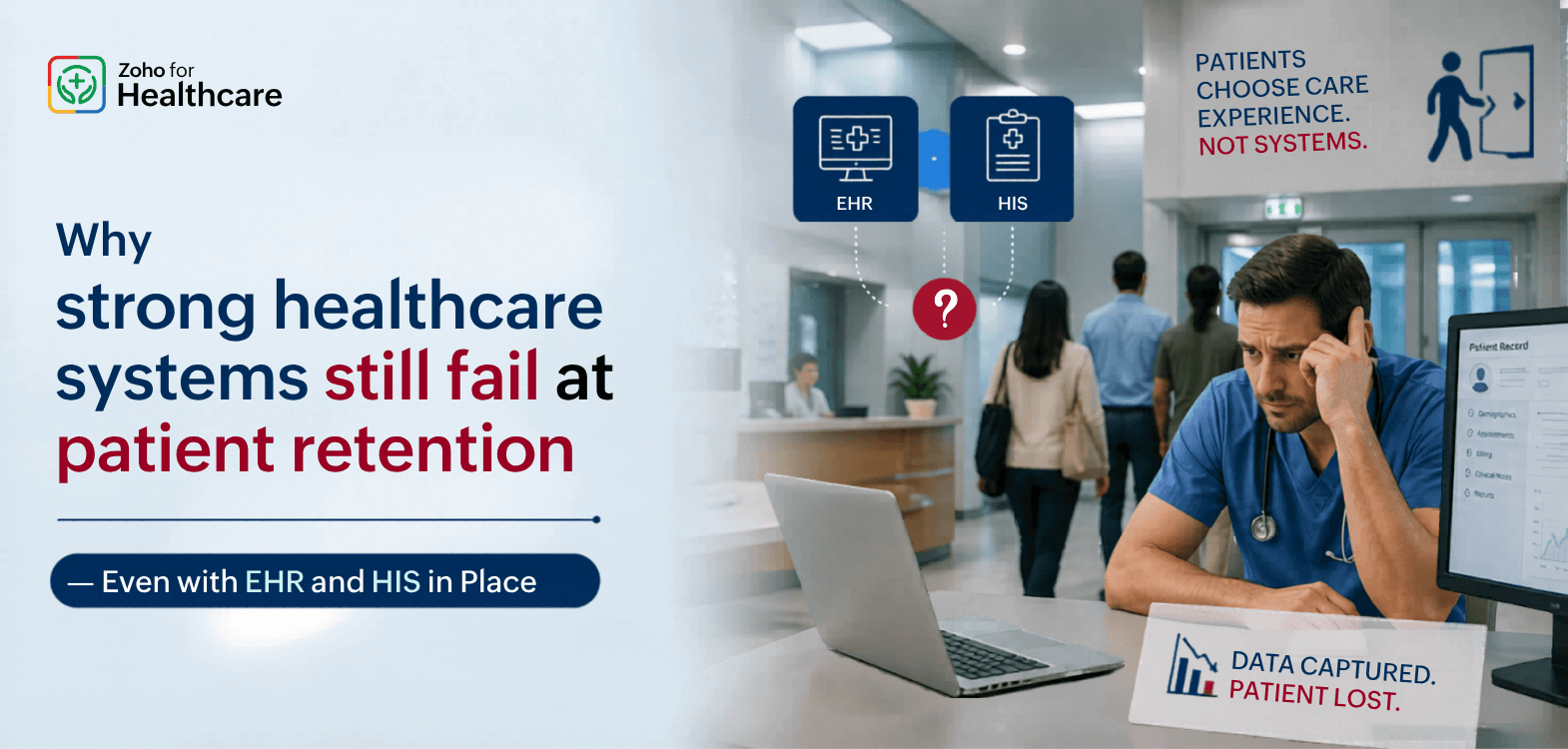
Your EHR is working. Your HIS is working. And your patients are still leaving. Not because something is broken. But because something was never built.
There’s a structural gap in healthcare infrastructure that rarely shows up in reports, and it’s almost never discussed at the board level until the consequences are already visible.
And when it does become visible, it often looks like this; as patient communication shifted toward messaging apps in one study, non-response rates jumped from 5.19% to nearly 21%. Nearly one in five patients became unreachable; not because they left, but because the system had no way to follow them.
The channel changed. The patient behavior changed. The infrastructure didn’t.
That’s the gap.
The moment a patient is discharged, something quiet happens inside your infrastructure.
The EHR closes the record. The HIS closes the transaction. And the relationship—the part that determines whether that patient returns, complies, or refers someone—is handed off to no one.
What appears operationally complete is, in reality, strategically incomplete. Over time, that gap doesn’t stay invisible. It shows up in declining retention, weaker referrals, and unpredictable growth. There’s no system that owns what comes next. Follow-ups depend on individual effort. Continuity depends on memory. And re-engagement depends on the patient themselves taking the next step.
Nearly half of healthcare executives report losing more than 10% in revenue due to patient leakage.
You’ve already invested heavily in EHR and HIS. Eventually, the question surfaces in the boardroom: What exactly are we missing?
Because if the gap is real and left unaddressed, it doesn’t stay contained. It shows up in declining follow-ups, weaker referral networks, and growth that becomes harder to predict or defend.
This isn’t a casual question. It’s the kind that gets asked in a boardroom, where every investment is scrutinized, and every gap must be justified.
And when it comes from a CFO or a senior executive, it carries a different kind of weight. Because the answer isn’t just about technology. It’s about whether the organization has been overlooking something fundamental.
The instinctive response, almost always, is to defend what already exists.
EHR and HIS systems are sophisticated, expensive, and essential, and that’s exactly what makes this conversation difficult.
When a system is working well, the instinct is to trust it. When an investment is significant, the instinct is to defend it. Both are reasonable. Both are also how blind spots survive for years inside well-run organizations.
Here’s what those systems will never tell you: how many patients meant to come back but didn’t. How many referrals weakened because no one followed through. How many decisions—quiet, individual, unremarkable—were made in the weeks after discharge that determined whether your organization was chosen again.
That data doesn’t exist in your EHR. It doesn’t exist in your HIS. Not because your systems are inadequate, but because they were never asked to capture it.
So the question isn’t "what are we missing".
The question is: How long have we been measuring the wrong things and calling it complete?
The blind spot in the healthcare technology stack
None of these systems were built to answer a different kind of question: What happens to the patient once they leave? Are follow-ups actually happening? Are referral relationships being nurtured? Not in theory, but in practice.
A healthcare CRM doesn’t replace existing systems. It extends them.
The EHR captures what happened. The HIS ensures the system runs. But the relationship—the factor that determines whether a patient returns, refers, or quietly disengages—exists outside both.
No one owns it. No system tracks it. And in most organizations, no one is asking why.
That’s not a technology problem. That’s a strategic blind spot.
The question is no longer whether this gap exists. It’s how long leadership can afford to look past it.
How can you close the gap?
So how does an organization close a gap that its existing systems weren’t designed to see?
Not by working harder. Not by adding headcount. But by bringing structure to the layer that has never had it—the patient relationship beyond the point of care.
Today, that layer is fragmented by default. An inquiry comes in but isn’t tracked end-to-end. A referral happens but isn’t followed through consistently. A patient completes treatment but the next interaction depends entirely on individual effort, which means it depends on chance.
This is where a healthcare CRM enters the picture. Not as a replacement for what exists, but as the missing layer that connects everything before, between, and after clinical care. Making every interaction visible. Every follow-up accountable. Every relationship manageable at scale.
The breakdown doesn’t happen at one point. It happens across the entire journey and it starts earlier than most organizations realize.
Before a patient ever arrives, there’s an inquiry. A call, a website form, a referral from a physician. In most hospitals, that moment is handled, but not managed. It’s responded to, but not tracked. And when it isn’t converted, no one knows why. The demand existed. The visibility didn’t.
The referral network runs the same way. For many hospitals, referrals are the primary driver of patient acquisition, yet the entire ecosystem is managed informally. Referral sources aren’t consistently tracked. Commissions live in spreadsheets. Communication happens across calls and messages with no single thread connecting them. Over time, that informality doesn’t just create inefficiency. It erodes relationships quietly, and without anyone noticing until the numbers shift.
Then care begins. And the assumption is that structure takes over. Appointments are scheduled. Consultations happen. But what follows—the follow-ups, the reminders, the next steps in a care pathway—still depends largely on individual effort. Which means it depends on consistency that no organization can guarantee at scale.
And across all of it, communication remains scattered. A patient calls. Then messages on WhatsApp. Then shows up in person. Nowhere do those interactions connect into a single view. So no one has the full picture. And without the full picture, accountability is impossible.
This is what the relationship layer looks like without structure. Not broken. Just invisible at every stage where visibility matters most.
EHR, HIS, and healthcare CRM: What each system is and does?
Three systems. Three distinct roles. And only one of them is responsible for what happens to the patient beyond the point of care.
The EHR owns clinical truth: what happened medically, during the consultation. The HIS owns operational reality: how the hospital runs during the stay. Neither was designed to answer the question that ultimately determines whether a patient returns: Are we managing this relationship, or are we leaving it to chance?
That question belongs to a third layer; one that most healthcare infrastructures don't yet have a formal answer for.
Final thoughts
Your investment in EHR and HIS is right. These aren’t optional systems, they’re the foundation of every well-run healthcare organization, and the decision to invest in them was the correct one.
But here’s a question worth thinking about:
What exactly goes wrong if you also have a CRM?
Not "do you need one." Not "can you afford one." But what’s the risk of having a structured layer that manages patient relationships beyond the point of care?
If the honest answer is "nothing goes wrong", then the real question isn’t whether to have it. It’s why you don’t have it yet.