Why Kenyan SMEs hit a compliance wall before they hit a revenue ceiling
Kenya has over 7.4 million MSMEs, and 14.4 million people contribute across sectors. Their share of GDP has climbed from 33.8% in 2015 to around 40%. These organisations are a powerhouse, creating roughly nine in ten of the 782,300 new jobs added in 2024 alone. But in this growing economy, the biggest hurdle they face is compliance overhead.
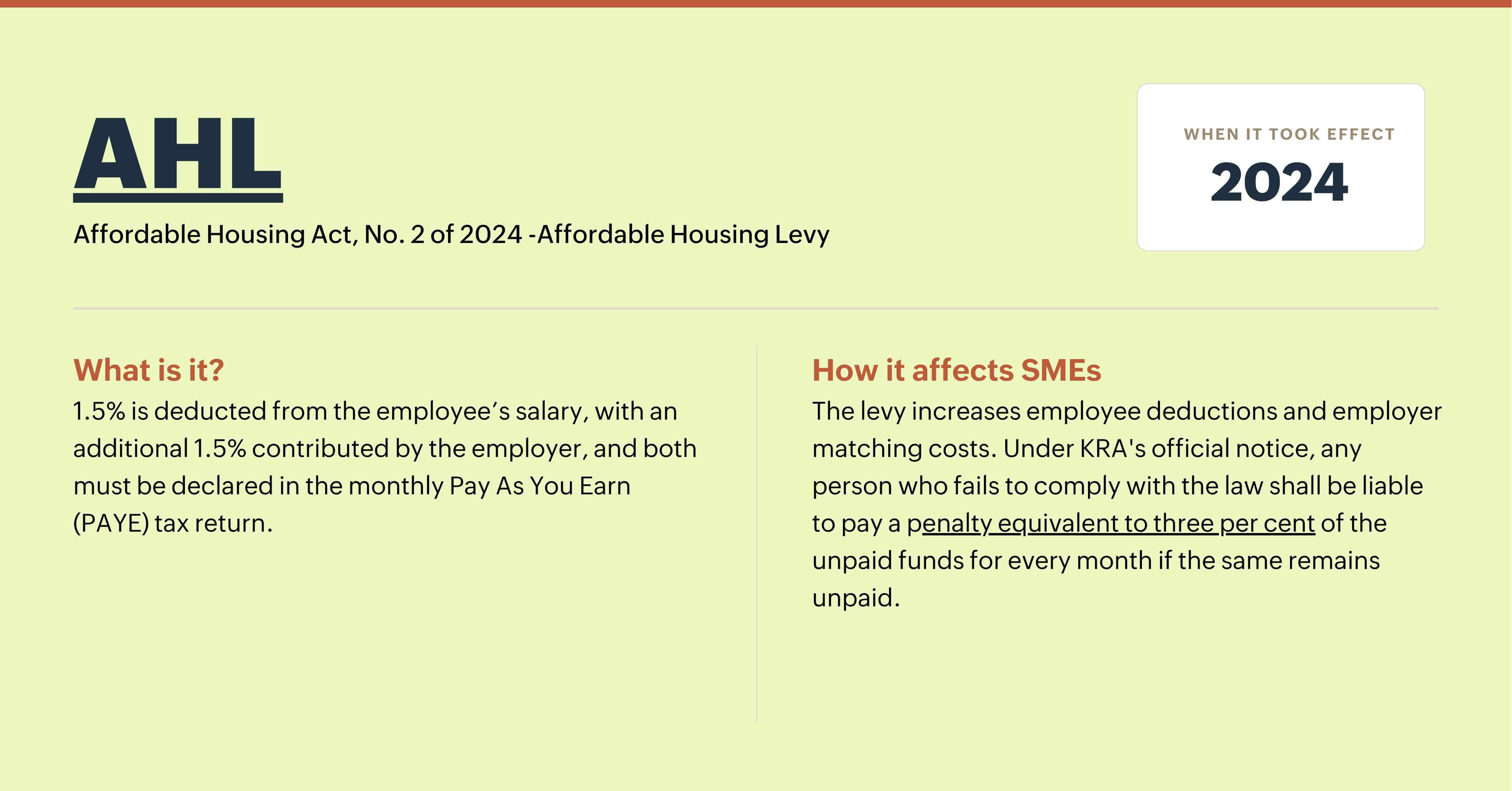
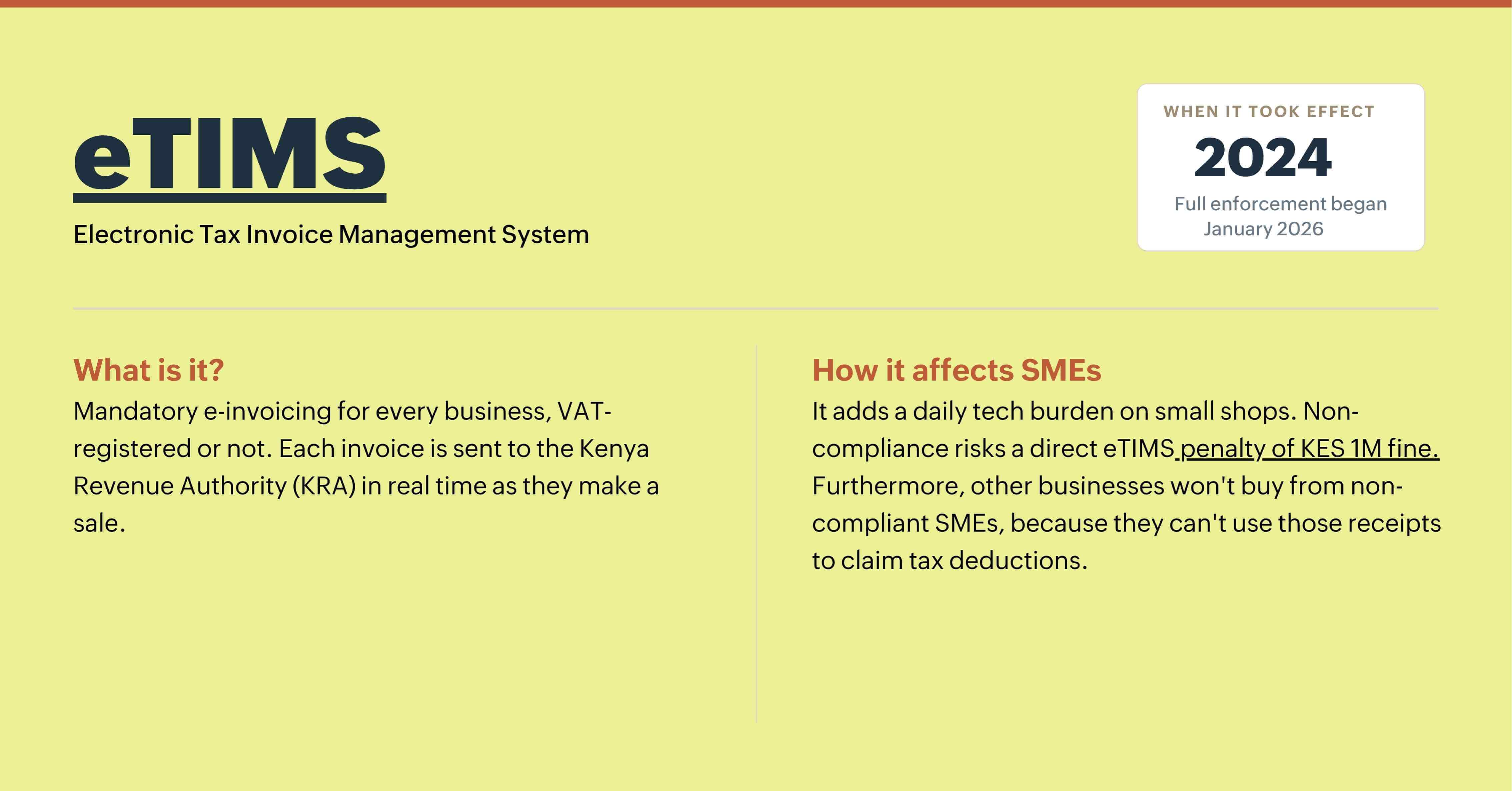
Four major statutory shifts landed inside a single calendar year:
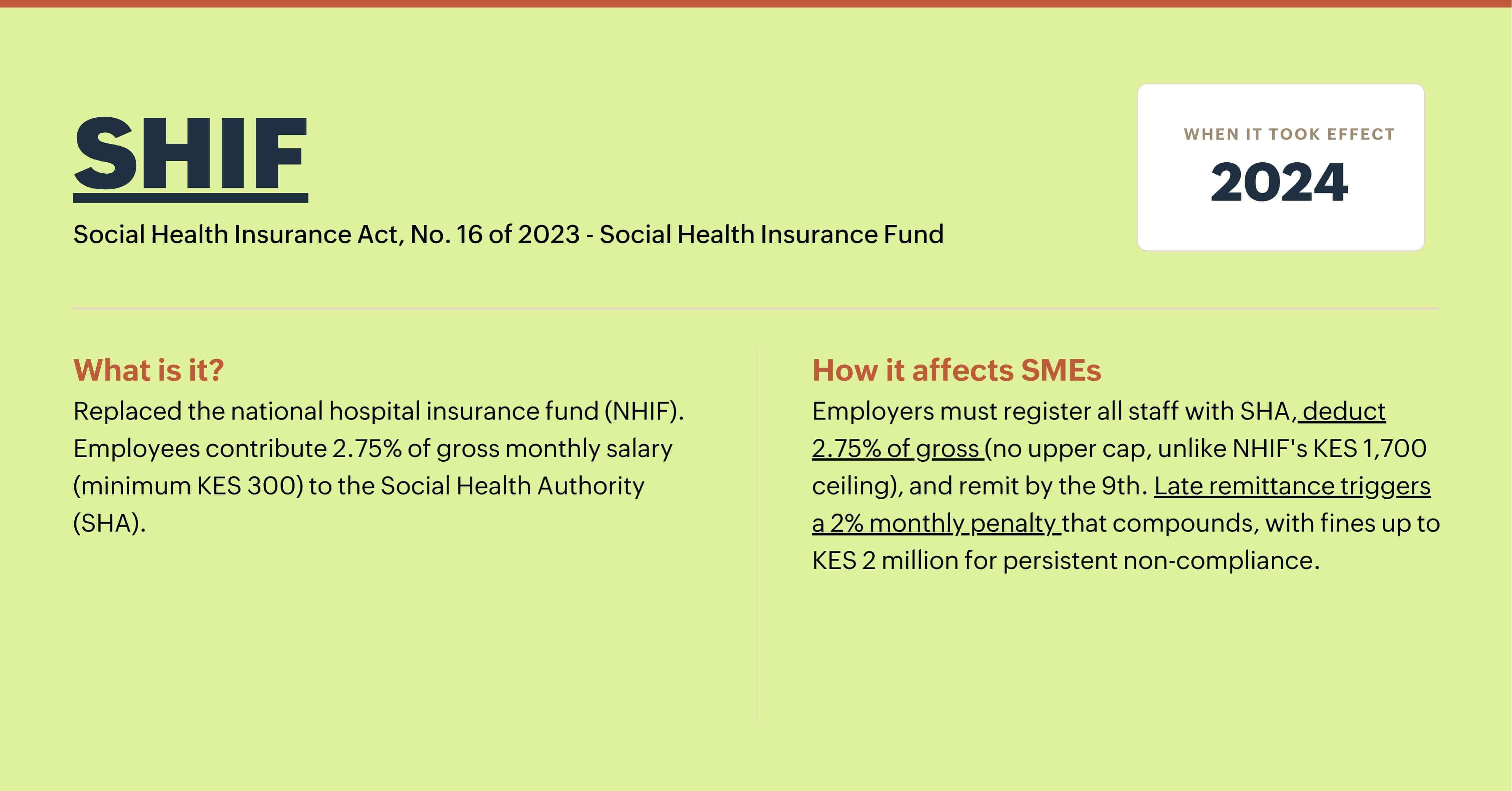
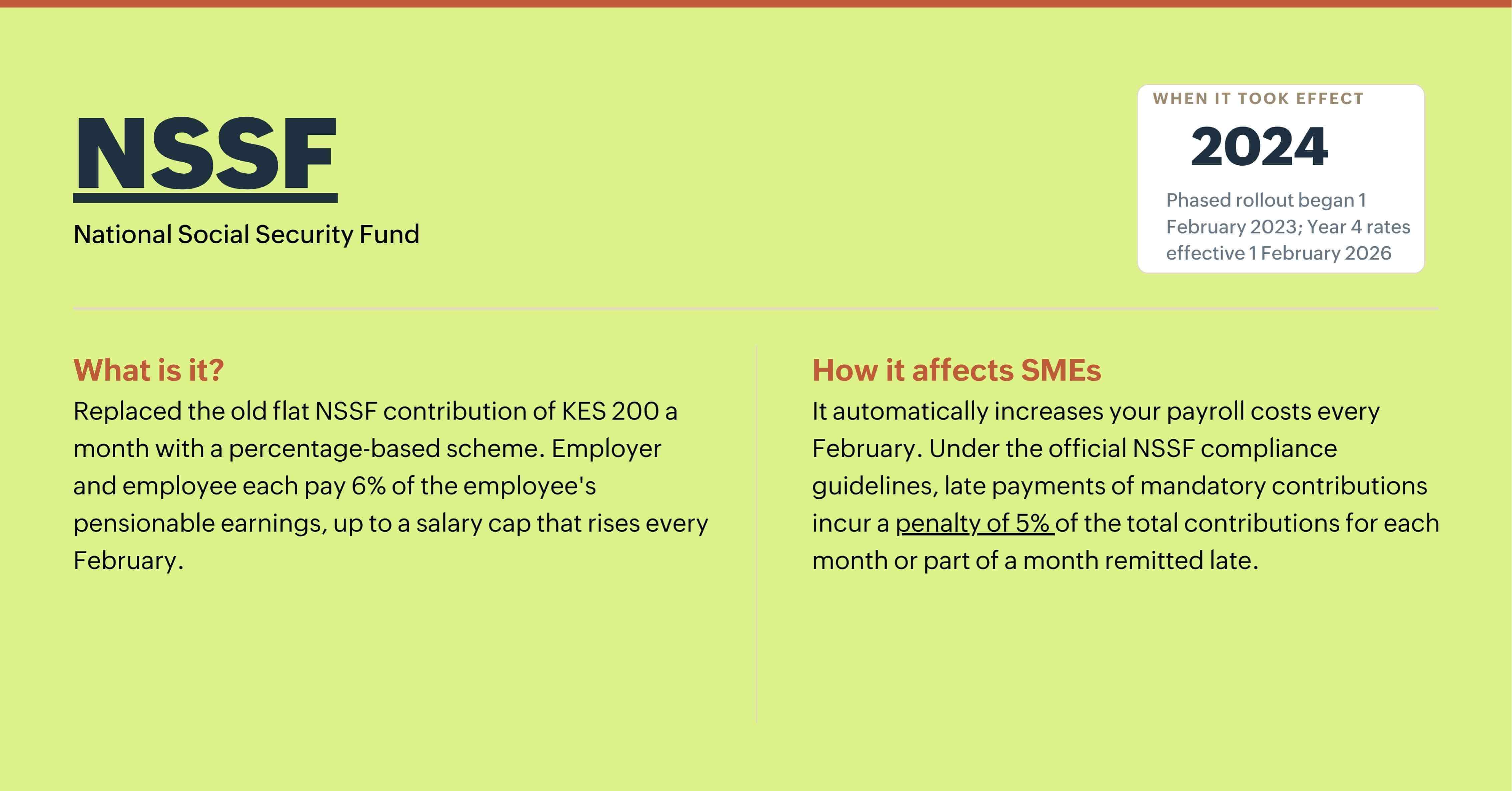
The silent compliance tax
Most SMEs start with the founder taking on multiple roles: sales, hiring, invoicing, and compliance. That works while the business is small. But as it grows, every new hire adds PAYE, SHIF, NSSF, and Housing Levy filings, each with its own calendar. Every new product line adds more VAT work. This is where many SMEs stall before reaching their full revenue potential. Compliance is often the first sign of this bottleneck, since it depends on accurate records from every part of the operation.
The manual compliance load shows up in four places:
- Hours lost on government portals
- Consultant fees that keep rising
- Time spent matching KRA records to your own books
- Penalties when something slips
The NSSF alone recovered KES 2.3 billion in employer penalties by the end of 2024, with total unremitted contributions sitting at KES 26.9 billion. This exposes systems that could not keep up.
The four statutory shifts are not separate problems neatly spaced across the month. They feed on the same employee records, payroll runs, and transaction histories. eTIMS pulls from sales. SHIF, NSSF, and the Housing Levy pull from payroll. The underlying numbers overlap, but each one sits on a different portal with its own deadline. Miss one window, and the penalties listed above will automatically apply.
Where hiring helps, and where it stops working
When compliance work piles up, hiring is a reasonable response. A finance assistant brings dedicated attention to filings. A compliance officer adds expertise that the founder doesn't have time to build. A payroll consultant takes a recurring monthly task off the calendar. Each of these hires earns its place and adds value to Kenyan SMEs.
Hiring more people stops working when the real issue isn’t capacity but how data moves through your business. If every sale has to be entered in your books, raised again as an eTIMS invoice, reconciled against KRA records, and then matched back to your VAT return, adding staff doesn't fix the process; it just adds another step. The new hire spends their time moving information between disconnected systems and chasing down mistakes. Combining automated data flows with human expertise eliminates the expensive coordination tax entirely.
Kenyan healthcare provider Figo Care Plus operates on exactly this model. "We use Zoho Books for our accounting and financials to manage all our invoices, purchase orders, every item that we need to purchase, and our profit and loss. Everything to do with accounting is handled on Zoho Books," says Victor Gitonga, the company's CRM Team Lead. When finance, sales, and HR data sit in one place, the reconciliation work and compliance drift fall away with it.
"The compliance reality has shifted faster than most Kenyan SMEs can adapt. We're seeing businesses spend more time on filings than on customers, and the answer is fewer disconnected tools. When your eTIMS invoicing, sales, and expense tracking run from the same data, mistakes fall away and last-minute scrambles disappear. That's where Kenyan SMEs win back the time to grow."
— Veerakumar Natarajan, Regional Head East Africa, Zoho
From fragmented tools to a single operating layer
Once a founder sees that the problem is structural, the next question is: what does a consolidated setup actually look like? The answer is one reliable system where sales, invoicing, and tax data live together, so your eTIMS invoices, VAT, and accounts all pull from a single source. In practice, that means software like Zoho Books, where every sales transaction generates a compliant eTIMS invoice instantly, allowing you to push it directly to the KRA with a single click while the VAT 3 return is built from that exact same data. AI-driven anomaly detection sits on top of this system, flagging inconsistencies between sales, invoicing, and VAT records before they ever reach a filing.
Compliance readiness checklist
Run this checklist against your current setup to identify hidden bottlenecks:
eTIMS posture
- Are invoices sent to KRA immediately or at the month-end?
- Do credit and debit notes process automatically through eTIMS?
- Is the VAT 3 return generated from invoice data?
The single accounting layer
- Does every eTIMS invoice flow straight into your accounts, or is it re-entered by hand?
- Can you reconcile KRA records against your own books without exporting to spreadsheets?
- Do sales, expenses, and VAT sit in one ledger, or across separate tools?
Audit trail
- Can every filing trace to transactions within an hour?
- Are corrections documented in the system, not spreadsheets?
- Would a KRA audit for 12 months take a day or a week to prepare?
If most of your answers indicate reliance on manual reconciliation, act now to future-proof your business: review your systems, identify gaps, and consider an integrated compliance solution that eliminates hidden obstacles. Don't wait for penalties; take proactive control to set your SME on a sustainable path forward.
What to do next:
- Prioritise the most urgent compliance gap you identified in the checklist above.
- Assign responsibility and set a timeline for resolving it this month.
- Research and trial integrated solutions that address your top compliance pain point.
- Revisit your checklist quarterly to ensure your SME remains audit-ready as regulations evolve.
Scale for a Kenyan SME isn’t about hiring more people; it’s about being able to double your customers, invoices, and staff without doubling your compliance burden. Adding headcount increases your monthly costs, but automating compliance lets you grow with confidence and control.
FAQs
Which Kenyan businesses must use eTIMS in 2026?
All businesses. Since 31 March 2024, eTIMS has been mandatory for any business that issues invoices, whether or not it is VAT-registered. Non-VAT businesses still need eTIMS so their customers can claim expense deductions. The only practical exceptions are businesses with no invoicing activity at all, and even those need to be registered with KRA.
Is Zoho Books a KRA-approved eTIMS integrator?
Yes. Zoho Books Kenya edition is integrated with eTIMS via the Online Sales Control Unit (OSCU), so invoices are pushed to KRA at the point of issue. VAT classification occurs at the item level; the VAT 3 return is automatically populated from underlying transactions, and credit and debit notes are routed through eTIMS without manual intervention.
How does Zoho Books keep my eTIMS invoices and accounts in sync?
As invoicing and the general ledger sit in the same system, each eTIMS invoice posts to your accounts the moment it is issued. Sales, VAT, and your books reconcile from a single set of records, eliminating manual re-keying between separate billing and accounting tools. The result? Your VAT 3 return always reflects exactly what you have billed.
Can a small Kenyan SME start with Zoho Books before adding other tools?
Yes. Because eTIMS compliance and VAT calculation run directly from your core financial data, Zoho Books handles the daily transactional burden entirely on its own. You can layer on other Zoho applications as your operations scale.