Key to choosing AI that actually helps customers
- Published : November 20, 2025
- Last Updated : June 4, 2026
- 342 Views
- 4 Min Read


Considering the evolution of technology over the years, it should only get simpler to get and provide help. Today, as many businesses consider the AI push, they end up replacing humans with AI to handle the high ticket volume. While AI can reduce the ticket load, it's important to note that around 86% of consumers still prefer human help. And at it's core, customer service is about building strong relationships—not just answering questions.
So, how can you use AI in a way that genuinely helps your teams and customers? It starts by understanding the different types of AI and deploying the right type of AI at the right time and place.
Types of AI for customers
1. Hybrid chatbots
Before AI, rules-based chatbots made 24/7 support possible. These chatbots followed a script and worked on a predefined set up. The conversation flowed based on the customer's selection of an option. However, when customers tried to initiate a request that was not a part of the preset flow, the chatbot failed to respond. Another drawback was the chatbots' inability to maintain context.
AI-powered rules-based chatbots on the other hand, have the ability to understand each customer's query through natural language processing, maintain context, and generate appropriate responses to the user more consistently. What makes them even more capable is their ability to route queries to human reps by analyzing the customer’s sentiment and intent instead of forcing them through rigid scripts.
Use case
→ To take care of predictable tasks
For queries that involve a predefined procedure, for instance, placing a cancellation request or rescheduling an appointment, you can deploy a rules-based chatbot. This enables customers to complete a request on their own without having to wait for a customer support rep. This is also helpful to collect basic information from the customer so that the support rep gets all the information needed to resolve the query quickly.
Best practices to build hybrid chatbots
→ List out customer-facing processes that can be standardized.
→ Map these processes into clear, step-by-step flowcharts.
→ Define clear rules when the chatbot should escalate to a human.
→ Choose a helpdesk system with a low-code chatbot builder.
2. Knowledge base chatbots
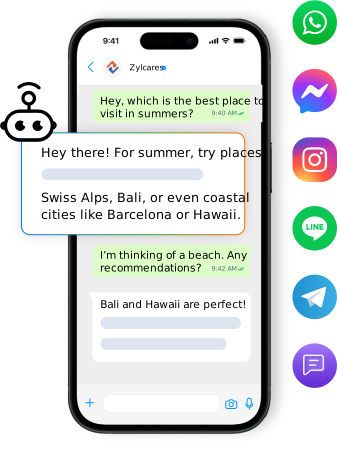
While knowledge base articles posted on your help center certainly help customers find answers, knowledge base chatbots make it faster. These chatbots can understand the user's question, pull the relevant article available in your knowledge base, and generate a brief response along with links to the knowledge base articles.
Use case
→ To answer commonly asked questions
Every business has a set of questions that customers ask on a repeated basis, for instance, "how do I change my password?" or "how do I log in?" To free your teams from answering the same questions repeatedly, you can use knowledge base chatbots. To ensure your customers have a smooth experience, you can also embed a transfer to human rep button that's made available throughout the chatbot session.
Best practices to build Knowledge base chatbots
→ Utilize your existing knowledge repository by importing all files to your customer service software.
→ Choose customer service software that allows you to create knowledge base articles with AI and automatically trains chatbots on them.
→ Keep articles clean, structured, and consistently formatted so the bot can interpret them reliably.
→ Track trending search terms and conversation tags to spot gaps and create new, high-impact knowledge-base articles.
3. AI agents
With generative AI coming into the picture, today you can create an AI agent that works autonomously towards an end goal. Unlike AI-powered chatbots, AI agents can reason and make decisions based on the instructions they're given. They enable smooth conversations and are much more effective than chatbots in complex scenarios.
Use case
To handle complex queries
If you receive a large number of complex queries that cannot be handled by hybrid or knowledge base chatbots, you can deploy AI agents. They can answer your customer's questions even if they change the context mid way and can direct requests based on the customer's sentiment and intent to human reps.
Best practices to build AI agents
→ List down the tasks you want the agent to carry out.
→ Choose the sources from which AI agents should access information like website, documents, or knowledge base.
→ Design clear guardrails and escalation paths.
→ Continuously monitor behavior and fine-tune.
→ Keep humans in the loop to correct mistakes, and steadily improve AI agent performance.
Deploy AI with the right support
While every AI solution for customer support has its own way of working and unique benefits, it's essential to choose the right customer service software to manage your AI deployment. Here are a few questions you should ask before choosing AI-powered customer service software.
Does your vendor give you the freedom to choose the LLM?
Generative AI has become the core of many software functions, and large language models (LLMs) are engines powering generative AI. To ensure your AI runs smoothly, check if the vendor allows you to choose the LLM powering AI instead of restricting you to their model of choice. This is essential as there are multiple updates being rolled out by LLM provides making them more capable and affordable. Having this freedom allows you to choose the LLM that's best for your business.
Is it easy to deploy AI from customer service software?
Choose customer service software that makes AI easy to deploy with a low-code chatbot builder, simple article training, and the flexibility to create AI agents yourself or let AI build them for you.
Does the vendor offer AI within the license fee or as an add-on?
Every vendor prices AI capabilities differently. Before choosing one, check which AI features are included in the license fee and which come as paid add-ons. Comparing these features will help you clearly understand which vendor offers the best value.
Conclusion
AI is capable of handling the routine stuff, but it still requires human intelligence to work effectively. That's why it's essential to use AI in a way that it helps human reps reduce the workload while giving customers the choice to get help the way they prefer.
If you're exploring AI-powered customer service software that empowers you and your customers, consider Zoho Desk. It brings together the best of both worlds, efficiency and experience, with its AI, Zia.