What will I learn?
- What is ETL?
- What are the various steps involved in ETL?
- What are the different types of transformations that happens in a ETL process?
- What are some common ETL use cases?
- What were the main goals of early ETL systems?
- How did ETL systems evolve over the years?
- What are the challenges of traditional ETL?
- What is the difference between batch ETL and real-time ETL?
- How does ETL compare to ELT?
- What are the advantages of modern data management systems over legacy ETL-based systems?
- What are data preparation tools? How are they different from legacy ETL tools?
- What are the key benefits of using data preparation tools?
- Conclusion
What is ETL? A detailed guide on how modern ETL works
ETL, an acronym for Extract, Transform, Load, is the cornerstone process enabling businesses to make sense of their vast data landscapes. Let's take a look at what ETL tools do, and how they have evolved over the years. We will also briefly touch upon on what modern data preparation tools can do and how they improve on legacy ETL processes.
What is ETL?
ETL, which stands for Extract, Transform, Load, is a data integration process from the data warehousing domain that involves extracting data from various sources, transforming it into a format suitable for analysis, and loading it into a central repository. This single, coherent repository is sometimes referred to as the "Single Source of Truth."
What are the various steps involved in ETL?
ETL can be broken down into three distinct stages:
Extract: Data is pulled from one or more source systems, such as CRMs, ERP systems, databases, SaaS applications, or flat files. The extraction can be a full load (all records) or an incremental load (only new or changed records since the last run).
Transform: The extracted data is cleaned, restructured, and formatted to meet the requirements of the target system and the business needs downstream. This is the most complex stage of the ETL process.
Load: The transformed data is written to a destination such as a data warehouse, data lake, or database, where it can be queried for reporting, analytics, or machine learning.
What types of data transformations happen in ETL?
Transformation is where raw data becomes analysis-ready. Common data preparation includes:
- Cleansing: Fixing or removing incorrect, incomplete, or duplicate records. For example, standardizing phone number formats or removing null values.
- Normalization: Converting data into a consistent format, such as mapping all dates to YYYY-MM-DD or converting currency to a single unit.
- Deduplication: Identifying and eliminating repeated records so only one version of each unique entry remains.
- Restructuring: Reshaping data to match the target schema, for example, splitting a "full name" field into "first name" and "last name."
- Enrichment: Augmenting source data with additional context, such as appending geographic data to a postal code.
- Filtering: Removing records that don't meet business criteria, such as excluding test accounts from a sales dataset.
- Aggregation: Summarizing data, such as computing monthly revenue from daily transaction records.
Modern data preparation tools surface many of these transformations through a visual interface, making them accessible to non-technical users without writing code.
What are common ETL use cases?
ETL is used across industries wherever data needs to move from siloed sources into a unified, analysis-ready form. Some of the most common use cases include:
Business intelligence and reporting: Organizations extract data from CRMs, ERPs, and marketing platforms, transform it into a consistent format, and load it into a data warehouse to power dashboards and reports. This is the most foundational ETL use case.
Data migration: When upgrading from legacy systems to modern platforms, ETL pipelines safely move historical data to new destinations while transforming it to match the new schema. This is common during cloud migrations or ERP upgrades.
Data consolidation: Businesses with multiple product lines, regions, or departments often have fragmented data. ETL unifies these into a single dataset, enabling cross-functional analysis that wouldn't otherwise be possible.
Compliance and audit trails: Regulated industries (finance, healthcare) use ETL to structure and store data in formats required by auditors and regulators. Transformation steps can also apply data masking or anonymization to protect sensitive fields before the data reaches analysts.
Sales, marketing, and RevOps pipelines: Revenue operations teams rely on ETL to unify data from CRMs, marketing automation platforms, ad networks, and customer success tools into a single pipeline. This gives sales, marketing, and finance teams a shared view of the funnel: from lead source and campaign attribution through to closed revenue and customer lifetime value. ETL makes it possible to align metrics across teams that historically worked from different datasets and definitions.
AI and machine learning pipelines: Training ML models requires large volumes of clean, well-structured data. ETL handles the extraction and preparation of training datasets, ensuring models are built on reliable inputs.
What were the main goals of early ETL systems?
ETL was introduced in the 1970s, coinciding with the origin and growth of data warehousing. It was originally designed for computational and analytics requirements, and became the de facto method for processing data for data warehousing.
The goal through the process was to bring in data from different sources and transform them to conform to a standard schema or data model.
ETL laid the preparatory steps for data analytics and machine learning, streamlining data through business rules to serve business intelligence and advanced analytics. It sought to enhance both operational efficiency and user interaction by:
- Retrieving data from older systems
- Refining data for quality and uniformity
- Integrating data into a designated database
How did ETL systems evolve over the years? What has been the impact of cloud computing on them?
The architecture of modern data management is vastly different from the data management that was in practice during the early days of ETL. The modern era of cloud computing, IoT, and AI has seen a quantum leap in the amount of data being recorded by businesses where enterprises have gone from recording millions of transactions to billions.
Today, businesses are not just looking at transactional data to make their decisions, but are also identifying and isolating "signals" from the vast troves of data. It is not only about incrementally improving business processes but also about identifying new opportunities.
Cloud computing brought with it solutions like cloud data storage that offered cost-effective storage at scale. Organizations that earlier stored structured data in on-premise data warehouses today have a variety of options for data storage, including data lakes and cloud blob systems. These systems can accommodate unstructured data and often store data in their raw format.
What are the challenges of traditional ETL?
While ETL has been foundational to data management, traditional ETL pipelines come with well-known limitations:
High engineering cost: Building and maintaining ETL pipelines requires specialized data engineers. Each new data source typically needs a custom pipeline, and changes to upstream systems can break existing ones.
Scalability constraints: Traditional ETL processes data on a dedicated transformation server. As data volume grows, this creates bottlenecks that are expensive to resolve, particularly in on-premise setups.
Fragility: ETL pipelines are tightly coupled to the schema of their source and destination systems. A simple change, like renaming a column in a CRM, can break a pipeline and require manual intervention.
Batch latency: Most traditional ETL runs on a scheduled batch cycle (nightly, hourly). This means the data in your warehouse is always slightly stale, which is a problem for use cases that need up-to-date information.
Limited accessibility: Legacy ETL tools were built for IT teams, not business users. This created a bottleneck where analysts had to wait for engineering support every time they needed a new dataset.
These limitations are a key reason modern data pipelines have evolved toward more flexible, self-service architectures.
What is the difference between batch ETL and real-time ETL?
ETL pipelines can be categorized by how frequently they move data:
Batch ETL processes data in scheduled intervals - hourly, nightly, or weekly. It is well-suited for use cases where data doesn't need to be current to the minute, such as monthly financial reporting or weekly marketing dashboards. Batch ETL is ideal for most business use cases.
Real-time (streaming) ETL processes data continuously as it is generated, delivering results within seconds or milliseconds. It is essential for use cases like fraud detection, live dashboards, IoT sensor monitoring, and customer behavior tracking. Real-time ETL typically relies on streaming platforms and requires more infrastructure overhead.
Most modern organizations use a mix of both, batch ETL for historical and aggregated datasets, and real-time pipelines for operational and time-sensitive workflows. Data quality monitoring becomes especially important in real-time pipelines, where errors propagate faster.
How does ETL compare to ELT?
ETL and ELT are both data integration approaches, but they differ in the order of operations.
In ETL, data is transformed before it is loaded into the destination. This gives you tight control over what enters your warehouse, which is valuable in compliance-heavy environments or when working with sensitive data that must be masked early in the pipeline.
In ELT (Extract, Load, Transform), raw data is loaded into the destination first, and transformation happens inside the warehouse using its own compute power. ELT is better suited for cloud-native environments where storage is cheap and warehouse compute is scalable on demand.
Neither approach is universally superior - the right choice depends on your data volume, latency requirements, infrastructure, and team capabilities.
For a detailed side-by-side comparison, see our dedicated guide: Difference between ETL and ELT
What are the advantages of modern data management systems over legacy ETL-based systems?
Modern data management systems are driven by the need for more flexibility, scalability, and efficiency in data handling.
Just as early ETL systems emerged alongside the data warehousing systems, modern data tools are closely linked with the emergence of new generation data storage systems.
The rapid development of flexible and scalable data storage systems has led to the decoupling of the data movement from data preparation. In effect, the extract and load aspects of ETL has been decoupled with the transformation aspect of data management.
Consider a business enterprise present in different locations with many departments - sales data in a CRM, employee information in an HR system, and inventory in a custom-built system. Traditionally, data engineers ran ETL processes to extract from these disparate sources, transform them, and load them to data warehouses.
However, modern data management does not require the help of data engineers or even an IT team to prepare or move data for analysis.
What are data preparation tools? How are they different from legacy ETL tools?
Data preparation or data wrangling tools tools are modern data tools that address the "transformation" part of the conventional ETL cycle. It is also the "content" part of the ETL process where data is being prepared for downstream consumption.
Though they work on the same core principles as early ETL systems such as mapping schemas between relational databases, computing formulas, and loading databases, modern data preparation tools go much further.
Where traditional ETL tools relied on data engineers and an IT department to run the processes, modern data preparation tools empower a broader set of users to work with data. Through a user-friendly interface and by providing visual breakdowns on data quality, smart suggestions, and other visual cues, data preparation today enables even non-technical users to prepare data.
Self-service data preparation tools use visualization and AI-driven recommendations to open the process of data preparation to a new generation of users, including data enthusiasts.
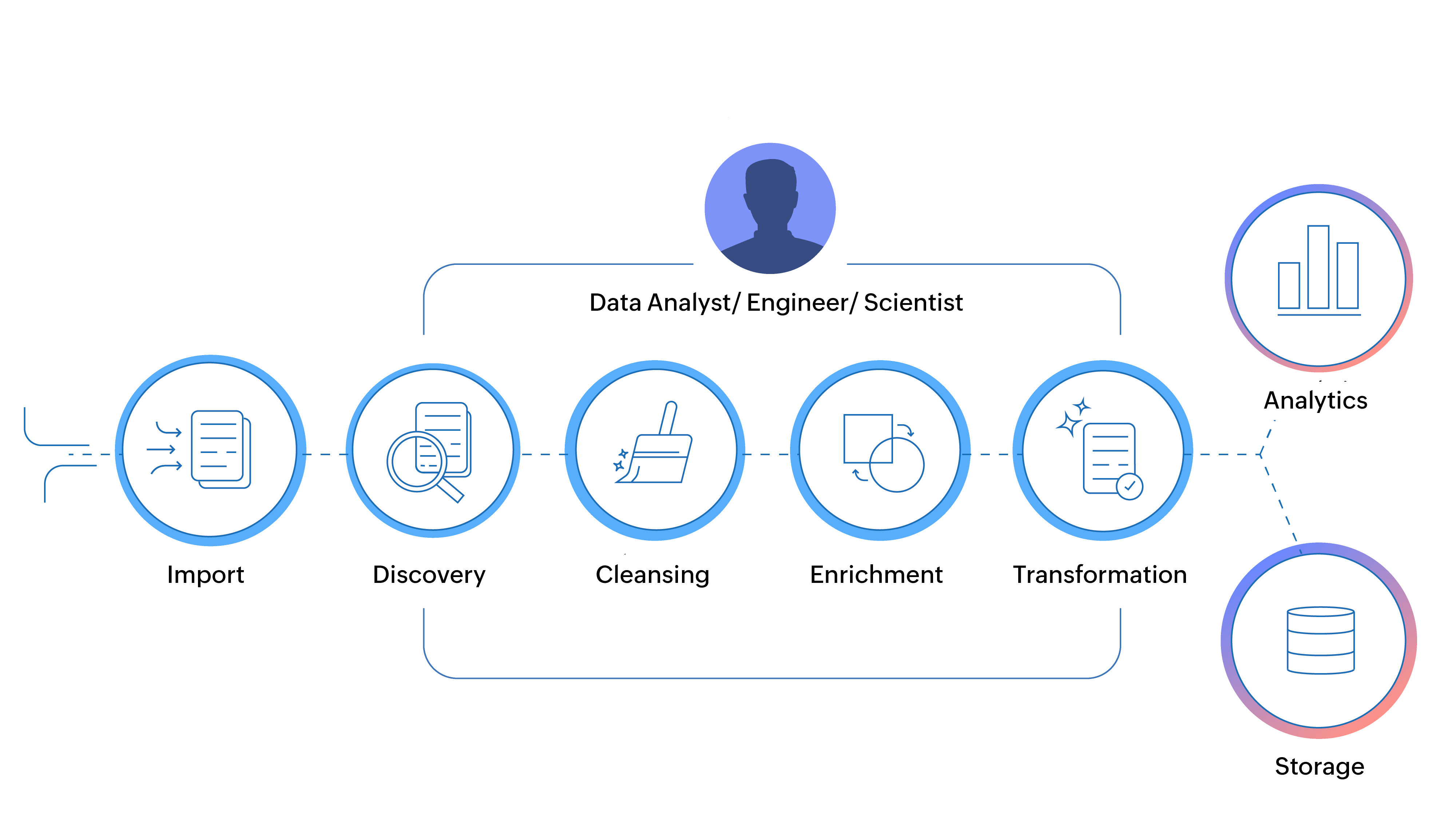
Modern data preparation tools allow users to prepare data in an easy to use interface and leverage modern technologies like artificial intelligence.
What are some of the key benefits of using data preparation tools?
Modern data preparation tools, which form one of the critical parts of the data management workflow today, offer three broad benefits:
Accelerate time to value: Business users can prepare and access data independently, without waiting on the IT team. Visual interfaces and AI-driven suggestions cut data preparation time significantly.
Reduce operational costs: By eliminating the need for custom-coded ETL pipelines for every use case, self-service tools reduce the burden on data engineering teams and lower total cost of ownership.
Improve monitoring and governance: Modern tools provide step-by-step data quality visibility, flagging issues like duplicates, nulls, and format mismatches at each stage of the pipeline rather than discovering problems after data has already landed in the warehouse.
Conclusion
When seen at a superficial level, the flow of data through a data management system today remains, in spirit, similar to what happened during the formative years of ETL. However, today's process of preparing data has been democratized due to modern tools that provide users with visual cues on how to prepare data easily.
Whether you're working with batch pipelines or real-time streams, ETL remains foundational but the only thing that has changed is the tools and people who execute it .
Zoho DataPrep brings the power of data accessibility to business users, with no code required.
Ready to simplify your data preparation? Try Zoho DataPrep for free