

- HOME
- Financial Management
- Fiscal year-end accounting in India: A complete guide
Fiscal year-end accounting in India: A complete guide
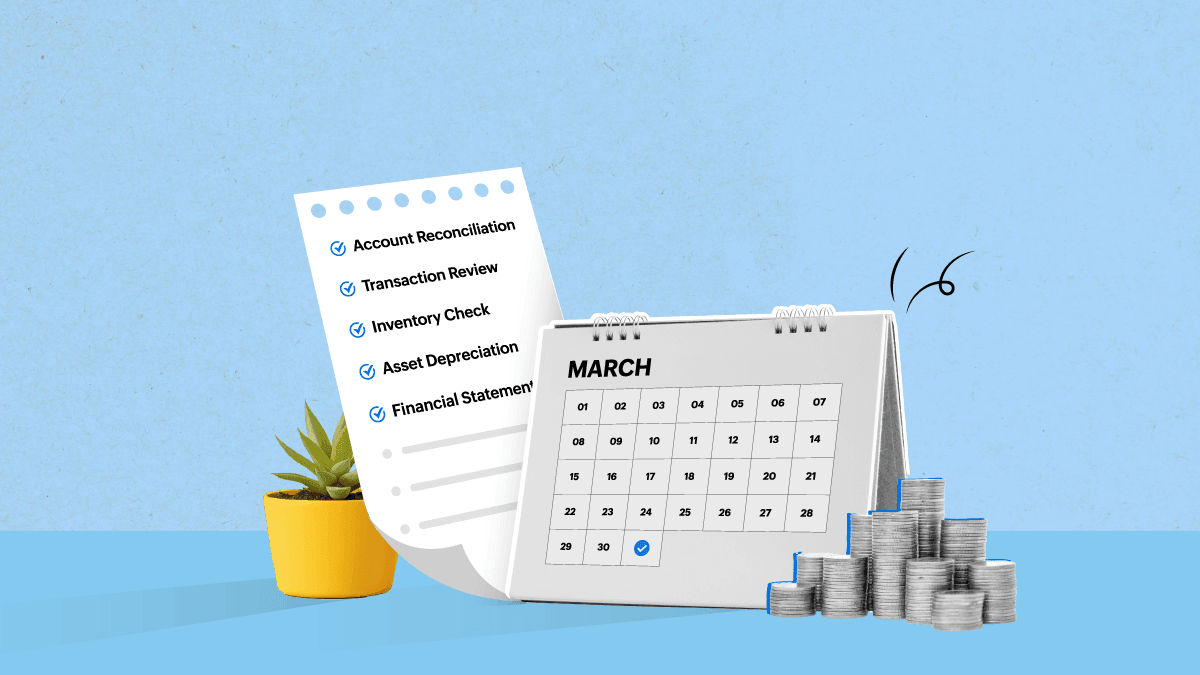
March is where most accounting gaps show up.
For Indian businesses, the fiscal year-end is not just about closing books. It is about making sure your GST data matches, expenses are captured, receivables and payables are accurate, and tax calculations are right before March 31. Do it well, and you start April with clean books and clarity. Get it wrong, and issues surface later during filings, audits, or assessments.
This guide breaks down fiscal year-end accounting in India in a simple, practical way for business owners, finance teams, and chartered accountants. It covers GST reconciliation, closing entries, compliance checks, and audit readiness. Consider this a complete checklist to help you close your books accurately and stay compliant.
What is the fiscal year-end in India?
The fiscal year (also called the financial year) is the 12-month period used for accounting, taxation, and reporting.
In India, it runs from April 1 to March 31, as defined under the Income Tax Act, 1961.
The fiscal year-end is simply March 31, the cut-off date to:
Record all transactions for the year.
Close books of accounts.
Finalize tax positions.
From April 1, a new financial year begins with fresh set of books.
Why March 31? Why does this date matter?
The April-to-March financial year in India traces back to the British colonial era, when the British government aligned India's fiscal calendar with its own. Post-independence, India retained the same structure, partly for continuity, partly because the agricultural cycle and harvest seasons made April a practical starting point for a new financial year.
Today, March 31 is one of the most important dates for any business in India because:
Compliance deadlines depend on it.
Financial statements are built around it.
Tax planning ends on this date.
How businesses use the fiscal year
The financial year acts as a structured timeline for how businesses operate, report, and plan.
Financial reporting : Businesses prepare profit & loss statements and balance sheets for the full year. These are used by investors, banks, and auditors.
Tax planning : Income and expenses are tracked within the financial year to calculate tax liability under the Income Tax Act, 1961.
GST compliance : GST returns like GSTR-1 and GSTR-3B are filed throughout the year, and annual reconciliation is based on this cycle.
Budgeting and forecasting : Most businesses set annual budgets in April and use year-end data to plan the next year.
Payroll and TDS : Employee tax reporting (Form 16) and TDS compliance follow the financial year.
Vendor and payment cycles : Payments, contracts, and procurement often align with year-end closure requirements.
In short, your financial year is your business story told in numbers.
Pre-year-end preparation
This is where smooth year-end closures actually begin.
Start at least 30–45 days before March 31; waiting until the last week of March turns a process into a crisis.
Begin by cleaning up your books. Record all pending sales and purchase invoices. Capture missed expenses—especially recurring ones like rent, subscriptions, utilities, and bank charges. Your books should reflect reality, not estimates.
Move to reconciliations. Match your bank balances with statements. Review receivables and follow up on long-pending payments. Confirm vendor balances. At the same time, reconcile your GST data, align your sales with filed returns and match purchases with GSTR-2B. Fix mismatches early. They don’t age well.
Next, run a compliance check. Ensure all GST returns are filed correctly under the Central Goods and Services Tax Act, 2017. Verify that TDS has been deducted and deposited as required under the Income Tax Act, 1961. Any gaps here will cost you interest and penalties.
Now focus on tax planning. Estimate your annual profit and compute your tax liability. Pay your final advance tax installment (due by March 15) based on realistic numbers. Review deductions and disallowances. This is your last chance to optimize taxes within the law.
At the same time, start inventory and asset checks. Conduct a preliminary stock review to identify discrepancies or slow-moving items. Verify fixed asset additions and disposals. Ensure depreciation is correctly accounted for.
Coordinate internally. Your finance team, operations team, and CA should work in sync. Misalignment at this stage is one of the biggest causes of delays.
Finally, organize documentation. Keep invoices, agreements, and compliance records ready. Clean documentation makes audits faster and far less painful.
The earlier you start, the fewer surprises you face.
Year-end accounting checklist
Use this as your working checklist for fiscal year-end accounting in India.
GST
Reconcile GSTR-1 with GSTR-3B for all months.
Match GSTR-2B with the purchase register.
Identify and pay pending RCM liabilities.
Reconcile electronic cash and credit ledger balances.
Tax and payments
Verify advance tax paid and top up if required.
Clear MSME vendor dues within applicable timelines.
Ensure TDS is deducted on all applicable payments.
Deposit March TDS by April 30.
Books and accounts
Reconcile all bank accounts as of March 31.
Clear suspense entries.
Book all outstanding expenses.
Verify and value closing stock.
Update fixed asset register and depreciation.
Compliance checks
Download AIS and Form 26AS and reconcile them with the books.
Check applicability of tax audit under Section 44AB.
Review tax-saving investments and deductions.
Ensure ROC compliance (for companies and LLPs).
Post year-end activities
Year-end doesn’t end on March 31. It moves into audit, reporting, and filing.
Start by finalizing your books. Review all adjustments (accruals, provisions, depreciation) and ensure complete accuracy. Lock the books once everything is verified.
Prepare for an audit. Depending on your business structure and turnover, audits may be required under the Companies Act, 2013 or the Income Tax Act, 1961. Organize all documents including ledgers, invoices, bank statements, GST returns, and reconciliation.
Next, prepare your financial statements including profit & loss statements, balance sheets, and cash flow (if applicable). Follow standards issued by the Institute of Chartered Accountants of India.
Move on to tax filings. File your income tax returns and complete GST annual compliance. Ensure consistency between your returns and reconciled data.
Expect queries from auditors. Respond with proper documentation and clarity. Delays here can slow down your entire compliance cycle.
Use this phase to review performance. Analyze revenue, costs, margins, and cash flow. Identify what worked and what didn’t.
Finally, prepare for the new financial year. Set budgets, improve processes, and fix recurring issues. Don’t carry forward the same problems.
Tips for a smooth year-end closure
Start in January, not March. Early preparation reduces risk and stress.
Keep your books clean. Your CA should review data, not rebuild it.
Track vendor compliance closely. It directly affects your ITC.
Reconcile your AIS before filing returns. Mismatches can trigger notices.
Stay updated with regulatory changes. For example, upcoming shifts in tax frameworks will impact future financial years.
Use a deadline-driven calendar, not a generic to-do list. Compliance is date-sensitive.
Common mistakes to avoid
Waiting until the last week of March
Ignoring GST mismatches
Claiming incorrect ITC
Missing RCM liabilities
Skipping stock verification
Confusing financial year with assessment year
Poor documentation
Most issues are not technical. They come from delays and lack of discipline.
Conclusion
Fiscal year-end accounting in India is more than compliance. It’s a core business process. When done right, it gives you:
Accurate financial visibility
Better tax efficiency
Faster audits
Stronger decision-making
When done poorly, it creates avoidable stress for you and your CA.
The difference usually comes down to how well your processes and your tools work together. When your books, GST data, reconciliation, and reports live in one place, year-end stops feeling like a scramble and starts feeling like a system.
That’s where modern accounting platforms like Zoho Books make a real difference. From automated reconciliation and GST-ready reports to clean financial statements and audit trails, the right setup can take a lot of manual effort out of your year-end process. Want to know how much Zoho Books costs? Visit our India pricing page to compare plans and features before you choose.
Don’t treat March as a deadline. Treat it as a reset point.
Because how you close your year defines how you start the next one.