

- HOME
- Accounting trends & insights
- What SMB owners need to know about AI hallucinations in financial data
What SMB owners need to know about AI hallucinations in financial data
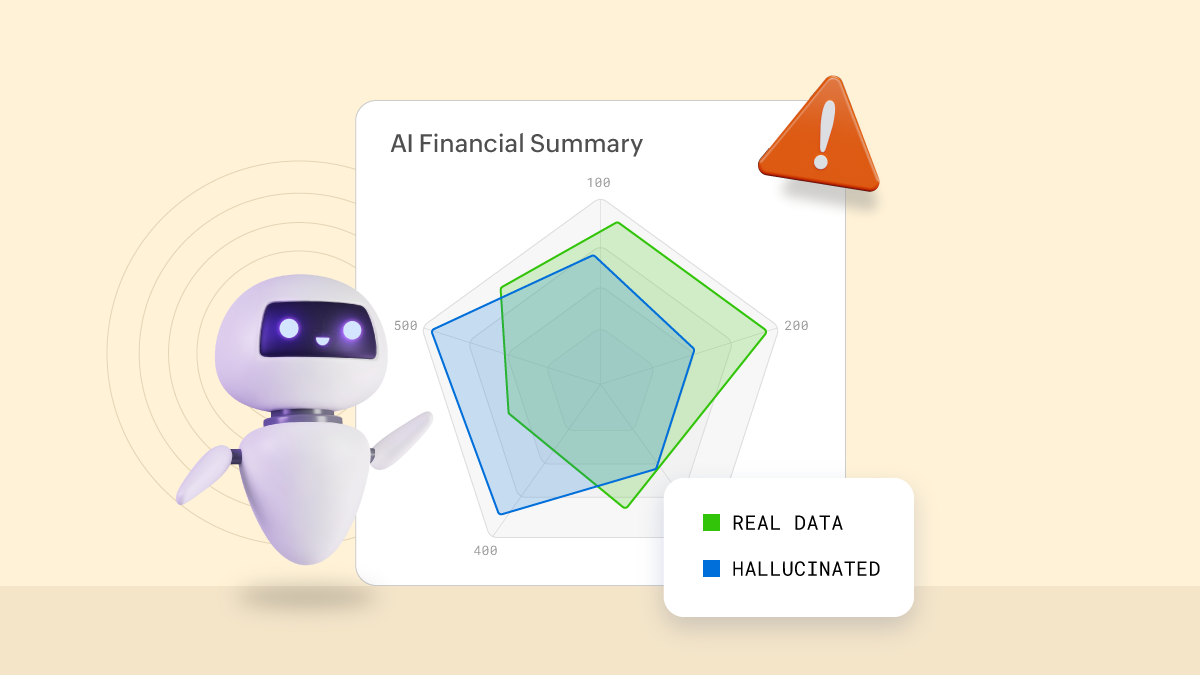
There are now AI tools that summarize invoices, flag anomalies, and auto-categorize expenses. But there's a less glamorous side to AI that doesn't get explored enough: AI hallucinations.
AI hallucinations are something that get glossed over or are not discussed at all. At a time when software providers ask you to pay more for your accounting software, it is something all consumers need to be aware of.
What are AI hallucinations in accounting software?
In simple words, AI models, particularly large language models (LLMs), sometimes generate outputs that sound completely reasonable but are factually wrong. They're essentially pattern-detecting machines that occasionally mismatch the pattern.
In non-financial contexts, this still remains a costly issue for companies. In 2023, Google's Bard plummeted company shares after it falsely stated that the James Webb telescope was the first to take pictures of a planet outside Earth’s solar system. With everyday chatbots, a hallucination might mean getting a made-up fact about the macros in your meal. In financial contexts, this can mean a fabricated transaction, an incorrect tax figure, or a cash flow summary that quietly omits a liability.
Why financial data is especially vulnerable to AI errors
Imagine an accountant who's read every accounting textbook ever written, AI tries to do the same but hasn't actually gotten to the depth of your accounts or has experience to go off of. It's primary goal is to give you an answer fast, and the majority of the time it sounds confident until you start questioning it.
Financial data is uniquely unforgiving. Imagine how a false figure in your tax filing or a wrongly classified expense that skews your profit and loss report will impact your business and finances. If this goes unnoticed for a few months, errors start to compound.
SMBs are particularly exposed here, partly because smaller teams mean fewer layers of review. Often times, one person is wearing five hats, and they're trusting the software to flag what matters. When that software hallucinates, the error may not surface until an audit exposes it.
The three areas where AI hallucinations are most likely to affect your business
Not all financial data carries equal risk. Based on where AI tends to go sideways, here are the areas to watch most closely.
Reconciliation summaries: When AI summarizes a bank reconciliation status, it can sometimes describe matched transactions that haven't actually been verified, especially if it's working from incomplete data exports or ambiguous transaction descriptions.
Vendor and customer records: Autofill and AI-assisted data entry can pull in the wrong contact details, merge duplicate records incorrectly, or populate fields with outdated information it saw elsewhere.
Tax calculations and compliance fields: This one's particularly tricky because tax rules are jurisdiction-specific and change frequently. AI trained on older data or generalized patterns may not reflect the current rules for your state or country. Always verify these figures manually or with a certified professional.
Should you avoid AI in your accounting altogether?
Avoiding AI altogether would be over-correcting. AI genuinely helps assist businesses and automation handles repetitive, low-stakes volume work well. But as tasks get more complex, false positives and negatives increase too. For instance, a recent OpenAI technical report found that its newer AI models, o3 and o4-mini, hallucinate far more often than its older o1 model. When asked to summarize publicly available facts about people, o3 gave incorrect or made-up information 33% of the time, while o4-mini did so nearly half the time (48%). By comparison, the older o1 model hallucinated 16% of the time. However, the issue isn't AI itself, it's unverified AI outputs being treated as the absolute word of truth.
The smarter move is knowing when to trust AI and when to check it. When it comes to one-off entries, edge cases, anything involving regulatory compliance, and similar tasks, human eyes need to stay locked in.
Build a simple verification layer
Here are a few tips you can follow to reduce AI-related errors and keep your financial data safe.
Cross-reference AI summaries monthly: Compare any AI-generated report against your source data at least once a month. If the numbers don't tie back to your actual ledger entries, that's a red flag. Catching this in the first month prevents errors from compounding for months together.
Set exception alerts for high-value transactions: Most accounting platforms let you configure alerts above a certain threshold. For any significant calculation, ask the software to show the reasoning behind the figure before you accept it.
Review your audit trail regularly: A healthy audit trail should tell a consistent story. Gaps, duplicates, or entries without clear origins need to be monitored to ensure accuracy.
The one thing AI cannot replace
At the end of the day, AI is just a tool, not a replacement for judgment. It doesn't understand context the way the human mind does. For example, it wouldn't know that your biggest client always pays late in December because of internal budget cycles. That contextual knowledge is unique to the human mind and it's your most valuable check against whatever the software flags.
The next time when your software surfaces an insight or generates a financial summary, it's crucial to double check it and understand the context behind it. It becomes essential to ask yourself whether the output makes sense given what you actually know about the business. If something feels off, businesses have to trust that instinct and investigate the data thoroughly.
Getting the most out of AI without the risk
AI in financial management is only going to get more capable. Advancement in AI leads to reduced manual errors in many scenarios and frees up time for higher-value decisions. But more capable doesn't necessarily mean error-free, because even contextually aware humans make errors from time to time. The businesses that will get the most out of AI are the ones that treat it like a powerful assistant with known blind spots. Verification is the best habit to possess even when things look fine. Most importantly, never let a confident-sounding output replace your intuition and evidence sitting right in front of you.
Your financial data is the nervous system of your business and it deserves to be handled with care.
How Zoho Books can help
Zoho Books is built with SMB owners in mind, giving you access to advanced automation and customization alongside clear audit trails and controls that keep you in charge of your financial data. Find out why thousands of small business owners, CPAs, and accountants choose Zoho Books.