

- HOME
- Taxes & compliance
- Input Tax Credit (ITC) rules in 2026: How to avoid cash-flow impact in India
Input Tax Credit (ITC) rules in 2026: How to avoid cash-flow impact in India
What is Input Tax Credit?
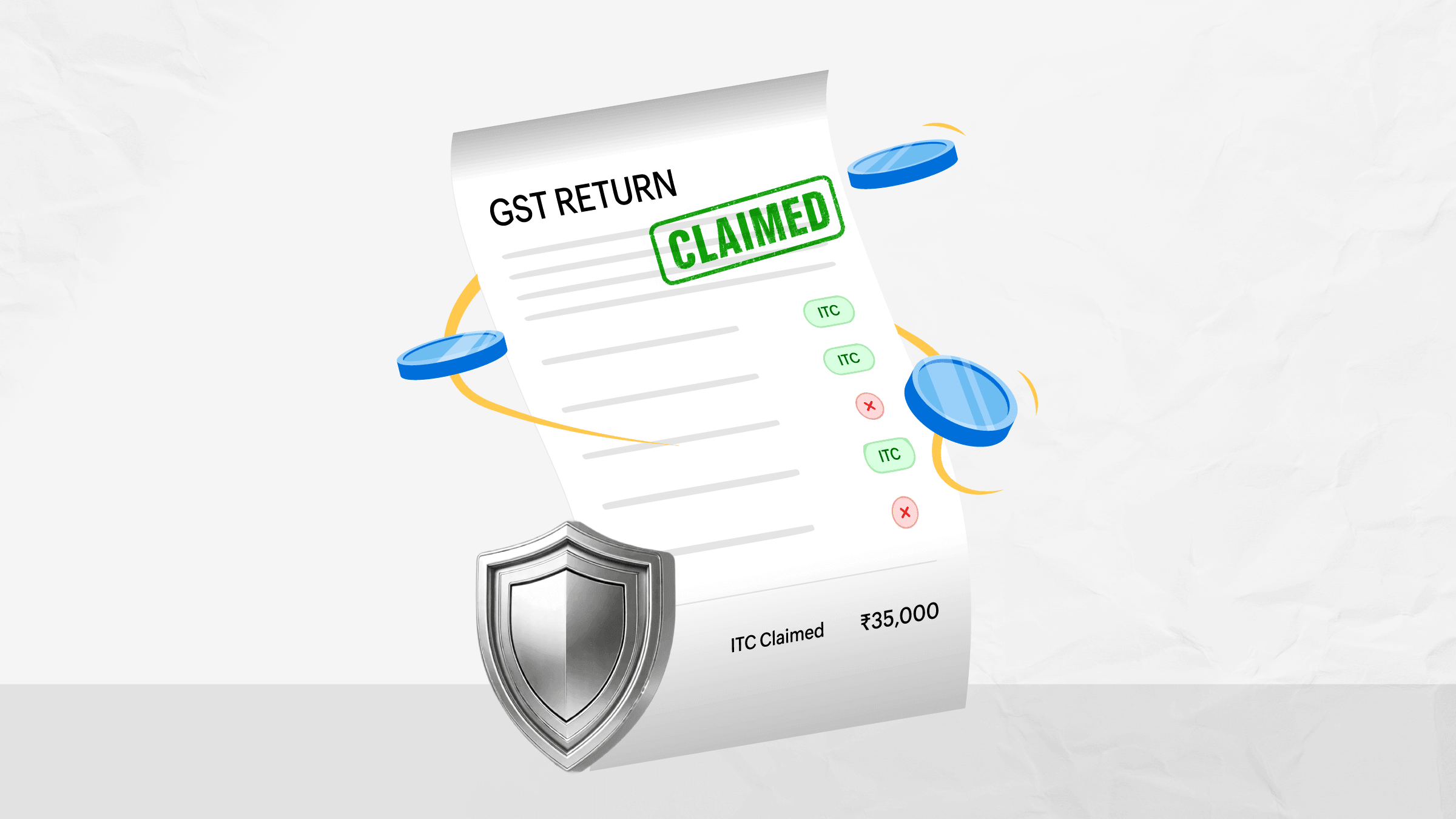
Under GST, Input Tax Credit refers to the system by which a registered taxpayer can subtract the tax already paid on purchased products or services utilised for business purposes from the GST payable on sales.
For example, a manufacturer pays Rs. 12,000 as GST on raw materials purchased and collects Rs. 36,000 as GST on finished goods sold. The Rs. 12,000 ITC is adjusted against the Rs. 36,000 GST liability, and the remaining Rs. 24,000 is paid in cash to the government.
Who can claim ITC?
ITC is available only to tax payers who are registered under GST.
Regular taxpayers filing GSTR-3B and GSTR-1.
Taxpayers registered under the composition scheme are not eligible to claim ITC.
Non-resident taxable persons may claim ITC only on goods imported by them.
Input Service Distributors (ISDs) are permitted to distribute ITC to branches.
Condition to be fulfilled for ITC eligibility
Tax invoice in possession
Good or service received
Tax paid by the supplier
GST return filed for the relevant period
Invoice reflected in GSTR-2B
ITC must be availed before filing of the September return
Blocked credits in ITC
Category | ITC status | Exceptions (if any) |
Motor vehicles (capacity ≤ 13 persons) | Blocked | Allowed if used for further supply, transportation of passengers, imparting driving training, or as stock-in-trade |
Food, beverages, outdoor catering | Blocked | Allowed if it constitutes an obligatory benefit under law or forms part of a composite/mixed supply |
Beauty treatment, health services, cosmetic surgery | Blocked | Allowed if used for making outward taxable supplies of same category |
Membership of clubs, fitness centres | Blocked | No exceptions |
Travel benefits to employees (leave travel, home travel) | Blocked | No exceptions |
Works contract for immovable property (construction) | Blocked | Allowed when the immovable property is a plant or machinery |
Goods or services for personal consumption | Blocked | No exceptions |
Goods lost, stolen, destroyed, gifted, or samples | Blocked | No exceptions |
Incorrectly claiming ITC on blocked credits often creates errors in GST audits, leading to tax demands and penalties.
ITC reversal rules and when they apply
Non-payment to the supplier within 180 days
Rule 37: If payment is not made to a supplier within 180 days from the invoice date, ITC must be reversed with 18% interest per annum.
Mixed use supplies
Rule 42 & 43: Where input services are used partly for taxable and partly for exempt supplies, ITC needs to be apportioned. The portion attributable to exempt supplies or personal use must be reversed.
Supplier default
Following the Finance Act 2026 amendment, ITC is restricted to the amount reflected in GSTR-2B. Where the supplier has not filed their return or has not paid tax, the corresponding invoice does not appear in the recipient's GSTR-2B so credit cannot be claimed.
Annual reconciliation shortfall in GSTR-9
At the time of filing the annual return, any excess ITC claimed during the year needs to be reversed with interest at 18% per annum. Monthly reconciliation is the most effective means of preventing year-end shortages.
Impact & ways to manage ITC cash flow
ITC-related cash-flow interruptions often occur from a mix of timing mismatches, supplier non-compliance, inaccurate claims, and accounts-payable lapses. All of these can be prevented with systematic management.
Timing mismatch problem
ITC is auto-populated in GSTR-2B only once the supplier files their GSTR-1. When a supplier files after the eleventh month, the credit is deferred to the next period. The recipient must either pay the production tax in cash for the current quarter or carry forward the mismatched credit for both of which harm liquidity.
How to manage it
Use vendor scorecards that track GSTR-1 filing history to evaluate supplier compliance at onboarding.
Use GST reporting as contractual agreements to provide additional leverage.
Supplier compliance as cask-flow risk
If a supplier delays filing GST returns or fails to file them altogether, the buyer may not be able to claim ITC related to those purchases. When this happens across many suppliers, even a small number of non-compliant ones can collectively block significant ITC amounts, creating cash flow pressure for the business.
How to manage it
Periodically review your GSTR-2B.
Businesses can also tie their preferred vendor status and favourable payment terms to a supplier’s GST for timely reporting.
Avoiding the 180-day reversal trap
When a business claims ITC on the purchase invoice but does not pay the supplier within 180 days, the claimed ITC must be reversed along with interest.
How to manage it
Reconcile accounts payable ageing reports with ITC already claimed to identify unpaid invoices.
Flag invoices nearing the 180-day limit and either clear the payment or reverse the ITC proactively to avoid interest accumulation.
Year-end reconciliation and excess ITC claim
Businesses that do not regularly reconcile their claimed ITC with their GSTR-2B may have missing invoices, incorrect tax amounts, or supplier non-compliances. These differences are often discovered with a GSTR-9 reconciliation.
How to manage it
Monthly reconciliation between the purchase record and GSTR-2B should be conducted before filing GSTR-3B to ensure proper ITC claims.
Any mismatches detected during reconciliation should be addressed and rectified within the same return period.
ITC compliance checklist
◻ Verify that the supplier's GSTN is valid and active.
◻ Check blocked credits and identify if they are for taxable, exempt, or mixed-use purposes.
◻ Reconcile the purchase register with GSTR-2B before filing GSTR-3B every month.
◻ Claim ITC invoices in GSTR-2B and follow up on missing invoices.
◻ Monitor unpaid invoices within the 180-day limit to avoid ITC reversal.
◻ Apportion ITC accurately for mixed-use purchases under Rule 42 and Rule 86B applicability.
◻ Identify suppliers with delayed GSTR-1 filings.
◻ Reconcile cumulative ITC claimed in GSTR-3B with GSTR-2B on a periodic basis.
◻ Before submitting GSTR-9 and GSTR-9C, reconcile annual ITC claims, reverse excess ITC, and validate the Rule 43 capital goods apportionment.
◻ Review banned credit categories annually to verify no ineligible ITC has been claimed.
How Zoho Books simplifies ITC management
As transaction volumes grow, the complexity of tracking blocked credits, apportionment ratios, 180-day payment timelines, and GSTR-2B mismatches compounds significantly.
Zoho Books is designed to address these challenges within the accounting workflow itself, so that ITC compliance does not become a separate, parallel effort.
Feature | How it helps |
GSTR-2B auto-fetch and reconciliation | Purchase data is matched against GSTR-2B automatically. Discrepancies are highlighted before GSTR-3B is filed, eliminating the need for manual spreadsheet matching. |
180-day payment alerts | Invoices approaching the 180-day threshold are flagged so ITC can be reversed proactively. |
Blocked credit classification | Expenses are categorised at the point of entry to identify non-eligible ITC before a claim is made, reducing the risk of disallowed credits. |
GST return filing | GSTR-1, GSTR-3B, GSTR-9, and GSTR-9C are prepared and filed directly from Zoho Books, with pre-filing validation checks built in. |
Vendor GSTIN validation | Supplier GSTINs are validated at the time of the transaction entry, reducing the risk of availing ITC on invoices from inactive or cancelled registrations. |
ITC ledger reports | A consolidated view of ITC available, claimed, and reversed is maintained at all times, providing the visibility required for accurate cash-flow planning. |
Effective ITC management is now essential, as regularly reconciling data, monitoring supplier compliance, and ensuring timely payments with the right accounting tools can help businesses avoid penalties and improve cash flow.
Try our online accounting software for free today to streamline your accounts payable process.