Microsoft retires EWS: What it means for Microsoft 365 to Zoho Mail migrations

Microsoft has officially announced the retirement of Exchange Web Services (EWS) for Exchange Online. Microsoft has been moving away from EWS for several years now: it stopped receiving new feature updates back in 2018, and basic authentication support for EWS was retired in 2020. 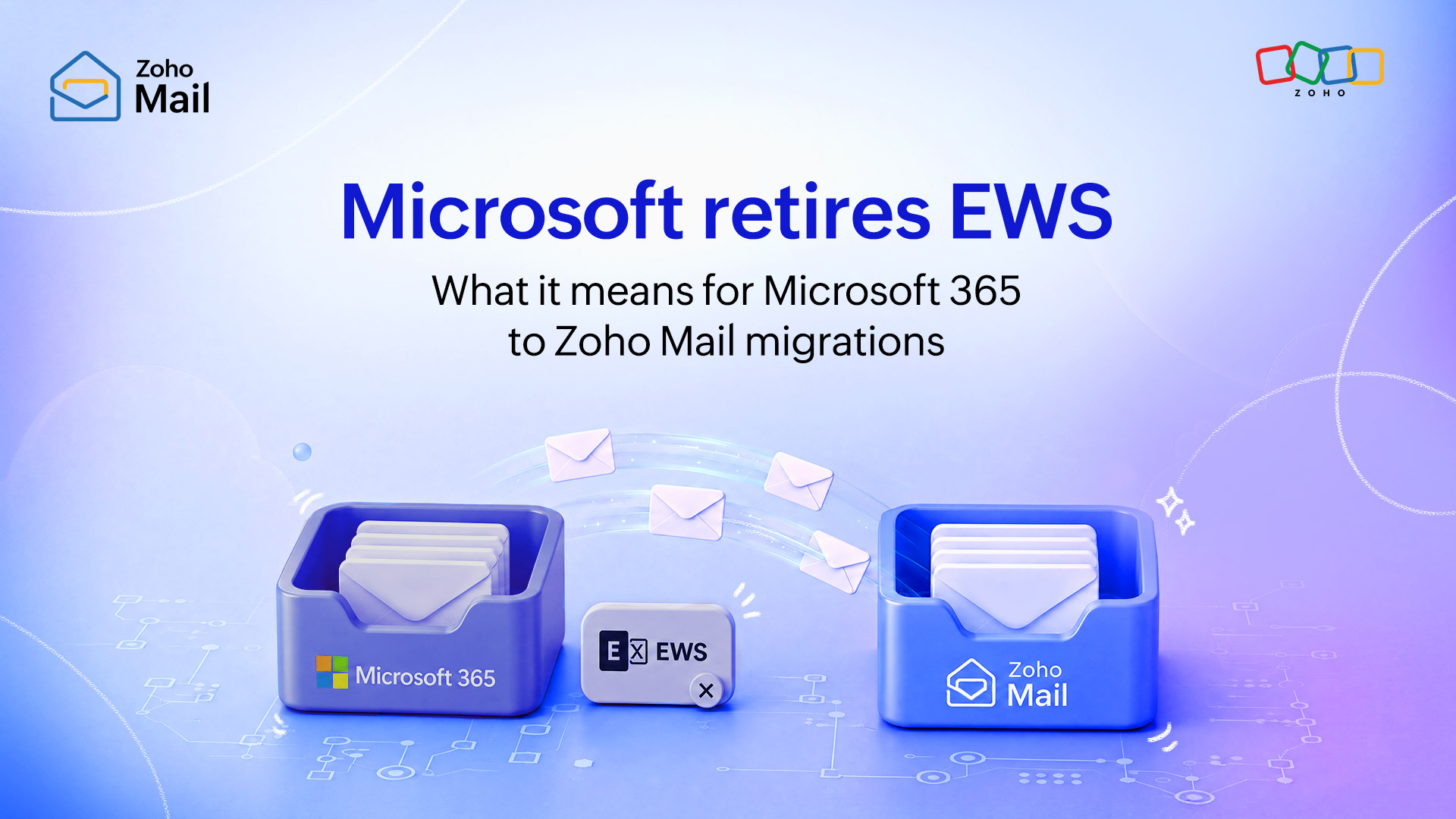
The timeline below highlights the key milestones still ahead.
| Date | Event | Impact |
| October 1, 2026 | EWS service blocking begins in Exchange Online. | EWS requests begin to be blocked in Exchange Online. The migration of Microsoft 365 in-place archive mailboxes to Zoho Mail will no longer be supported. Primary mailboxes, contacts, calendars, and shared mailboxes will continue to be supported. |
| April 1, 2027 | EWS is fully retired from Exchange Online. | Exchange Web Services is completely removed from Exchange Online. Applications and services relying on EWS will no longer function. |
For organizations planning a migration from Microsoft 365 to Zoho Mail, this announcement brings an important consideration, especially for businesses that rely on in-place archive mailboxes.
What is EWS, and why does it matter?
EWS is a Microsoft API that enables applications to access mailbox data stored in Exchange Online. For years, EWS has been widely used for mailbox migrations, integrations, archiving solutions, and third-party email management tools.
Zoho Mail currently uses EWS to facilitate migrations from Microsoft 365, allowing administrators to migrate emails, contacts, calendars, shared mailboxes, and in-place archive mailboxes.
How EWS retirement affects migration to Zoho Mail
Microsoft's retirement of EWS affects only one aspect of Microsoft 365 to Zoho Mail migrations: in-place archive mailboxes.
As part of its modernization strategy, Microsoft is transitioning from EWS to Microsoft Graph API for Exchange Online integrations. While Microsoft Graph supports most mailbox operations, it does not currently expose APIs for accessing in-place archive mailboxes.
Because of this, there will be no supported API available once Microsoft begins blocking EWS in Exchange Online. As a result, Zoho Mail will no longer be able to migrate in-place archive mailboxes from Microsoft 365. The migration of primary mailboxes, contacts, calendars, and shared mailboxes from Microsoft 365 to Zoho Mail will continue to be fully supported without interruption.
Planning your Microsoft 365 archive migration
If your organization plans to migrate in-place archive mailboxes from Microsoft 365 to Zoho Mail, we recommend completing the migration before October 1, 2026. The following steps can help you prepare:
- Identify users with in-place archive mailboxes: In your Microsoft 365 Admin Center, identify all users who have in-place archive mailboxes enabled and assess the total data volume. This will help you estimate migration duration and plan your timeline effectively.
- Configure the migration in Zoho Mail: Log in to the Zoho Mail Admin Console and navigate to Data Migration. Add the required server details and migration settings for Microsoft 365. When adding users, select In-Place Archive Mailbox under MailboxType for the relevant accounts. Users with large or business-critical archives can be marked as Priority to ensure their data is migrated first. Once the configuration is complete, start the migration.
For detailed configuration steps, refer to our Migration from Microsoft 365 to Zoho Mail help page.
Archive mailbox migration after EWS retirement
Organizations that do not complete their in-place archive mailbox migrations before October 1, 2026, may permanently lose the ability to migrate archived mailbox data from Exchange Online to Zoho Mail unless Microsoft introduces alternative API support in the future.
If you are evaluating Zoho Mail as an alternative to Microsoft 365, explore our detailed comparison guide here. For assistance with migration planning or execution, contact us at support@zohomail.com. Our team will be happy to help you assess your requirements and ensure a successful transition to Zoho Mail.
FAQs
1. When is Microsoft retiring EWS?
Microsoft is retiring EWS in two phases: EWS requests begin getting blocked in Exchange Online starting October 1, 2026, and EWS is fully removed from Exchange Online on April 1, 2027.
2. Will Zoho Mail migration from Microsoft 365 stop after EWS retirement?
No. The retirement only affects the migration of in-place archive mailboxes. Migration of primary mailboxes, contacts, calendars, and shared mailboxes from Microsoft 365 to Zoho Mail will continue to be fully supported.
3. What is the deadline to migrate Microsoft 365 in-place archive mailboxes to Zoho Mail?
We recommend completing in-place archive mailbox migrations before October 1, 2026, since EWS service blocking begins in Exchange Online on that date.
4. Can archived mailbox data be migrated after April 1, 2027?
No. In-place archive mailbox migration to Zoho Mail must be completed before October 1, 2026, when EWS service blocking begins in Exchange Online. Once blocking starts, archive mailbox migration is no longer supported, regardless of the April 1, 2027, full retirement date. This may change only if Microsoft introduces alternative API support for archive mailboxes in the future.
4. Is EWS being deprecated for on-premise Exchange?
No. The retirement of EWS applies only to Microsoft 365 and Exchange Online; there are no changes to EWS in Exchange Server, and EWS will continue to be fully supported for Exchange on-premise mailboxes and deployments.



Comments