

- HOME
- Billing basics
- Beyond MRR: The two metrics that actually measure retention—NRR and GRR
Beyond MRR: The two metrics that actually measure retention—NRR and GRR

What MRR tells you—and where it stops
Most subscription businesses build their dashboards around monthly recurring revenue (MRR). It gives finance teams a reliable foundation for forecasting and a clear read on monthly revenue momentum.
But MRR has a blind spot.
It tells you what you're earning, not whether that revenue is safe. If new customer acquisition is fast enough to offset losses underneath, a business can report growing MRR while gradually losing grip on its existing customer base.
This is the problem that net revenue retention (NRR) and gross revenue retention (GRR) exist to solve. They work in tandem with MRR which provides insight into the size of your revenue, as opposed to NRR and GRR that measure its stability.
Net revenue retention (NRR): What does it really measure?
Net revenue retention measures how much recurring revenue your existing customers generate over a given period once you've accounted for what they added through upgrades, and what you lost to downgrades and cancellations. Strip out new customers entirely, and NRR is what's left.
It's a read on whether your existing base is growing or contracting on its own.
Calculating NRR:
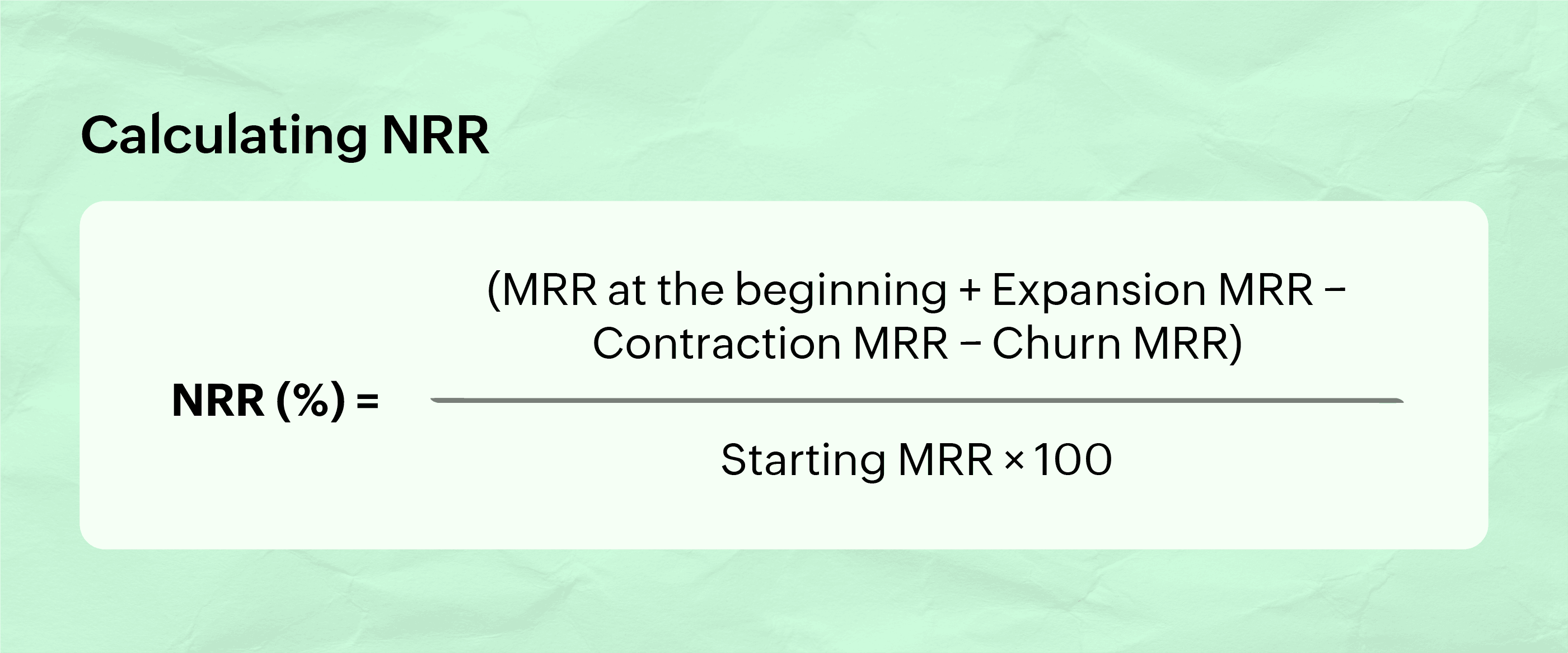
A value above 100% means existing customers are generating more revenue than you're losing to churn and downgrades. Any value below 100% signals contraction. In other words, customers are probably downgrading or churning faster than others are expanding.
NRR is sometimes called 'Net Dollar Retention (NDR)', especially in investor reporting contexts. However, both terms describe the same metric.
Gross revenue retention (GRR): What does it deliberately exclude?
Gross revenue retention (GRR) looks at the same customer base, but with expansion taken out of the picture. It measures only what you held onto after downgrades and cancellations, without letting upsell activity soften the number. GRR is a measure of pure retention with nothing else added.
Calculating GRR:
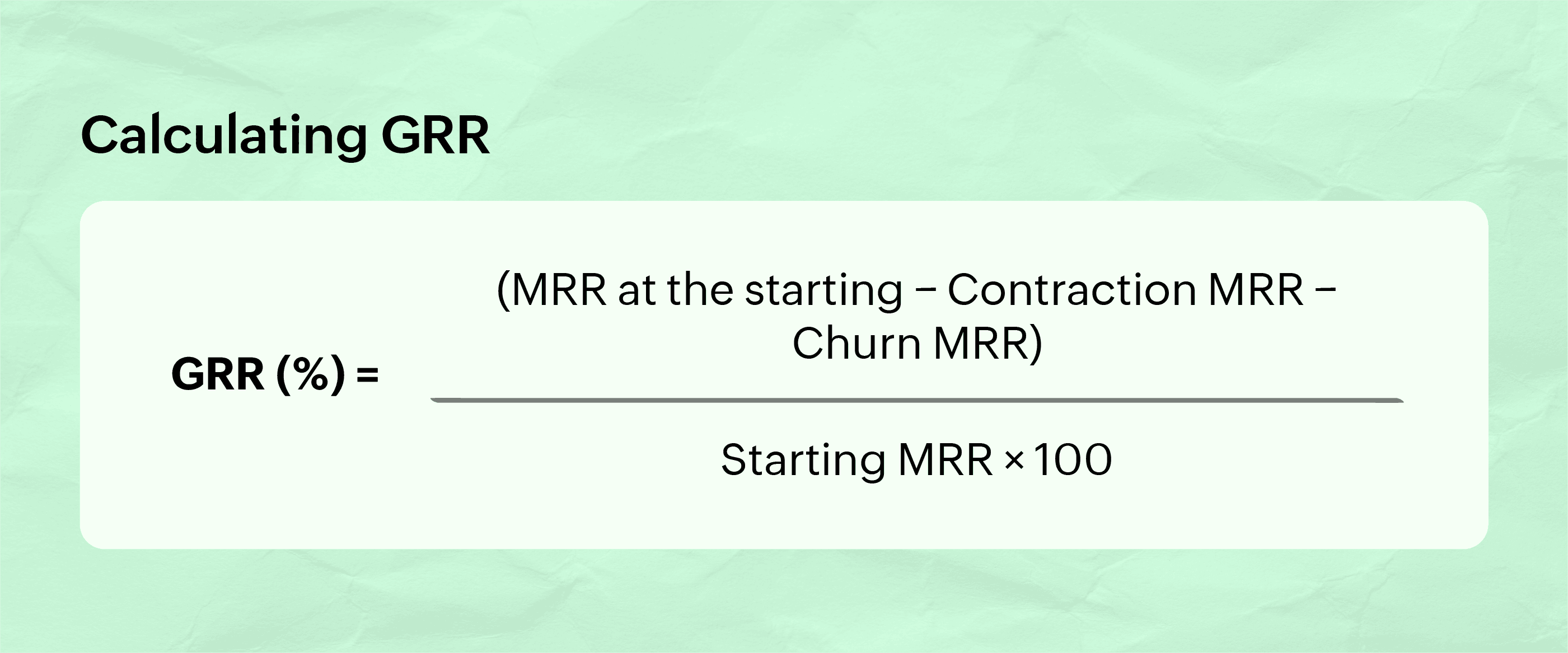
There are two things to know about GRR.
It can never exceed 100%: Since expansion is excluded, the metric can only move downward. A GRR of 100% would mean zero downgrades and zero cancellations in any specific period. This isn't impossible, but it's a rare scenario.
The ceiling is what makes GRR useful: It strips away the flattering effect of upsell activity and shows you exactly how much revenue you're losing to downgrades and cancellations, with nothing masking it. If NRR is your growth indicator, GRR is your retention floor.
The NRR vs. GRR gap: What does it reveal?
The true picture emerges only when both metrics are examined together. To illustrate this, consider the two following scenarios.
A wide gap: The leaky bucket scenario
Your NRR is 108% and GRR is 74%, showing that revenue growth does not offset significant losses from customer churn and downgrades. Although the business looks stable with a strong NRR, actual customer retention is poor, meaning customers are being replaced frequently in a system where they are leaving at a high rate—a leaky bucket.
A narrow gap: The favored outcome
On the other hand, in a narrow gap, an NRR at 102% and GRR at 96% shows better health, strong retention, and genuine growth from expansion on a stable foundation. This is essentially the most favored outcome for any business to flourish.
How NRR and GRR connect to MRR
NRR and GRR are the retention lenses you apply to MRR to get a complete picture of growth. For a deeper foundation, Zoho Billing Academy's guide to MRR covers the base metric in full.
It has to be noted that NRR and net negative churn describe the same condition: the point at which expansion MRR from existing customers is greater than the MRR lost through churn and contraction.
When NRR rises above 100%, you see that same effect represented as a retention percentage. NRR tells you exactly how strong that effect is, while net negative churn simply indicates that the balance is positive.
So, what's the takeaway in this case? It is that your current customer base increases in value over time.
Why these metrics matter beyond the finance team
NRR and GRR are best associated with investor reporting. NRR is a standard due-diligence metric in SaaS funding rounds and acquisitions. A consistently high NRR signals strong product-market fit, low involuntary churn, and a customer base that grows in value over time.
But, the audience for these metrics extends well beyond traditional understanding.
Audience #1:Customer success teams – For them, a declining GRR is an early warning signal that surfaces retention problems before they compound into a churn crisis.
Audience #2: RevOps teams – For this team, the NRR‐GRR gap distinguishes a genuine growth in performance from a simply compensatory one.
Audience #3: Product teams – Irrespective of how well acquisition is performing—for the product teams—sustained NRR below 100% signals that the product is underdelivering enough value to hold existing customers.
Monthly tracking of both metrics gives each of these teams a shared language for revenue health—one that connects individual customer decisions to company-wide outcomes.
How Zoho Billing reports NRR and GRR
Zoho Billing reports both NRR and GRR natively under Retention Reports, with formula-level breakdowns, month-on-month and year-on-year comparisons, and chart views for each metric.
The component-level breakdown view shows the Starting MRR, Expansion MRR, Contraction MRR, and Churn MRR alongside the resulting retention rate for each month in the selected date range. Going beyond just reading numbers, you can see exactly which component is driving a change in either direction.
One scenario the GRR report is particularly useful for is when an NRR looks healthy but something feels off. If your net revenue retention (NRR) has stayed above 100% for several months while your gross revenue retention (GRR) is gradually declining, Zoho Billing's retention breakdown will expose the underlying increase in churn within MRR that was previously masked by expansion revenue at the NRR level. Catching that early is the difference between targeted retention intervention and a revenue recovery problem.
Both reports support scheduled delivery, so finance and customer success teams can receive them automatically without pulling them manually each month.
FAQ
Frequently Asked Questions
A good benchmark depends on your segment and contract value; 100% is the universal baseline. Values above that show growth without new business. Generally, benchmarks rise with average contract value. Anything above 110% is strong across most segments.
No. By definition, GRR excludes expansion revenue; it only accounts for contraction and churn. Since both move in one direction (down), GRR can approach 100% but never exceed it. A GRR of 100% would mean zero downgrades and zero cancellations in the period.
For most B2B SaaS companies, a GRR above 85% is considered a minimum threshold for retention health. More specifically:
SMB SaaS – An 85–90% GRR is typical; below 80% signals a product-market fit problem.
Mid-market SaaS – An 88–92% GRR is a healthy range.
Enterprise SaaS – A 90%+ Grr is expected; a best-in-class rate that exceeds 95%
GRR is considered a "table stakes" metric—without clearing the relevant floor, expansion revenue cannot sustainably mask the underlying churn.
Both describe the same condition—expansion MRR outpacing losses from downgrades and cancellations. The difference is precision. Net negative churn tells you the balance is positive. NRR tells you by how much.
The best way would be to start with GRR. A healthy NRR can mask a retention problem if expansion is doing the heavy lifting. Fix churn and contraction first and the NRR follows. Chasing NRR while GRR slips, is treating the symptom, not the cause.
Most subscription businesses use a monthly cadence. It tracks MRR well and detects decline early. Quarterly reviews help with trend analysis and board reports. Frequent tracking offers little benefit unless you're in a fast-paced, short-term business.