The complete guide to managing hybrid events: Host one event, reach two audiences

Learn how to design and manage hybrid events that deliver equal value to onsite and virtual attendees, and how the right hybrid event platform can streamline setup, streaming, and engagement.

Hybrid events aren't a relic of the pandemic. The industry has moved past the question of whether hybrid event management is a temporary phase. It's now part of how organizations think about reach, accessibility, and risk. And the numbers show it's becoming structural, not situational.

In 2026, about 15% of events in North America were hybrid, and the model isn't fading. It's expected to remain a standard part of event programs in 2026. In fact, the 2026 Amex Global Meetings & Events Forecast reports that 22% of organizations now treat "ability to support hybrid meetings" as a requirement when selecting a destination or venue.

This guide looks at the practical side of hybrid events—how to plan them, how to use technology wisely, and how to manage two audiences at once.

Hybrid event management guide

All you need to know about hybrid event management

What are hybrid events? (and why they're not just a pandemic leftover)

A hybrid event is a single event that people can join in person or online at the same time. It's planned so both groups can follow the program and participate in ways that make sense for them. The core idea is to blur the gap between the room and the screen so neither audience is an afterthought.

While hybrid events came into the spotlight during the pandemic, their impact and popularity hasn't faded in the last five years. Event teams have kept using them because they witnessed firsthand how going hybrid solved problems that existed long before 2020: scattered teams, tight budgets, and the reality that not everyone can or will travel for every gathering.

A good example of this in action: UNDP's COP30 climate conference in Brazil. They're running over 80 sessions across two weeks—some are in-person only, others are fully virtual, and a few use the hybrid format.

The strategy is deliberate. High-level ministerial meetings happen in-person where diplomacy matters. Technical workshops run virtually to save costs and widen participation. But when a small country like Liberia wants to showcase its climate initiatives, they go hybrid—using their physical pavilion for local impact while streaming to a global audience through UNDP's Maloca virtual hub.

What makes this work is intentionality. UNDP isn't making everything hybrid by default. For country showcases and technical discussions where global input actually matters, the hybrid event format provides both local presence and global reach.

The benefits of hosting a hybrid event in 2026

Hybrid events didn't stick around because they're trendy; they stuck because they solve real operational problems. They're also measurably better for the planet. A Cornell University study found that moving from entirely in-person conferences to hybrid formats reduces emissions by 67% while still keeping more than half the attendees on site.

Here are the four benefits of hybrid events that consistently justify the shift:

  • Broader access for event attendees: Hybrid lowers economic and physical barriers. People who can't travel, can't afford to, or have mobility or health constraints can still participate meaningfully.
  • Better ROI for event organizers: Attendance goes up when people have more than one way to join. At the same time, you avoid the cost of scaling physical space, catering, and logistics for every additional participant.
  • Built-in flexibility for event managers: Hybrid gives you a built-in contingency plan. If travel is disrupted, a speaker falls ill, or conditions change, the event can still run without scrambling the entire program.
  • Lower environmental impact for all of us: Fewer flights and fewer on-site requirements mean a smaller carbon footprint and less waste. The ecological impact drops without sacrificing engagement.

How to host a hybrid event: The technology foundation

Here's where most planners hit a wall: technology. Not because it's inherently complicated, but because the market is crowded with tools that all claim to "do hybrid" while actually requiring you to stitch together five different platforms with duct tape of manual fixes, plug-ins, workarounds, and hope.

Here are some tips to build your hybrid event tech stack:

Picking a hybrid event management solution

A hybrid event isn't just what happens on event day. It's everything that happens pre-event, too, starting with event registration and running through post-event follow-up. Which means your platform choice affects your entire workflow, not just the livestream.

Most planners make the mistake of thinking they can use their existing event registration tool, add a separate streaming service, bolt on an engagement app, and call it done. What actually happens when data doesn't sync is nothing short of an event manager's nightmare:

  • Attendees get confused about where to log in
  • Your team is copy-pasting information between systems
  • Analytics are scattered across three dashboards

Here's when hybrid event management software comes into play:

  • Registration that knows the difference: Create custom paths for in-person versus virtual attendees so they're signing up for the right sessions. One attendee profile that follows them through the entire event journey, regardless of the mode they attend.
  • Check-in that works for both formats: QR codes for physical attendees walking into the venue. Simple, no-download login for virtual participants joining from their laptops. Both feed into the same attendance tracking system.
  • Built-in streaming with no handoffs: If your event platform and your streaming service are separate tools, someone on your team is managing that integration on event day. That's a failure point you don't need.
  • Engagement tools everyone can access: Polls, Q&A, chat—these can't be in-person-only features. Virtual attendees need the same access, in real time, and it has to sync with the in-person attendee experience.
  • A unified analytics dashboard. You need to see registration rates, attendance patterns, engagement metrics, and sponsor exposure for both audiences in one place.

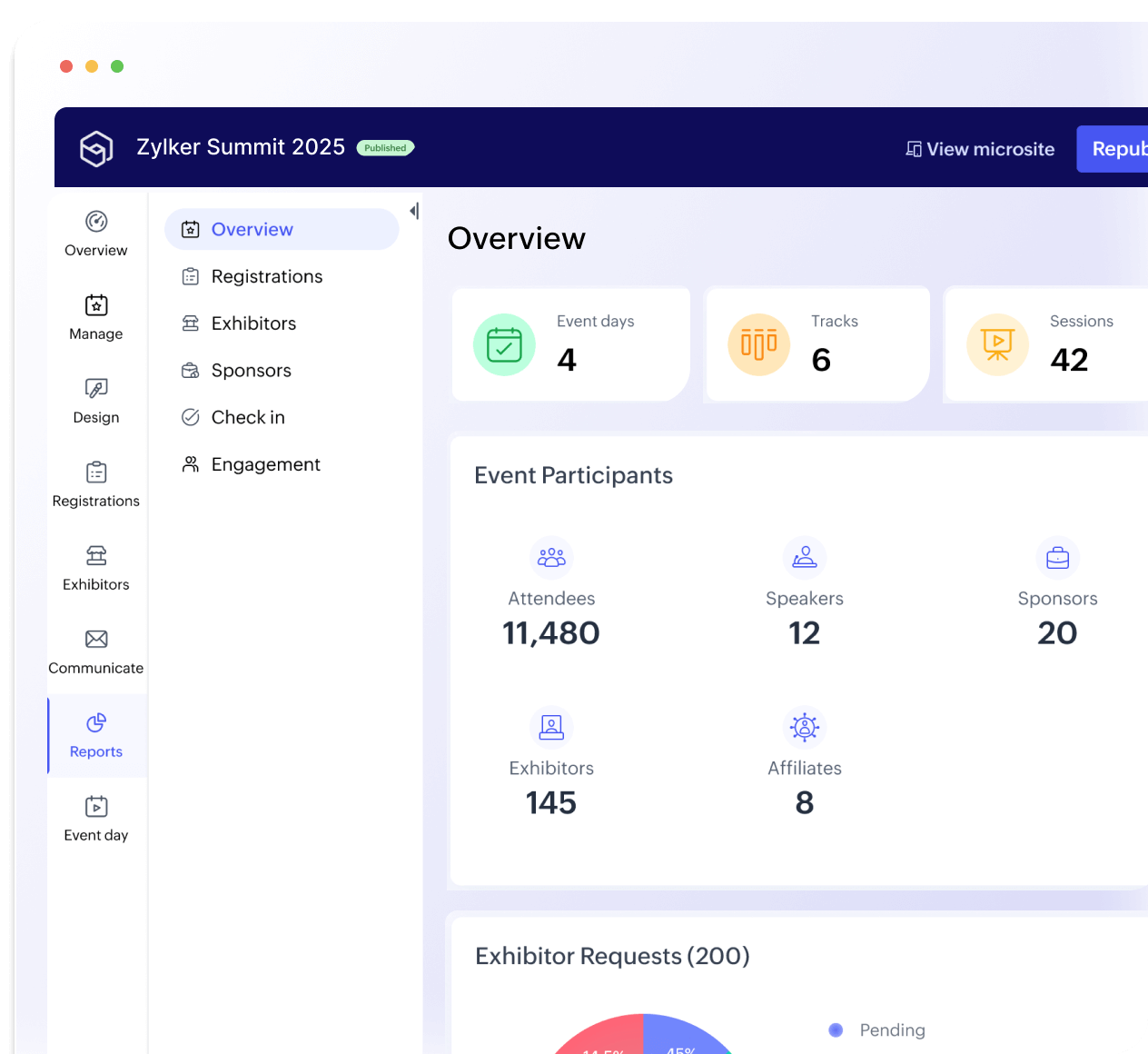
For example, when you use a unified platform like Zoho Backstage together with its native streaming tool, Backstage OnAir, the entire workflow sits in one place: attendees register once, check in through a QR code or a simple web login, join polls and Q&A inside the same session window, and all their activity flows into a single analytics dashboard without any manual stitching.

Compare that to piecing together Eventbrite for registration, Zoom for streaming, Slido for engagement, and Google Sheets for tracking everything manually. It works until someone calls you saying they can't access the event, and you're trying to figure out which system is causing the problem.

Getting your onsite tech ready

Your hybrid event platform is the bridge between your two audiences, but for in-person livestreaming to actually work, you need physical equipment that turns your venue into a broadcast studio. Your physical venue needs more than it did for traditional events.

Hybrid events often require additional technology and AR/VR equipment to create an immersive experience for both audiences. The equipment list expands because you're now designing for both cameras and screens, not just the back row of the room. Here's a quick checklist of what you need onsite:

  • Three cameras minimum—one wide shot, one on the speaker, one for audience reactions. This creates an immersive experience for virtual attendees instead of a static, boring feed.
  • A switcher to move between camera angles smoothly.
  • Lapel mics for speakers to reduce ambient noise, plus wireless mics for audience Q&A so virtual attendees can actually hear the questions being asked.
  • Powered speakers and a mixing board run by someone who knows how to balance audio between live room sound and what's being captured for the stream.
  • Data projectors for presentations (obvious, but check that your setup works for both in-person viewing and what the camera captures).
  • Interpretation equipment if your event spans multiple languages—and it should, if you're going global.

Don't forget the basics: reliable internet with bandwidth that can handle streaming, and ideally a venue tech support person who can help troubleshoot on the day.

Getting your speakers set up and ready

Once your equipment is sorted, your speakers need to know how to work with it—and requirements differ drastically depending on where they're presenting from.

  • Virtual speakers need a tech pack sent in advance: a decent microphone, ring light or adjustable lamp for lighting, backdrop setup instructions, and a one-page troubleshooting guide.
  • In-person speakers need a different brief: which camera to look at when addressing virtual attendees, how the streaming setup works, and what to do if they want to take a question from the online audience.

Planning for tech contingencies at your event

Here's the uncomfortable truth: tech fails. The question isn't if something will go wrong, but what you'll do when it does. Here are some non-negotiables to plan for:

  • Secondary streaming encoder in case your primary one crashes
  • Backup internet connection (mobile hotspot, separate provider, something)
  • Pre-recorded content ready to play if a live segment falls apart
  • Server vulnerability checks before the event so you're not dealing with security issues mid-stream

Run a full dress rehearsal with all technology at least two days before the event. Test everything twice. Then test it again. Equipment malfunctions are one of the most common ways hybrid events get derailed, and most of them are preventable with proper prep and a detailed contingency plan.

And if it's your first time running a hybrid event or you're simply nervous about the technical logistics, ask your event management software vendor about on-site support. Most vendors—including Zoho Backstage—offer implementation assistance and event-day support to handle the tech while you focus on the experience.

Hybrid event best practices: Designing one event with two experiences

The biggest mistake planners make with hybrid events is treating them like a traditional event with a camera bolted on. Your virtual audience becomes an afterthought—watching from the sidelines while the in-person crowd has all the fun. That's not hybrid; that's livestreaming with extra steps.

Real hybrid event design starts with a principle: both audiences get full access, but delivered differently.

Here are some hybrid event management best practices:

Balancing in-person and virtual needs

In-person and virtual audiences behave differently. People in the room can sit through longer sessions and prefer fewer breaks. Virtual attendees need shorter segments and more pauses to reset. You can approach that mismatch in two ways:

  • Aim for a shared structure: Sessions run 30–40 minutes so virtual attendees stay with you, and in-person attendees get enough depth. Breaks happen at the same time, but serve different purposes: networking and coffee on site; interviews, sponsor content, or short recaps online.
  • Build format-specific elements: You keep the core program consistent, but give each group something designed for them. In-person attendees get workshops, site tours, or space to meet exhibitors. Virtual attendees get dedicated interviews, extended Q&A, or behind-the-scenes content that doesn't interrupt the main room.

A low-effort workaround: Planning async hybrid events

If your team or budget can't support simultaneous delivery, asynchronous hybrid events are a simpler model. IEEE VIS uses this: virtual attendees watch recorded sessions on their own schedule, then join live Q&A on Discord. It reduces production stress but still gives both groups meaningful access.

Syncing online and onsite experiences

Once you're designing for two audiences, the next challenge is keeping them connected. Without intentional coordination, hybrid events split into parallel tracks: the room has one experience, the virtual audience has another, and neither sees or hears the other.

Here's how to make sure both groups stay visible to each other and feel included in the same event.

  • Dedicated moderator: Someone responsible for connecting the two audiences, pulling in online questions, and making sure the conversation flows both ways.
  • Unified Q&A and polls: Virtual and in-person questions go into the same queue. Polls show combined results so everyone sees the full picture.
  • Cross-audience networking: Use an event app that lets people message, schedule meetings, and exchange contact info regardless of how they're attending.

Your venue plays a role too. A hybrid-ready space isn't just good lighting. It's a space that lets you show more than the stage. Capture the lobby, backstage prep, or informal moments. It signals that virtual attendees aren't outsiders looking in.

A low-effort workaround: Hosting hybrid hubs

If you're running a global or regional program, small satellite gatherings can help. They give remote attendees a chance to meet locally without traveling to the main event. They also support tiered pricing—if in-person tickets are more expensive because of venue and catering, virtual and hub attendees can pay less without feeling shortchanged.

Designing for accessibility and inclusion

Hybrid events only work when everyone can participate on equal terms. Without intentional event design for accessibility and inclusion, virtual attendees miss key information, in-person attendees get a richer experience by default, and the gap between the two grows wider as the event goes on.

Here's how to make the experience equally usable for both groups:

  • Closed captions: Enable captions for all sessions. This helps attendees with hearing impairments, non-native speakers, and anyone joining from a loud or unstable environment.
  • On-demand access: Give attendees the ability to watch sessions later. It solves time-zone conflicts and makes the event workable for people with caregiving or work schedules.
  • Mobile optimization: Ensure the platform works cleanly on phones and tablets. A significant share of virtual attendees will join from mobile, especially in regions with limited bandwidth.
  • Equal networking: Tools should work for everyone—direct messaging, meeting scheduling, and digital business cards shouldn't depend on being physically present.
  • Virtual event kits: Ship a small kit to remote attendees—workshop materials, printed agendas, sponsor items. It creates a tangible connection and signals that remote participation is a full version of the event, not a reduced one.

A low-effort workaround: Adjust the price to match the experience

If you can't give both audiences the same level of quality, acknowledge it openly and price accordingly. Some conferences do this well—Social Media Marketing World, for example, prices its virtual pass lower because remote attendees don't get the same access to the venue, networking, or on-site sessions. It's a simple way to keep the format fair without overextending your team or your budget.

With Zoho Backstage, you can sell both in-person and virtual event tickets directly without paying commission, keeping pricing transparent and maintain equity between the audiences.

Run your hybrid events with ease with Zoho Backstage

Hybrid events aren't as complicated as they look. Most of what you already do still applies. Think of it as a 70/30 shift: about 70% of your existing event skills transfer directly—content strategy, speaker prep, sponsor management, attendee communication, program design. The remaining 30% is where hybrid-specific decisions come in: how the two audiences interact, how the tech fits together, and how you make both groups feel equally included.

And if you want a platform that supports 30% of your hybrid event planning without adding new headaches, Zoho Backstage keeps everything under one roof. You get separate registration paths, integrated streaming, and shared tools for Q&A, polls, and chat. This means both audiences show up on the same dashboard, and you manage the entire event without switching platforms.

FAQs

Hybrid event management involves planning one event for two simultaneous audiences: in-person and online. Unlike virtual events, which exist entirely online, hybrid events coordinate physical logistics, streaming, engagement tools, and content delivery so both audiences can participate fully.

You need a hybrid event platform with registration, streaming, engagement tools, and analytics; reliable venue internet; cameras and microphones; a switcher; and an event app for cross-audience networking. Optional additions include captioning, translation, and backup streaming systems.

Hybrid event management challenges include balancing two audience experiences, synchronizing Q&A and engagement, managing complex AV setups, ensuring stable internet, avoiding fragmented tech stacks, and preventing virtual attendees from feeling sidelined. Strong moderation and a unified platform reduce most issues.

We'd say Zoho Backstage is the best hybrid event platform for beginners because it handles registration, streaming, engagement, and analytics in one place. It removes the need for multiple tools, supports both attendee types with a single workflow, and has a simpler learning curve than most platforms.