How to create an event marketing plan that actually converts in 2026

Learn how to build a complete event marketing strategy—from pre-event promotion to post-event conversion—with proven frameworks and tools like Zoho Backstage.

For 95% of events teams, proving event ROI is the topmost priority. But most event marketing plans stop short at promotion—emails, social posts, maybe some ads.

The problem isn't in the execution of your best-laid event plans. The issue is that your event promotion tactics have little in common with your desired event outcomes. Why? You may be missing the strategy that links pre-event outreach to live engagement to the post-event pipeline.

In this guide, we share the secret recipe of building an event marketing plan across the full event lifecycle: targeting and promoting before the event, capturing engagement during, and converting attendees after. Bonus: we share our own tried and tested frameworks for audience segmentation, channel orchestration, real-time tracking, and closed-loop reporting.

Event marketing guide

2026 event marketing guide: From event registration to revenue

What is event marketing (and why traditional approaches fall short)

Gone are the days when event marketing was just about publicizing an event in a "spray and pray" manner. Today, you must define event marketing in two ways.

First, there's the promotional side: the marketing tactics you use to drive registrations and get people to show up. Emails, ads, social posts, landing pages. This is what most people mean when they say "event marketing."

Then there's the strategic side: using events as a channel to hit business goals—building pipelines, retaining customers, establishing thought leadership. This is where events stop being a line item and take on the role of one of the revenue drivers.

The problem? Most organizations treat events like one-off campaigns. You promote it, run it, send a thank-you email, and move on. There's little, or worse, no integration with your broader marketing strategy or sales process.

Why event marketing demands different metrics

What matters for event ROI: pipeline influenced, revenue sourced, opportunities created, faster sales cycles, customer retention rates, and upsell triggers.

Here's a real calculation: If your event costs $50K and generates 200 attendees, with 40 converting to MQLs, 10 becoming opportunities, and 3 closing at $100K each—that's $300K in revenue from a $50K investment. 6 times the ROI.

Compare that to reporting "500 social media impressions" or "great engagement."

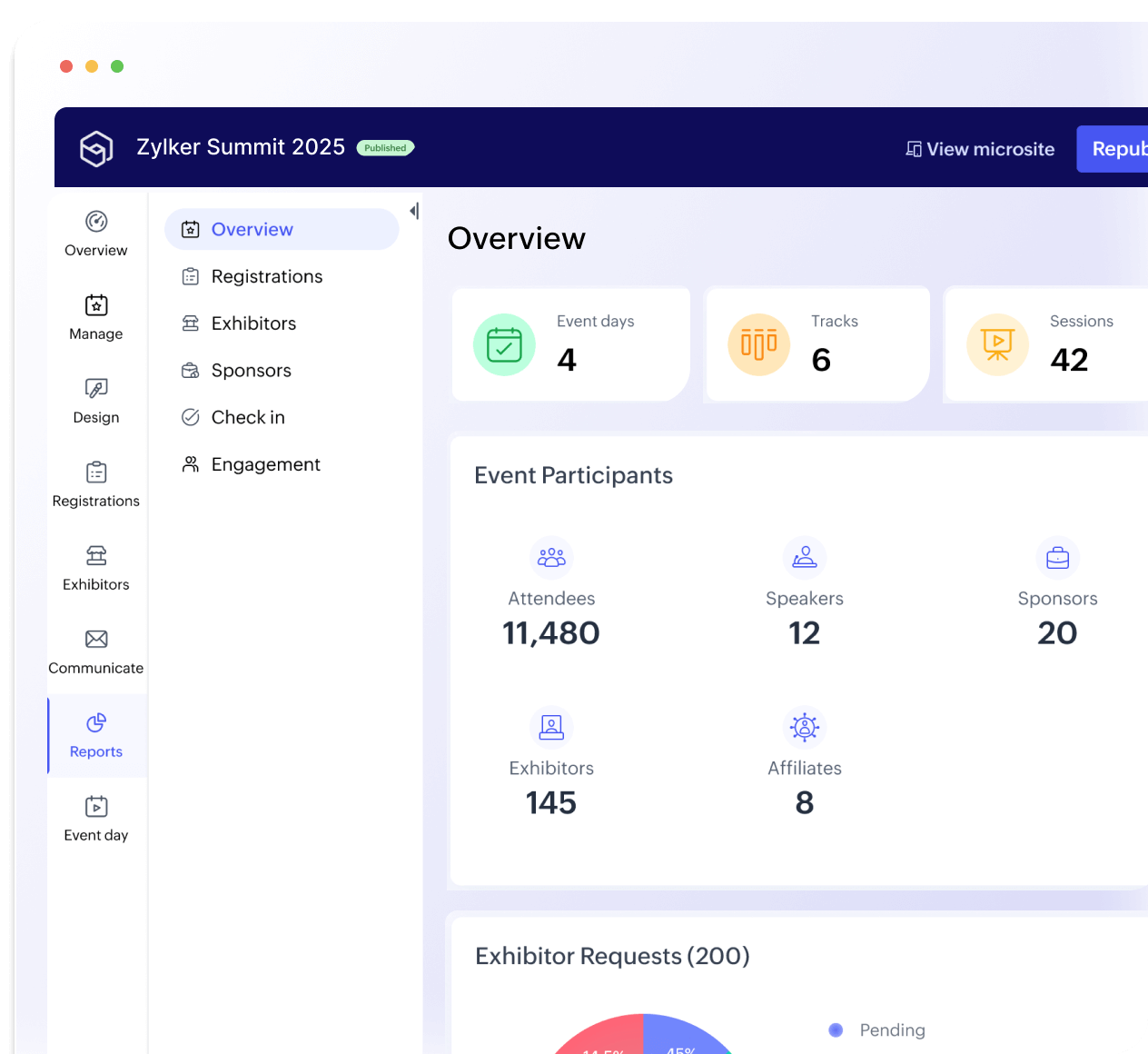
If your event KPIs aren't connected to sales outcomes, your budget is vulnerable. That's why, at Zoho Backstage, we provide in-depth sales and marketing analytics out of the box. We also integrate with Zoho Analytics for 50+ visual charts and data blending when you need deeper analysis. Plus, you can use Zia, our intelligent assistant, to generate reports without manually building them.

Building your event marketing strategy: The basics

Most event promotion plans start with tactics—"let's do a webinar" or "we need a booth at that conference." That's regressive and a reactive approach at best. For an event's marketing success, strategy has to come first, tactics second. Here's a top-down approach that helps align every event—big or small—with the leadership's vision.

Start by aligning events to business outcomes

Demographics don't tell you what people need from your event. Knowing someone's title and company size won't tell you whether they should be in your product demo session or your executive roundtable, whether they need beginner content or advanced use cases.

Segment by where they are in the buyer journey:

  • Active pipeline contacts need proof like customer stories, competitive differentiation, and product deep-dives.
  • Existing customers want advanced features and expansion opportunities.
  • Executive buyers want peer networking and strategic discussions, not product demos.

Engagement history matters too. Someone attending their third annual conference expects a different experience than a first-timer. Past webinar attendees might respond to an email invitation, but someone who's never engaged with you might need a LinkedIn ad or a personal sales outreach to register.

Pro tip:CRM and marketing automation integration is what makes this actually work. You need your target audience data to flow automatically so you can send personalized pre-event content and trigger different follow-ups based on which event they attended or showed interest in. Manual segmentation will not scale past your first event.

Create a cohesive event brand

Your event brand should reinforce your company brand, not exist separately. Some things to consider are:

  • Event name and optionally, a tagline
  • Visual identity that's cohesive with your larger brand identity
  • Thematic messaging that aligns with current business priorities

If your event marketing plan template looks disconnected from your brand, you're diluting both. For example, at Zoho, we design our annual Zoholics user conference with a location-specific theme that stays true to our core brand. Each event gets a unique visual identity, but we always stick to our official color palette (red, green, blue, yellow) and branding guidelines. We also provide partner branding kits so co-branded materials stay consistent.

That way, every Zoholics feels fresh and localized, but unmistakably Zoho.

A 12-week pre-event marketing plan

Pre-event promotion isn't about doing more. It's about doing the right things at the right time—and most importantly, through the right channels. And the first step is to stop treating channels like a checklist.

Each one plays a specific role, and they need to work together—not compete for attention.

Owned media

Owned media is any channel you control—your website, email list, mobile app. No algorithm changes, no ad costs, just direct access to your audience.

Event website

Your event website is the hub. Everything else drives people here. Some sections or pages to include in your event website are:

  • Clear value proposition (why should I attend?)
  • Agenda highlights and speaker credibility signals
  • FAQ that answers objections before they happen

💡 Not every event needs SEO, but if you're trying to attract attendees beyond your existing database, it matters.

Target keywords like "[industry] conference 2026," "AI in business event," or "[city] marketing summit." If your event is local or open to the public, optimize for location-based searches—people Google "marketing events in Austin" or "tech conferences near me."

Some event management platforms handle SEO optimization out of the box. In Zoho Backstage, you can control whether your event appears in search results, add keywords to your event summary for local SEO, and optimize metadata—all without needing a developer.

Email marketing

According to Forrester, 94% of events teams say pre-event email marketing is the most important type of content. But generic blast emails don't cut it anymore.

We suggest you segment by:

  • Audience type (prospects vs. customers vs. executives)
  • Engagement history (past attendees vs. first-timers)
  • Registration status (registered vs. considering vs. no-shows from last year)

Automate confirmations, reminders, and agenda updates. You shouldn't be manually emailing hundreds of people every time the schedule changes.

Pro tip: Pick an event management solution that comes with built-in email marketing. That's one less tool to juggle, and you can trigger emails based on registration actions, segment dynamically, and track opens and clicks without switching tools.

Referrals

Referrals—also called affiliate marketing—are a great channel to amplify reach without ad spend. You can give registered attendees an incentive to bring others—early access to exclusive content, discounts, or VIP experiences.

You can take TwitchCon's tiered referral program as an example:

TwitchCon gives attendees a unique referral link after purchase with tiered rewards:

  • 3 referrals = 25% off their ticket
  • 5 referrals = 50% off
  • 10 referrals = free ticket

Attendees can track their referrals through their account dashboard and receive email notifications when someone uses their link.

And if you're looking to set up a similar referral program for your event, Zoho Backstage's affiliate marketing tools let you build similar systems:

  • Create unique tracking links for each affiliate or referrer
  • Monitor performance with built-in KPIs—visits, orders placed, and total sales generated through their promotions
  • Manage affiliates by exporting data, deactivating underperformers, or reactivating links as needed

Once your owned channels are working together, the next step is amplifying through earned reach.

Earned and user-generated content

Earned media is content other people create about your event—social posts, blog mentions, word-of-mouth. You don't control it, but you can influence it.

Social media marketing

People often discover events through their networks. A post from someone they follow carries more weight than a sponsored ad. Social media also creates visible momentum—when people see others talking about your event, they want in.

Here's what you can do

  • Create an event-specific hashtag for discoverability and engagement tracking.
  • Set up speaker amplification programs—give your speakers pre-written posts they can customize and share with their audiences.
  • Run attendee UGC campaigns with contests, challenges, or testimonial requests ("Share why you're attending and tag us to win VIP access").

Platform-specific strategies also matter. What works on LinkedIn (thought leadership posts, speaker Q&As) doesn't work on Instagram (behind-the-scenes stories, attendee spotlights).

Spotlight: How Anthropic's coffee pop-up went viral

Anthropic didn't host a flashy launch event for Claude. They opened a low-key coffee shop pop-up with some swag—caps, tote bags, nothing extraordinary.

But they nailed social amplification. A staff member posted a casual announcement on X. The Claude account followed up the next day, showing the caps were already sold out. Another post showcased more swag. Lines formed around the block.

The caps went viral. But more importantly, the vibe went viral. No champagne-fueled tech event. No overscripted keynotes. Just "pop in, have coffee, learn about AI."

The lesson: Simple, authentic activations create shareable moments. Give people something to post about and a reason to show they were there. That's what drives social reach—not production value, but genuine excitement people want to share.

PR and journalist outreach

Media coverage gives you third-party credibility and reaches audiences outside your existing network. A feature in an industry publication positions your event as newsworthy, not just promotional.

Some ways you can get coverage are:

  • Pitch unique angles—don't just announce your event exists. What trend are you addressing? What's the big reveal or exclusive announcement?
  • Offer journalists exclusive access: early speaker interviews, press passes, and embargo briefings on major announcements.
  • Send press releases 6-8 weeks out with clear news hooks, not just event details.
  • Build relationships early—don't contact journalists for the first time, asking for coverage.

Here's a recent Shoptalk press release that's a great example of strong PR writing. It clearly communicates the news upfront, ties it to broader industry trends, and includes credible quotes that reinforce its message.

Brand ambassadors

Loyal customers and past attendees provide authentic promotion you can't manufacture. They'll post organically, answer questions in their networks, and vouch for your event when others are on the fence.

Here are some tips to help you get the right people on board:

  • Identify your biggest advocates early—look at past attendee engagement, social mentions, referral activity
  • Give them reasons to talk: exclusive previews, ambassador-only perks, recognition at the event
  • Make it easy: provide shareable content, pre-written posts they can personalize, graphics they can use
  • Engage with their posts—comment, share, amplify what they're already saying

A customer posting "Can't wait for [Event Name]—last year changed how we do X" is worth more than any ad you'll buy.

Optional: add some Zoholics UGC posts from Instagram as a collage

Paid promotions

Paid media is advertising you pay for—display ads, social ads, search ads, sponsored content. Use it strategically, not as a blanket solution. Paid works best when you're reaching net-new audiences or accelerating action among high-intent segments.

Retargeting

Most people don't register the first time they visit your event page. Retargeting brings them back by showing ads to people who've already interacted with you but haven't converted yet.

Who to retarget:

  • Website visitors who didn't register
  • Email openers who didn't click through
  • Past attendees who haven't signed up for this year's event
  • People who started registration but didn't complete it

This is your highest ROI paid tactic because you're not starting from scratch—these people already know you exist. A reminder ad closes the gap.

Sponsor co-marketing

Your sponsors have audiences. You have an audience. Swap access and double your reach without increasing ad spend. Here are some tips:

  • Co-host pre-event webinars with sponsors and cross-promote to both email lists
  • Run joint LinkedIn or display ad campaigns with shared creative and split costs
  • Feature sponsors in your content (speaker spotlights, industry trend pieces) and ask them to share it. Simply adding sponsor logos and details to your event website can help you get more attendees—and sponsors. And most event management platforms let you do this with templated pages, so it should be quick.
  • Offer sponsors co-branded social toolkits—graphics, copy, hashtags—they can use to promote the event to their followers. For example, when using Zoho Backstage, you can share an IFRAME of your ticketing page with sponsors to embed on their website.

Paid search and social ads

Paid search captures demand when people are actively looking for events like yours. Paid social creates demand by reaching people who match your target audience but aren't searching yet.

When to use it:

  • Paid search: Target keywords like "[industry] conference 2026" or "marketing events in [city]" when registration opens. You're catching people already looking.
  • Paid social: Use LinkedIn or Facebook ads to target job titles, industries, or interests that match your ICP. Layer in lookalike audiences based on past attendees.
  • Geotargeting: If your event is local or targets a specific region, use location-based ads to reach people within driving distance or in key markets

And most importantly, track cost per registration, not just clicks or impressions.

During-event marketing: Real-time engagement and content capture

Most event marketing stops when the event starts. But what happens during your event can create demand for the next one—and drive conversions from this one.

Live content = future event marketing gold

Your event is happening right now. Non-attendees are watching. What you share during the event determines whether they register next time.

In short, it's your content factory. We recommend you capture three types of content:

  • Sessions: Record for on-demand viewing—extend the life of your content beyond the event date
  • Soundbites: Cut 30-second speaker highlights for social clips (they perform better than full sessions)
  • Attendee moments: Document testimonials, reactions, and experiences for future promotional materials

You can also live-tweet key moments with your event hashtag. Post Instagram and LinkedIn stories from the event floor—not just the agenda, but the energy.

Another idea is to encourage attendees to share with contests like "Best event photo wins X" and recognition by reposting their content or featuring them in your stories.

Pro tip: Use gamification and leaderboards to boost live engagement. Award points for session check-ins, social shares, booth visits, or networking connections. Display real-time leaderboards to create friendly competition and keep attendees active throughout the event.

Post-event marketing: what to do after the doors close

Most teams treat post-event follow-up like a formality—send a thank-you email, share a survey, call it done. But the people who just spent hours engaging with your brand are the warmest leads you'll ever have. What you do in the next 24-48 hours determines whether they convert or go cold.

Here's how to turn attendee engagement into pipeline:

  • Segment follow-up by actual behavior: Stop sending the same "thanks for attending" email to everyone. High-intent attendees who hit product demos and sales booths need immediate sales handoff. Content consumers need nurtureemails with case studies. Networking-focused attendees want community invitations.
  • Act within 24 hours: Hot leads go cold fast. Don't just hand your sales team an attendee list—provide engagement intelligence: share the analytics on which sessions they attended, which booth conversations they had, which pre-event emails they opened, who they networked with.
  • Turn your event into months of content: Gate on-demand session recordings for lead generation. Use session recordings as sales enablement. This year's content promotes next year's event—that's how you turn events into a scalable growth channel.

Post-event marketing isn't the end of your event strategy—it's where the real work begins and ROI gets proven.

Measure complete event marketing ROI

Most events stop tracking metrics at attendance. That's not a measurement of ROI—that's just a headcount. Real event ROI means connecting your event to closed deals and proving it accelerated your pipeline. Track the complete journey:

  1. Top of funnel: Registrations by source, cost per registration
  2. Engagement: Attendance rate, session participation, content consumption
  3. Lead generation: Total leads → MQLs → SQLs → opportunities
  4. Revenue impact: Pipeline influenced, deals closed, revenue attributed
  5. Velocity: Time from lead to opportunity, deal cycle acceleration

Market your events smarter, better with Zoho Backstage

The event marketing framework is simple: pre-event promotion builds the right audience, live engagement captures intent signals, and post-event follow-up converts warm leads while they're still engaged.

Zoho Backstage gives you the tools to execute this strategy end-to-end. From mobile-responsive event websites to email marketing automation to referral and affiliate tracking to gamification to real-time analytics, you don't need five tools to run one event. You need one platform that connects promotion to the pipeline.

FAQs

The most effective channels for event promotion are email marketing and your event website as the conversion hub. You can also use social media for amplification, referral programs for trusted reach, and paid ads only for high-value retargeting.

You should start marketing your event 12+ weeks out with thought leadership and early-bird registration. Launch your main call-to-register campaigns at 8-10 weeks, reveal full agenda at 4-6 weeks, and create urgency at 2-3 weeks. Sustained momentum beats last-minute panic.

To measure event marketing ROI, track the complete journey: registrations by source and cost per registration, attendance rate and session participation, MQLs to SQLs to opportunities, pipeline influenced and revenue attributed, and deal cycle acceleration.

You need an event management platform that integrates with your CRM and marketing automation. Essential event marketing technology includes registration and website tools, email automation, and real-time analytics—ideally in one event management platform so data flows automatically without manual exports.